Plenty of regional fine-dining rooms say "local" and mean a decorative map. Huniik is more convincing because locality here appears as a working constraint. The official restaurant language is unusually plain about it: chef Roberto Solis and his team work with small producers, use a fair-trade scheme, and favor local, strictly seasonal products so Yucatan's raw materials can stay visible inside a contemporary tasting menu.[1] That immediately makes the restaurant more interesting than a generic heritage pitch. It suggests that the menu is not merely inspired by the region. It is structurally dependent on the region showing up intact enough to matter.
That is also why Huniik reads well in 2026. Merida already has enough culinary prestige that a new room could survive on atmosphere, chef biography, and the broad appeal of "modern Mexican" luxury. Huniik pushes in a narrower direction. Solis's own biography frames him as the main driver of nueva cocina yucateca, but the restaurant does not use that identity as an excuse to drift away from supply. His official chef page says he has spent years experimenting with ingredients from traditional regional cooking, while the restaurant page emphasizes that the exchange is not only between chef and diner, but also between the kitchen and the producers who keep the pantry specific to Yucatan.[1][2]
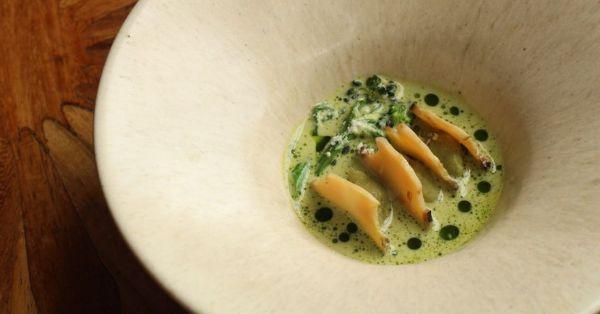
Image context: the cover uses a real dish photograph rather than a room glamour shot because this post is about how an ingredient story survives plating. The bowl is elegant, but the point is not visual opulence by itself. It is that the restaurant can translate regional sourcing into a calm, tightly edited final form.[3]
1. The producer loop is the real luxury
The strongest Huniik detail is not a famous ingredient or a headline ranking. It is the chain behind the meal. The official site says the restaurant partners with small local producers who provide ingredients from the region under fair-trade commitments, and that this arrangement supports sustainability by keeping the kitchen focused on local and seasonal products.[1] Food Police's recent guide to the restaurant reinforces the same structure from outside the house: it describes a tasting menu built from fresh seasonal ingredients, often working with producers from across the Yucatan peninsula, while interpreting Mayan and Yucatecan traditions through a contemporary lens.[5]
That matters because Yucatan is easy to flatten. A lot of distant diners know the region through a short list of emblematic flavors: habanero, achiote, recados, castacan, maybe a citrus note or a corn reference. Huniik's sourcing language points somewhere broader. The kitchen is not just selecting famous ingredients; it is treating the peninsula as a live procurement field. Locality, in other words, is not a garnish after the menu has already been designed. It is upstream of the design itself.[1][5]
This is where Huniik starts to look more durable than restaurants that use regional identity as atmosphere. When producers are named as part of the system and seasonality is treated as a discipline, "Yucatecan" stops being a mood board. It becomes a set of limits and opportunities the chef has to answer every day.
2. Small scale keeps the sourcing legible
Huniik's sourcing story would be weaker if it were buried inside a large room engineered for distance. Instead, the restaurant is built for sixteen guests and an open kitchen.[1][3] Those are not decorative facts. They change how ingredient work is read. A tiny room means the kitchen does not have much space to hide behind generic fine-dining choreography. If the sourcing claim is real, the diner should feel it in pacing, explanation, and the sense that transformation is happening almost within reach.
The official site leans into that reading. It says Huniik was created so diners could stay close to the processes that shape the dishes, and that the open kitchen is meant to reduce distance, promote dialogue, and let guests contemplate the transformation of ingredients.[1] Food Police makes the same point in more atmospheric terms, describing a 16-seat room where barriers between kitchen and table begin to dissolve.[5]
That intimacy does important work for an ingredient-driven restaurant. Sourcing can become abstract very quickly when it is only explained through a website paragraph or an awards citation. Huniik avoids that by shrinking the stage. The closer the diner sits to the pass, the harder it is for regional supply to remain a slogan. The room asks the kitchen to make provenance believable course by course.
3. Nueva cocina yucateca stays anchored when the dishes still taste of place
Roberto Solis's biography matters here, but not in the usual prestige sense. His official page presents him as the principal force behind new Yucatan cuisine, formed through work at global-name kitchens while continuing to experiment with ingredients tied to the region's traditional cooking.[2] That could have produced a familiar luxury outcome: international technique laid over local references. Huniik looks stronger because the dish descriptions coming from independent ranking pages still read unmistakably as Yucatan.
Latin America's 50 Best gives the clearest examples. It describes a tasting menu centered on the region's distinctive and sustainably sourced ingredients, citing plates such as yellowfin tuna and Yucatecan ponzu wrapped in a hoja santa flute, and a dessert of mango with recado negro, coconut foam, and coconut ice cream.[4] Those are contemporary dishes, but they are not placeless contemporary dishes. The ingredients and flavor structure still carry the peninsula inside them.
That is the right way to understand Huniik's modernity. The official restaurant page says Solis's team adds Yucatan's traditional and essential flavors to rich raw materials, translating them into dishes that reflect the present while sometimes offering traditional preparations in purer form as well.[1] The restaurant is not trying to escape the region in order to look advanced. It is trying to prove that precision, intimacy, and contemporary presentation can make the region read more clearly, not less.
Why it matters now
Huniik matters in 2026 because it makes Merida look like more than an auxiliary stop to the Riviera Maya circuit. Latin America's 50 Best currently places it at No. 32 in the region, and 50 Best Discovery presents it as one of the most evocative gastronomic experiences in the city.[3][4] Those signals explain attention, but they do not explain the mechanism. The mechanism is the tighter part: a chef with a long regional argument, a 16-seat open kitchen, fair-trade relationships with local producers, and a menu that keeps Yucatan close enough to the pass that locality still has to survive contact with dinner.[1][2][5]
That is a harder achievement than vague authenticity. Huniik makes intimacy do sourcing work. The room is small, the producer loop is explicit, the dishes remain regionally legible, and the whole experience suggests that luxury in Merida does not need to arrive through imported codes first. It can begin with the peninsula, stay there, and still end in a polished modern plate.
Sources
- Huniik, "Huniik" - official English page describing the 16-seat concept, open kitchen, partnerships with small local producers, fair-trade commitments, and strictly seasonal regional sourcing.
- Huniik, "Roberto Solis" - official chef biography covering Solis's work with regional ingredients and his role in nueva cocina yucateca.
- 50 Best Discovery, "Huniik - Merida" - profile covering the restaurant's current visibility, chef background, intimate scale, and tasting-menu positioning.
- Latin America's 50 Best Restaurants 2025, "Huniik" - ranking page covering Roberto Solis's role in new Yucatecan cuisine, the 16-seat room, and menu examples built on sustainably sourced regional ingredients.
- Food Police, "Guia de las mejores comidas de Mexico / Huniik, el espiritu de la cocina yucateca moderna" - recent feature covering fresh seasonal ingredients, producers from the Yucatan peninsula, the open-kitchen room, and the restaurant's contemporary interpretation of Mayan and Yucatecan gastronomy.