Hof van Cleve could have become a museum to itself. That is the danger when a restaurant carries as much Belgian fine-dining weight as this one: a farmhouse address in Kruisem, decades of Peter Goossens history, long international guide memory, and a name that can make diners arrive already half-sentimental. The more interesting current story is that Floris Van Der Veken appears to be doing the opposite. He is not trying to erase the legend, and he is not trying to shout louder than it. He is making the house work at a smaller, more exact pitch.
The official language is careful but clear. Hof van Cleve now describes Van Der Veken as bringing his own vision after years as Goossens' trusted right hand, with a focus on pure flavors, foundational ingredients, detail, and service.[1] That does not sound revolutionary, which is precisely why it matters. At a restaurant like this, the harder move is not novelty for novelty's sake. The harder move is to make continuity feel alive.
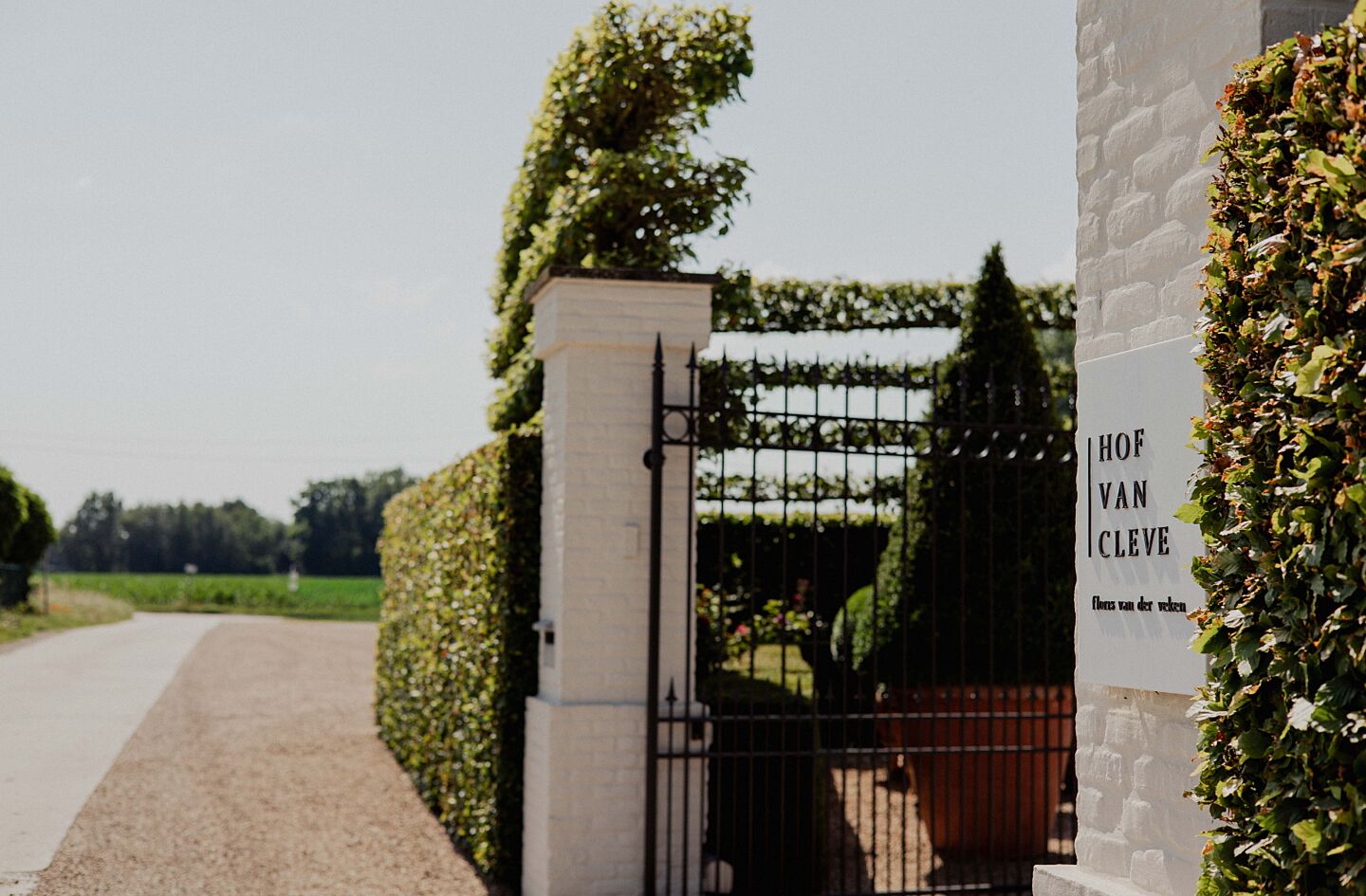
The cover photograph catches the pressure in one frame: the gate, the white sign, the clipped greenery, and the Flemish fields beyond it.[8] It is a real place before it is a trophy. The best reading of Hof van Cleve in 2026 starts there: not as a former three-star address trying to recover a past version of itself, but as a country restaurant testing whether inheritance can be edited into a fresh working rhythm.
A Heavy House, Handed Over Carefully
The handoff was not casual. Horeca Magazine reported in 2023 that Lieve and Peter Goossens would hand Hof van Cleve over at the end of that year to Floris Van Der Veken, then the restaurant's sous-chef, and quoted Goossens presenting him as the right successor for a new chapter.[6] The scale of the inheritance was plain: 50 Best Discovery still frames the restaurant through its farmhouse setting, Goossens' long tenure, 2021 and 2022 global-list placements, and Belgian-produce-with-global-influence cooking memory.[5]
That background changes how the current restaurant should be judged. A new chef at an ordinary address gets to invent the room around himself. Van Der Veken inherited a finished grammar: product-first luxury, polished service, Belgian-French technique, wine seriousness, and a guest base trained to expect near-ceremonial care. The problem was not how to create importance. It was how to stop inherited importance from freezing the restaurant.
Michelin's current listing gives one public answer: Hof van Cleve - Floris Van Der Veken is listed as a Two Stars restaurant in the 2026 Belgium guide.[4] That matters because the new chapter did not need to prove that the old third star had simply been copied forward. It needed to prove that the restaurant still had enough identity, discipline, and momentum to stand on its own. Two stars, in this context, reads less like demotion drama and more like a hard reset that passed its first serious tests.
50 Best Discovery still preserves the pre-handoff memory: the farmhouse exterior, elegant dining room, Goossens' long tenure, the 2021 and 2022 global list placements, and a cuisine where Belgian produce met wider influence.[5] Put that next to the current official site and the profile becomes sharper. Van Der Veken is not operating on blank paper. He is revising a manuscript everyone already thinks they know.
The Menu Is Built Around Choice Without Looseness
The clearest current signal is the menu architecture. Hof van Cleve publishes two structured menu lanes plus a la carte: "The simplicity of nature," a broader signature menu, and "Field, garden & woods," a vegetable-, cereal-, and herb-focused path.[2] The signature menu is listed at 5 courses for EUR200 or 6 courses for EUR235, while the plant-led lane is EUR175 for 5 courses or EUR205 for 6 courses.[2] Wine and non-alcoholic pairings are also priced explicitly, with selected wines starting at EUR100 and juices and infusions at EUR90 for the shorter menus.[2]
Those numbers are not just spending data. They show what kind of restaurant this second act wants to be. The house is still expensive, still formal, still special-occasion serious. But it is not only selling one locked, maximal tasting-menu tunnel. A diner can choose the more classical luxury path, the plant-led path, or the a la carte route when available.[2] In a room with this much history, that flexibility is useful. It lets the restaurant breathe without becoming casual.
The dishes themselves show the same balance. The signature spring menu moves through langoustine with burrata, turnip cabbage, and verbena; wild sea bass with green pea, dashi, and whelks; king crab with caviar, cauliflower, and chamomile; farm chicken with asparagus, Groendal, and morel; Wagyu A5 with eggplant, zucchini, and chermoula; and a chocolate dessert built around Van Dender Madagascar 72%, blackcurrant, vanilla, and earl grey.[2] That is not a nostalgic Belgian menu in costume. It is product-led and polished, but quietly global in its seasoning vocabulary.
The "Field, garden & woods" menu is the more revealing lane. Red rice with avocado, turnip cabbage, and burrata; green pea with broad bean, spinach, and savory; cauliflower with leek, hen of the woods, and vin jaune; asparagus with wild garlic, morel, and madeira; eggplant with chermoula, zucchini, and almond: these are not abstinence dishes.[2] They suggest a restaurant that understands plant-forward cooking as another form of luxury concentration rather than as a concession.
That matters now because many legacy fine-dining rooms still treat vegetables as either decoration or moral update. Hof van Cleve's plant lane reads more maturely. It lets the restaurant keep its product obsession while lowering the symbolic volume. The message is not "we have become lighter because the market demands it." The message is "we can apply the same care to a field grammar."
The Room Makes Belgian Craft Do Service Work
Hof van Cleve's current atmosphere page is unusually useful because it names the room as part of the restaurant's argument. The restaurant says every detail is cared for, and it treats hospitality and service as inseparable from the culinary work.[3] That would be ordinary luxury copy if the page stopped there. It does not. It names Belgian craft inside the room: Pieter Stockmans table decorations, Verilin table linen, Jules Wabbes chairs, art curated by Kris Martin, and a setting that consciously uses local craftsmanship as part of the experience.[3]
This is the kind of detail that can become stiff if mishandled. A restaurant full of named craft can easily make the guest feel like a visitor inside a catalog. Hof van Cleve's better possibility is that those objects lower the temperature of luxury. Instead of signaling only imported prestige, the room keeps returning to Belgian hands, Belgian material culture, and a village known for egg production.[3]
That localism continues in the sourcing language. The restaurant says it overlooks the Flemish fields, works with fresh local ingredients, serves game from surrounding fields, selects fish from the North Sea, and tries to minimize waste by using what is usable.[3] Again, the point is not that every ingredient is local; the menu itself is too globally tuned for that. The point is that the house's center of gravity remains close enough to the fields and the sea for locality to shape the room's tone.
This is where Van Der Veken's challenge becomes interesting. If he leaned too hard into pure heritage, Hof van Cleve would risk becoming reverent and heavy. If he leaned too hard into contemporary looseness, the restaurant would lose the discipline that made the address matter. The current evidence points to a middle solution: keep the local craft, keep the service detail, keep the serious product spine, but let the plate language move.
Why This Profile Matters Now
The reason to look at Hof van Cleve now is not only that the chef changed. It is that the handoff has moved beyond announcement and into operating proof. The site currently advertises July 2026 last-minute tables, the menu pages show current pricing and dish structure, and Michelin's 2026 guide listing keeps the new name and two-star status visible.[1][2][4] The restaurant is no longer a future question about whether Floris can carry the house. It is an active case study in what a major European dining address becomes after the founder era.
Gault&Millau's current listing reinforces the operating picture from another angle: Floris Van Der Veken is chef and owner, the opening pattern runs Tuesday dinner through Saturday lunch and dinner, and the menu ladder sits around EUR175 to EUR235 depending on course count and path.[7] It also names a full team structure, including host, sommelier, and front-of-house roles, which matters because Hof van Cleve is not only a chef succession story.[7] A house like this survives through service choreography as much as through sauce.
That is the key to the profile. Van Der Veken's Hof van Cleve does not appear to be selling rebellion. It is selling governed change. The menu still has langoustine, sea bass, king crab, farm chicken, turbot, Wagyu, caviar, wine ladders, and cheese decisions.[2] But it also has a clearly priced plant-led route, local craft in the room, North Sea and field language, and enough visible post-handoff confidence to avoid sounding defensive.[2][3][7]
The result feels quieter than the legend, and probably stronger for it. Some restaurants need a dramatic rupture to become themselves. Hof van Cleve's second act needs something rarer: restraint under expectation. A famous farmhouse can become a burden if every service is forced to prove history. The current restaurant seems more interested in making that history usable, table by table.
That is why Hof van Cleve remains worth watching in 2026. It is not just a Belgian institution with a new chef. It is a test of whether fine-dining inheritance can stay warm, local, and exact without pretending the past did not happen. The gate still says Hof van Cleve. The more important question is whether dinner inside feels like today. The evidence says yes.
Sources
- Hof van Cleve official homepage - current English framing of Floris Van Der Veken's new chapter, product-first cooking, team identity, address, opening windows, and July 2026 reservation signal.
- Hof van Cleve, "Menu" - current menu lanes, dish examples, course counts, pairing prices, a la carte availability, and freshly sourced product note.
- Hof van Cleve, "Experience" - official atmosphere page covering service philosophy, Belgian craft details, local sourcing language, North Sea fish, field game, and waste-minimization note.
- MICHELIN Guide, "Hof van Cleve - Floris Van Der Veken" - current 2026 Belgium guide listing identifying the restaurant as Two Stars.
- 50 Best Discovery, "Hof van Cleve - Kruisem" - profile preserving the farmhouse setting, 2021 and 2022 World's 50 Best placements, Goossens-to-Van Der Veken handoff, and Belgian-produce-with-global-influence framing.
- Horeca Magazine, "Lieve en Peter Goossens laten Hof van Cleve eind 2023 over aan sous-chef Floris Van Der Veken," March 2, 2023 - handoff report covering Lieve and Peter Goossens, Floris Van Der Veken, and the planned end-2023 transition.
- Gault&Millau Belgium, "Restaurant Hof van Cleve" - current listing with Floris Van Der Veken as chef-owner, menu ladder, opening hours, team roles, awards, features, and cuisine tags.
- Hof van Cleve official image file by Louise De Groote, June 2026 - entrance-gate photograph used as the article image.