Providence is not a bargain, and pretending otherwise would flatten the meal before it starts. The current dinner page lists a $375 classic tasting menu and a $495 chef's tasting menu, before tax and gratuity, with wine and zero-proof pairings available on top.[1] That puts the Melrose Avenue restaurant in the part of fine dining where the useful question is no longer "is this expensive?" It is. The better question is what kind of expense it is.
The answer is not simply "three-star seafood." Providence now carries the public pressure of Los Angeles's highest Michelin tier, appears on the 2026 North America's 50 Best Restaurants list at No. 32, and has the old-school aura of a room that opened in 2005 and kept improving rather than peaking early.[3][7] But the price only begins to make sense if you read the restaurant as a labor machine: fish buying, shellfish holding, prep discipline, sauce work, service memory, wine and zero-proof calibration, pastry, chocolate, and sustainability systems all condensed into one quiet plate.
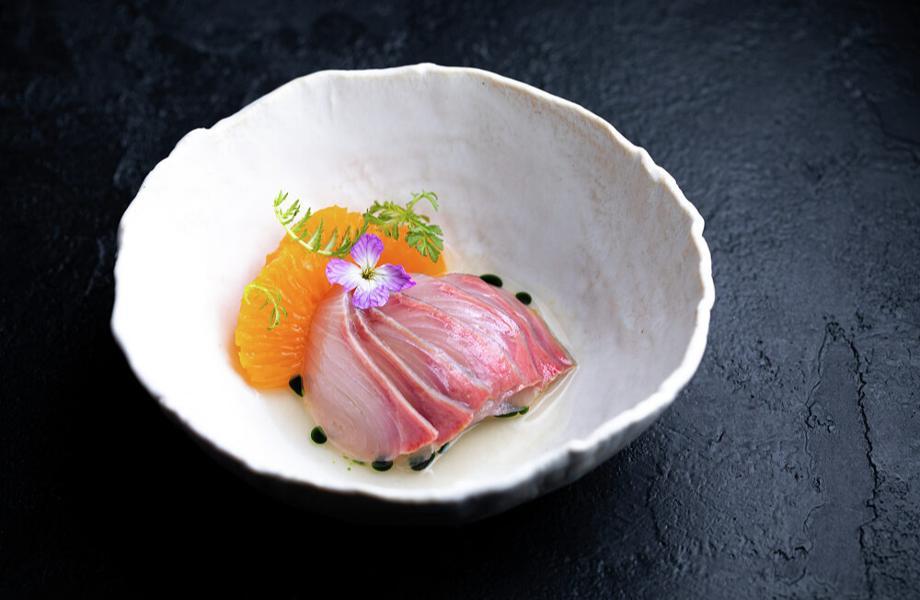
That is why the cover image matters. It shows a composed seafood dish, not a spectacle: clean fish, citrus brightness, herbs, a flower, and a dark tabletop that makes the white bowl feel almost tidal.[6] Providence's value case lives there. If you want shock, smoke, projection mapping, or a maximalist night out, the ticket may feel too restrained. If you want seafood handled as a chain of decisions, the numbers become easier to parse.
The Ticket Has Become A Choice, Not A Single Tunnel
The most useful current detail is the two-menu stack. Providence publishes a classic tasting menu at $375 and a chef's tasting menu at $495.[1] That $120 spread is not incidental. It is the restaurant asking whether the diner wants the core Providence argument or the fuller version of the kitchen's attention.
The classic menu already carries luxury signals: kaluga caviar with country ham, giant clam, and soy milk; sashimi with hibiscus and creme fraiche; abalone with Brentwood corn and black truffle; tortelli with crab, uni, and summer squash; striped bass with artichoke, snap pea, and red pearl onion; king salmon with porcini and ramp, with duck or A5 wagyu available as alternatives and the wagyu carrying a $45 supplement.[1] Before dessert, the menu has already moved through roe, shellfish, raw fish, pasta, finfish, and optional meat.
That makes the $495 chef's tasting menu less a simple upgrade than a temperament test. Some diners will want every rare product and every extra turn. Others will get more value from the classic lane because it leaves enough appetite, attention, and budget for a pairing, a targeted add-on, or simply a cleaner exit from the evening. The smartest order may be the less maximal one. Fine dining often tempts guests to confuse completeness with satisfaction.
The a la carte "should you be in the mood" section sharpens the point. Oysters are listed by the half-dozen, the uni egg is $35 with a possible $40 golden kaluga caviar supplement, and salt-roasted Santa Barbara spot prawns sit at market price.[1] These are not filler luxuries. They show where Providence thinks its identity lives: oysters, caviar, uni, spot prawns, and the ocean-side ritual of choosing one more thing before surrendering to the menu.
What The Money Buys Is Mostly Invisible
Seafood luxury is cruel because the best work often disappears into the absence of flaws. The fish should not smell tired. The shellfish should not taste muddy. The sauce should not bully the flesh. The garnish should not make a pristine ingredient feel decorated to death. When Providence succeeds, the diner may feel only calm, which is dangerous for value perception. Calm is expensive to produce.
Michelin's 2025 promotion note is helpful because it describes Providence through purity, precision, classic technique, modern sensibility, global inspiration, and sustainable seafood often wild-caught from American waters.[4] That is not just guide language. It is a cost map. Wild-caught seafood is less predictable than standardized luxury protein. The kitchen has to buy well, adjust constantly, and preserve quality through butchery, holding, portioning, cooking, and service.
50 Best's current profile says Providence cooks in tune with seasonality, farmers market finds, and what fishers bring to shore; it also notes a roof garden certified as a wildlife habitat, with bat sanctuaries, beehives, herbs, flowers, Hollywood honey, and house-processed Hawaiian cacao appearing in the broader experience.[3] Those details matter because they move the value case away from plate count. A restaurant can spend money making dinner louder. Providence appears to spend it making dinner more controlled.
The team page supports the same reading. Michael Cimarusti is framed as a seafood authority and sustainability advocate, and the restaurant describes him as having led Providence since its 2005 opening; Donato Poto's biography makes the front-of-house partnership part of the restaurant's DNA; Tristan Aitchison's path from Water Grill into Providence explains why the kitchen's continuity is not just a staffing footnote.[2] A guest does not eat biographies, but at this level continuity is part of the product. It means standards can be remembered service after service.
The Labor Bill Is Part Of The Luxury
Eater's 2022 behind-the-scenes piece remains useful because it catches Providence before the current three-star price layer. At that time, the article described a $295-per-person tasting menu and a pre-service world of thousands of dollars of wild-caught fish, front-of-house meal, pressed jackets, kitchen notes, reservation details, allergies, repeat guests, and a 5 p.m. meeting where the night's information was transferred from kitchen to room.[5]
The current classic menu at $375 is not directly comparable to that older single number, but the rise is still a signal.[1][5] Providence did not become a different category of restaurant overnight. It became a more expensive version of a system that was already labor-heavy: the fish must be ready, the room must know the guest, the service must make the tasting-menu constraint feel chosen rather than imposed, and the staff must hide most of the friction.
That is the part many price comparisons miss. If two restaurants both charge several hundred dollars, the better value is not always the one with more courses or louder ingredients. It may be the one that wastes less of the guest's attention. Providence's public materials point toward a house trying to make the meal feel exact rather than effortful: the seafood focus is narrow, the service tradition is old, and the add-ons are visible enough that a diner can choose where excess belongs.[1][2][5]
The danger is that the third star can make guests order defensively. Nobody wants to feel that they under-bought the big night. But defensive ordering is how a $375 dinner becomes a blurred, overextended bill. The better move is to decide in advance what kind of value you want: seafood clarity, trophy completeness, beverage exploration, or one targeted luxury add-on.
Where The Value Can Break
Providence's value case breaks if the diner wants novelty per dollar. The restaurant is not priced like an experimental young room trying to surprise the city with a new grammar. It is priced like a mature institution doing difficult things with discipline. That maturity is the appeal, but it also limits the emotional upside for diners who measure dinner by astonishment.
It can also break through supplement drift. The $375 classic menu is already a serious commitment. Add the $45 wagyu supplement, the $35 uni egg, the $40 caviar addition, market-price spot prawns, pairings, tax, and gratuity, and the psychological anchor moves fast.[1] None of those choices is foolish by itself. The mistake is pretending they are small because the base ticket is already large.
The third break point is seafood preference. Providence's menu includes duck and wagyu alternatives, but the restaurant's strongest identity is still briny, marine, and product-driven.[1][3][4] A diner who only tolerates seafood should not use the Michelin rating as a reason to book. The value depends on wanting the ocean to be the point, not the prelude.
The Best Order Is Disciplined
The most coherent Providence order in 2026 is probably the classic tasting menu plus one intentional decision. For a first visit, that might mean the uni egg because it is a compact expression of the house's sea-and-luxury language. For a seafood obsessive, it might be salt-roasted Santa Barbara spot prawns if they are available and priced within your ceiling. For a beverage-focused diner, it might mean skipping food supplements and putting the extra spend into the pairing conversation instead.[1]
That discipline fits the restaurant better than collector behavior. Providence is not asking to be conquered. It is asking to be read carefully. The room's current public reputation rests on seafood sourcing, long team memory, service calm, sustainable practice, and a menu that can turn caviar, sashimi, abalone, crab, uni, striped bass, king salmon, and cacao into a sequence rather than a pileup.[1][2][3][4]
So the value answer is conditional but clear. Providence is worth the money when you are paying for precision under restraint: the fish bought right, the shellfish held right, the sauce stopped before it dominates, the guest remembered, the service tuned, and the last sweet course still connected to the meal. It is poor value if you mainly want volume, novelty, or proof that you ordered every possible luxury.
The third star may get people through the door. The value lives elsewhere. It lives in the unglamorous work of making seafood taste inevitable.
Sources
- Providence official dinner menu - current tasting-menu prices, course examples, supplements, a la carte options, pairing availability, schedule, and change notice.
- Providence official team page - biographies for Michael Cimarusti, Donato Poto, Tristan Aitchison, and David Osenbach, with sustainability, service, and restaurant-continuity context.
- North America's 50 Best Restaurants 2026, "Providence" - No. 32 listing, Cimarusti and Dimla roles, seafood-centric framing, roof garden, seasonality, and dining-room context.
- Michelin North America, "California raises the bar with two Three Starred restaurants joining 2025 selection" - official Providence promotion note and inspector comments on seafood, technique, and signatures.
- Mona Holmes, "How Providence's Pre-Dinner Meeting Is the Key to Its 17-Year Dominance in Los Angeles," Eater LA, September 15, 2022 - reporting on pre-service labor, menu communication, fish prep, reservation details, and the then-current tasting-menu price.
- 50 Best Discovery image file, "Providence-LosAngeles-USA-01.jpg" - real Providence dish photograph used as the article image.
- Rebecca Roland, "Here Are the 2026 Michelin Star Winners in Los Angeles," Eater LA, June 2026 - current Los Angeles Michelin list placing Providence under Three Stars.