Croquembouche is not a cake that happens to be tall. It is a pastry structure that makes height, crunch, and timing part of the eating. A weak version is only a cone of cream puffs with spun sugar drama. A strong version behaves like edible architecture: each choux has to remain light, each filling has to stay contained, each caramel join has to hold, and the whole tower has to look festive without becoming an engineering stunt.
That is why croquembouche still belongs in fine dining. It asks a pastry team to make abundance legible. Many desserts create luxury by concentrating attention on one plated object. Croquembouche does the opposite. It turns repetition into ceremony. The diner sees dozens of small units, but the dessert succeeds only if those units merge into one confident form.
The name itself gives away the right standard. Larousse defines croquembouche as a piece montee made from sweet items glazed with cooked sugar.[1] In other words, this is not simply "cream puffs for a party." It is a mounted piece. The sugar is not garnish. It is the building system.
The Crunch Is A Structural Promise
Bon Appetit describes the familiar modern version as a tower of pastry-cream-filled choux held together with caramelized sugar, often served at French and New Orleanian weddings.[2] The celebration context matters because it changes the dessert's job. A plated dessert can be intimate. Croquembouche has to enter the room as a public object. It should make the table look up before anyone tastes it.
But spectacle is the easy part. The harder part is that the dessert's visual claim has to survive the spoon, fingers, tongs, or ceremonial separation. The "crunch in the mouth" idea is not just a cute etymology. It is the promise that cooked sugar will remain present as texture. If the caramel is too thick, the bite becomes hard and dangerous. If it is too thin, the structure loses grip and the cream puffs taste like ordinary profiteroles. If humidity softens the sugar, the tower loses its argument.
The choux has its own burden. It needs enough air to feel light, enough shell strength to hold cream, and enough dryness to keep from collapsing under filling and caramel. Fine dining often hides structure under smoothness: a sauce looks effortless, a mousse looks calm, a custard looks simple. Croquembouche exposes structure. The guest can see whether the pastry team understands repetition, weight, and proportion.
That is the first reason the dish remains interesting. It takes the pastry kitchen's most private anxieties and makes them vertical.
Careme's Shadow Is Really About Display
Marie-Antoine Careme's Le Patissier royal parisien, visible in a Google Books record for the 1815 pastry treatise, belongs to the world that made elaborate pastry display a serious professional language.[3] The point is not to turn every croquembouche into a museum object or to pretend that today's restaurant should imitate nineteenth-century banquet sculpture. The useful inheritance is more practical: pastry can organize a room.
A croquembouche is a descendant of that display logic. It says the kitchen is able to coordinate small craft and grand gesture at the same time. The choux are individual. The form is collective. The caramel is both flavor and fastener. The spun sugar, when used well, should not obscure the construction; it should make the tower feel momentarily caught between confection and architecture.
This is where the dish can go wrong in ambitious restaurants. If the tower becomes only a photo opportunity, it loses the eating. If the pastry is too fragile, guests admire it and then struggle with it. If the caramel is overworked, the dessert becomes a dental negotiation. If the cream is too heavy, the tower may look airborne while the bite feels tired.
The strongest croquembouche keeps the old banquet instinct but edits it. It understands that height is not enough. The dessert has to make its own height delicious.
Caramel Is The Load-Bearing Sauce
Great British Chefs' croquembouche method is useful because it names the assembly problem without romantic fog: the profiteroles are layered in tight circles, and the caramel sets quickly, holding the structure firm.[4] That sentence is the dish in miniature. Croquembouche is not built by decoration. It is built by speed, repetition, and hot sugar.
Caramel behaves like a sauce until it suddenly behaves like glue. That change is the entire service risk. While hot, it can dip, coat, stretch, burn, drip, and connect. Once set, it hardens into the crunch and grip that make the tower possible. The pastry cook works inside a shrinking window. Too slow, and the caramel cools. Too fast, and the tower leans. Too casual, and the sugar web looks messy rather than light.
That is why croquembouche is a better fine-dining lesson than many more polished plated desserts. Its luxury is visible as labor. The tower says: someone filled these puffs, cooked this sugar, judged this viscosity, placed these units, controlled this cone, and stopped before decoration swallowed the form.
The same source's instruction to flick remaining caramel into threads after assembly also clarifies the order of operations.[4] Structure comes first. Ornament comes after. Spun sugar should be the weather around the building, not the building itself.
Why It Is Not Just Profiteroles
Profiteroles can be wonderful, but they usually behave as individual pastry pleasure: shell, cream, sauce, cold, warm, spoon. Croquembouche changes the unit of attention. A single choux matters because it is part of a tower. The dessert asks the eater to move between the one and the many.
That movement is the pleasure. Each puff should still deliver the small satisfaction of choux and cream, but the form turns that satisfaction into ceremony. Pulling one piece from the structure should feel slightly transgressive, as if the guest is allowed to dismantle the celebration. Fine dining often likes controlled participation: breaking a pastry lid, pouring a sauce, lifting a cover, choosing a bite from a tray. Croquembouche is one of the older and better versions of that impulse. The guest does not merely receive the dessert. The guest helps unbuild it.
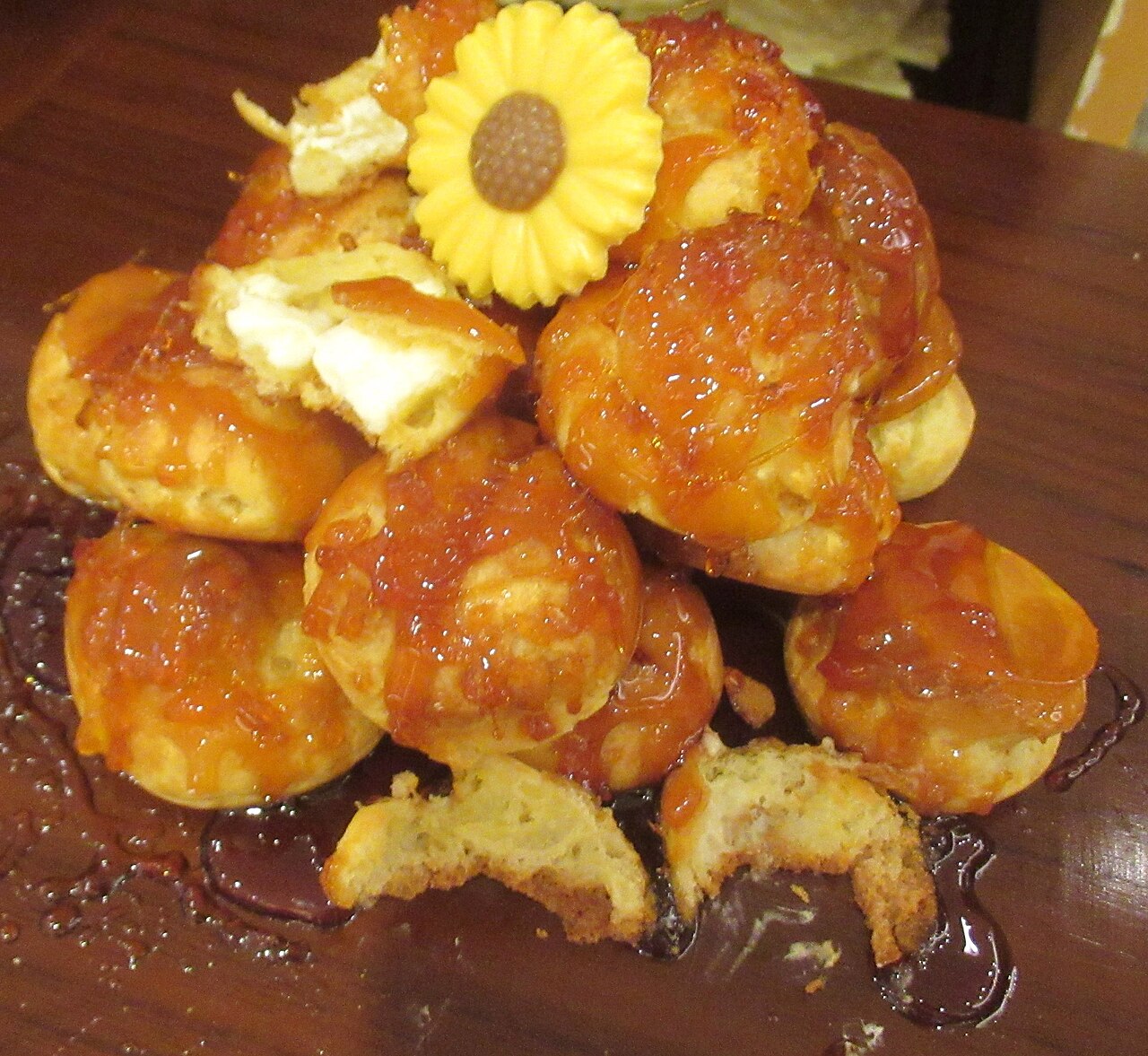
The photograph used here makes that legible.[5] It is not a diagram and not a studio fantasy. It shows the actual problem: a mountain of small round pastries, caramel gloss, repeated shapes, and a form that needs to look generous without turning chaotic. The image works because croquembouche is physical before it is symbolic. It has mass. It casts a party-sized shadow.
The Fine-Dining Standard Is Restraint
Modern pastry has many ways to produce height: molds, silicone, tempered chocolate supports, laminated shards, sugar cages, frozen inserts, printed garnishes. Croquembouche remains distinctive because its height comes from a humble repeated form. The puff is not hidden. The join is not hidden. The risk is not hidden.
That visibility should encourage restraint. A croquembouche can take flowers, sugared almonds, ribbons, chocolate, nougatine, macarons, or theatrical sugar work, but each addition should answer a simple question: does it make the tower taste, move, or read better? If the answer is only that it makes the photograph busier, the addition weakens the dish.
The best version is almost severe in its logic. Choux provides air. Cream provides softness. Caramel provides crunch and structure. Height provides ceremony. Spun sugar provides shimmer. Service provides timing. Nothing in that chain is optional, and nothing should try to become the whole story.
Croquembouche survives because it makes celebration technically honest. It does not ask the diner to believe in luxury by price alone. It asks the kitchen to prove that many small, perishable, fragile things can hold together briefly and beautifully. That is a useful definition of fine dining: control made hospitable before control disappears.
At its best, croquembouche is not a tower of sweets. It is the moment when pastry admits that architecture can be eaten, but only if the room is ready on time.
Sources
- Larousse, "croquembouche" - dictionary definition of the dessert as a mounted piece made from sweet items glazed with cooked sugar.
- Bon Appetit, "How to Make a Croquembouche, the Totally Over-the-Top Tower of Cream Puffs" - modern assembly overview describing choux, pastry cream, caramelized sugar, and wedding-service context.
- Google Books, Marie-Antoine Careme, Le patissier royal parisien, Volume 1 - bibliographic record for the 1815 pastry treatise used for the display-pastry context.
- Great British Chefs, "Eggnog Croquembouche Recipe" - practical assembly notes on tight profiterole layering, fast-setting caramel, and spun-sugar finishing.
- Wikimedia Commons, "File:Croquembouche mountain.jpg" - real 2025 photograph by CNEcija12345 used as the article image.