The easiest way to flatten Hiakai is to call it a fine-dining restaurant that uses Indigenous ingredients. That is true, but it misses the craft. Hiakai matters because Monique Fiso and Katie Monteith have treated research itself as a kitchen technique. The current official page describes Hiakai as a wāhine-led creative project specializing in storytelling through kai, and says it began in 2016 as a dining series devoted to exploring and developing Māori and Pasifika cuisine.[1] That origin still explains the work better than any generic restaurant category.
In a conventional luxury kitchen, technique often means repeatable control: a sauce mounted the same way, a garnish cut to the same size, a service script that absorbs chaos before guests see it. Hiakai's technique begins earlier. It asks how a pantry becomes legible after colonization, neglect, disrupted transmission, and the practical absence of many ingredients from ordinary commercial supply. The meal is the polished end of that work. The harder craft is making the ingredients, stories, protocols, and supply routes available enough to cook with at all.[2][5]
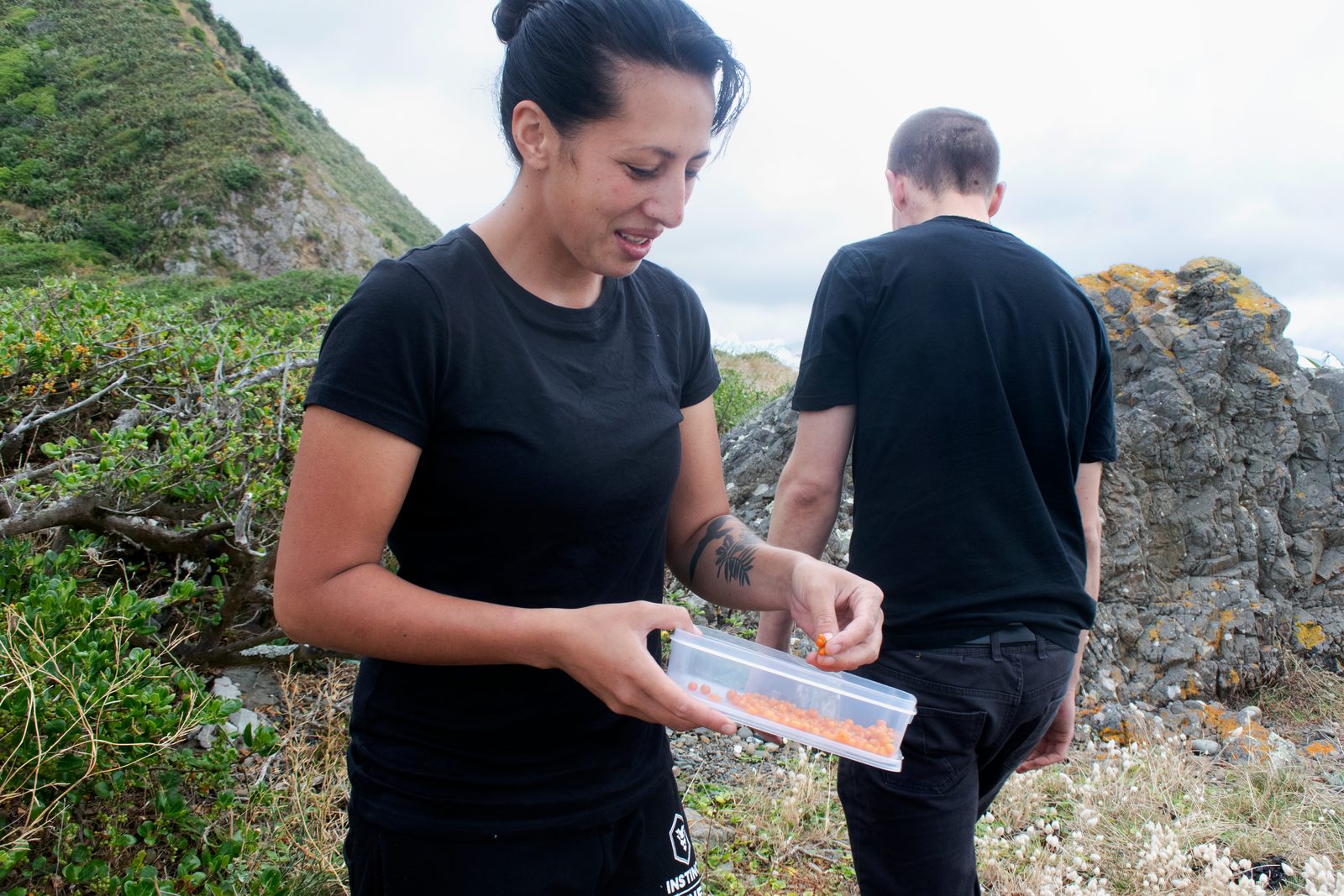
Image context: the cover photo shows Fiso and Maxime Gnojczak gathering along the Island Bay shoreline in Wellington. It is not a mood image. It shows the physical labor behind Hiakai's argument: the kitchen has to know where food grows, what it is called, who can gather it, when it is ready, and how it behaves once brought back inside.[2]
1. The pantry had to be rebuilt before it could be refined
Brian Ng's Eater feature is still the clearest technical account of Hiakai's early problem. Fiso returned to New Zealand after years in New York kitchens and discovered that many native ingredients did not behave like restaurant commodities. Some were not available through normal suppliers. Some depended on short seasons. Some required weeks of lead time. Kiekie, for instance, is described as a vine whose fruit and flower bracts arrive from different plants and demand difficult harvesting conditions.[2] That is not a sourcing inconvenience. It changes what kind of cuisine can exist.
This is where Hiakai's work becomes more engineering-like than many fine-dining narratives admit. If an ingredient cannot be ordered predictably, the kitchen cannot simply build a permanent signature dish around it. It has to build relationships, substitutions, processing knowledge, storage habits, and menu flexibility. Eater describes Fiso gradually developing a network where she could send out requests and be referred from one supplier or gatherer to another.[2] That system is looser than a wholesale account, but it is also more culturally specific. It recognizes that some foods arrive through people, whakapapa, timing, and trust before they arrive through invoices.
The result is not rustic spontaneity. It is a different kind of discipline. Cuisine Magazine's Good Food Guide writeup captures the dining-room version: tītī, kawakawa, horopito, and kaimoana appear as part of a distinctly local menu, but the article also stresses that Hiakai aims to engage guests in the history and culture that make the land unique.[3] The plate is therefore doing two jobs at once. It has to taste good in the immediate fine-dining sense, and it has to carry enough context that the ingredient is not reduced to novelty.
2. Tītī shows why supply is part of the recipe
The strongest example is tītī, or muttonbird. In Eater's account, Fiso's use of tītī depends on Rakiura Māori harvesting networks, family rights, difficult island logistics, preservation habits, and a growing restaurant demand for fresh rather than only salted birds.[2] New Zealand's Titi (Muttonbird) Islands Regulations add the hard seasonal boundary: people may not enter the relevant land earlier than 15 March, and birding begins no earlier than 1 April and ends with 31 May.[6]
Those dates matter in a craft explainer because they show why the ingredient cannot be treated like a luxury protein that merely appears on demand. The bird arrives through a regulated seasonal practice and through people with the right to be there. Its flavor, scarcity, preservation, and timing are part of the technique stack. Hiakai's craft is not only how tītī is roasted, confited, or used as fat. It is how the kitchen respects the channel that makes the ingredient possible.
That is a sharper luxury proposition than rarity alone. A rare imported ingredient can still be anonymous. Tītī at Hiakai is not anonymous because its route is part of the meaning. The kitchen has to translate that route without turning it into a lecture. That is why the best reading of Hiakai is not "modern Māori ingredients in a tasting menu." It is "a tasting menu disciplined enough to let cultural logistics remain visible."
3. Testing is a form of authorship
Hiakai's second technique is experimentation under uncertainty. Eater describes the team tasting new ingredients raw, then trying pickling, brining, cooking, and dehydration before deciding what works.[2] That process sounds ordinary until the historical context is added. The same feature notes that information about some plants used at Hiakai can be scarce or distorted, partly because use was not widely documented and partly because Māori knowledge transmission was damaged by colonial pressure and legal suppression.[2]
Fiso's book project formalized that work beyond the restaurant. Her official book page describes Hiakai: Modern Māori Cuisine as an account of kai Māori covering traditions, ingredients, tikanga, foraging and usage notes, an ingredient directory, and more than 30 recipes.[5] The National Library record describes the 2020 Godwit volume in similar terms: history, tradition, tikanga, personal journey, foraging notes, an illustrated ingredient directory, and recipes that give old knowledge new life.[7] AUT's coverage of the 2021 Ockham New Zealand Book Awards adds that the book won best illustrated non-fiction, with judges emphasizing that the recipes occupy less than half of the pages because the wider Māori knowledge frame is the work's foundation.[8]
That matters for the restaurant because it makes clear what kind of chefly authorship is being claimed. Hiakai is not only inventing dishes. It is helping make a reference system. In most fine dining, research hides behind the final plate. At Hiakai, research is part of the plate's ethical and technical claim. The kitchen becomes a place where ingredient behavior, cultural memory, and modern service are tested against one another until they can share a form.
4. Storytelling is not decoration
MiNDFOOD's 2020 account helps explain why the meal cannot be separated from narration. It describes Hiakai as a Wellington restaurant whose menu combines flavor, texture, beverage pairing, and an aromatic journey through Fiso's interpretation of Māori cooking, culture, and nature.[4] It also notes that storytelling appears through the printed menu and front-of-house delivery, with one menu built around the Battle of the Mountains.[4] In a weaker restaurant, that could become theatrical garnish. At Hiakai, it is more structural.
The reason is simple: if the dish uses ingredients whose meanings have been obscured, marginalized, or misunderstood, silence would make the meal less accurate. The story is not there to make the course sound expensive. It is there to keep the course from being read through the wrong category. Kawakawa is not just pepperiness. Horopito is not just heat. Rēwena is not just bread with an interesting fermentation note. Kaimoana is not just seafood. These foods need culinary treatment, but they also need a frame that keeps them attached to place, language, use, and memory.[3][5][7]
That is the craft lesson Hiakai gives the broader fine-dining world. A restaurant can be technically ambitious without pretending that technique is culturally neutral. It can plate with precision while admitting that some of its hardest work happens in naming, researching, sourcing, and explaining. It can be polished without smoothing away the conditions that make the food possible.
Hiakai's real innovation, then, is not a single dish or ingredient. It is a method: rebuild the pantry, make supply visible, test the unknown carefully, write the knowledge down, and let service carry the story without turning it into spectacle. That is why the restaurant's importance survives beyond the usual ranking language. It shows that modern fine dining can be a research practice with dinner service attached, and that the most consequential technique in the room may be the discipline of remembering accurately.[1][2][5][8]
Sources
- Hiakai, "Kaupapa" - official current page describing Hiakai as a wāhine-led kai creative project, its 2016 origin as a Māori and Pasifika dining series, Wellington address, and current public-facing positioning.
- Brian Ng, "The New Zealand Chef Bringing Māori Ingredients to the Fine Dining Stage," Eater (February 27, 2019) - feature and Brian Ng photography covering Hiakai's sourcing problem, tītī logistics, native-ingredient trials, rēwena, and the shoreline gathering image used as the cover.
- Cuisine Magazine, "Hiakai" (Cuisine Good Food Guide 2023) - profile noting the local menu vocabulary of tītī, kawakawa, horopito, kaimoana, and Hiakai's cultural storytelling aim.
- Cameron Douglas, "Hiakai: A celebration of nature, culture and Māori cuisine," MiNDFOOD (June 25, 2020) - behind-the-scenes profile covering the restaurant's 2018 opening, storytelling through menu and service, and Māori technique references.
- Monique Fiso, "Hiakai by Monique Fiso" - official book page describing Hiakai: Modern Māori Cuisine as a work on kai Māori traditions, ingredients, tikanga, foraging notes, an ingredient directory, and recipes.
- New Zealand Legislation, "Titi (Muttonbird) Islands Regulations 1978" - primary legal source for Tītī Islands entry and birding-season boundaries.
- National Library of New Zealand, catalogue record for Hiakai: modern Māori cuisine - bibliographic record identifying the 2020 Godwit book, contributors, ISBN, scope, and format.
- AUT News, "Hiakai wins Ockham NZ Book Award" (May 13, 2021) - award report on the book's best illustrated non-fiction win and the role of Māori knowledge, history, ingredients, practice, and culture in the work.
Editor's Pick Review
This article takes today's merged standard/add-on editor-pick slot because it has the strongest 24-hour quality profile under the tightened rubric. The piece turns Hiakai from a restaurant profile into a precise craft argument: research, Māori and Pasifika pantry reconstruction, tītī seasonality, supplier relationships, and front-of-house storytelling all become parts of one culinary method rather than decorative context. The sourcing is unusually useful for a fine-dining post, combining the restaurant's own kaupapa page, detailed food journalism, legal seasonality rules, book metadata, and award context into a clear evidence chain.
It also clears the stricter image-policy gate cleanly. The visual is immersive and topic-grounded: a real documentary photograph of gathering at Island Bay, directly tied to the article's claim that Hiakai's technique begins before the dining room. There is no analytical graphic, generic restaurant glamour, or abstract support image. The Chinese edition preserves the argument with natural sensory cadence, stable handling of Māori terms, and low translationese, so the bilingual reading experience stays both textured and precise.