The most useful way to read Delmonico's is not as a museum of disputed origin stories. Eggs Benedict, Baked Alaska, Lobster Newberg, Chicken a la Keene, and Delmonico steak all orbit the name, but the restaurant's deeper invention was structural. It made fine dining in the United States feel like a complete operating system: a printed field of choices, private rooms for power, a wine cellar as social signal, French technique translated through American abundance, and a dining room close enough to Wall Street that appetite and status could recognize each other across the table.[1][2][4]
That matters because American luxury food did not arrive fully formed. It had to be organized. Delmonico's began from the modest grammar of pastries, coffee, chocolate, wines, liquors, and cigars before the brothers moved into the more ambitious triangular site at Beaver, William, and South William Streets in 1837.[1] The official history calls that move the opening of the country's first fine-dining restaurant, a claim that is less interesting as a trophy than as a clue. The restaurant was not merely offering better food. It was teaching a young commercial city how to behave around choice, privacy, service, and French culinary prestige.
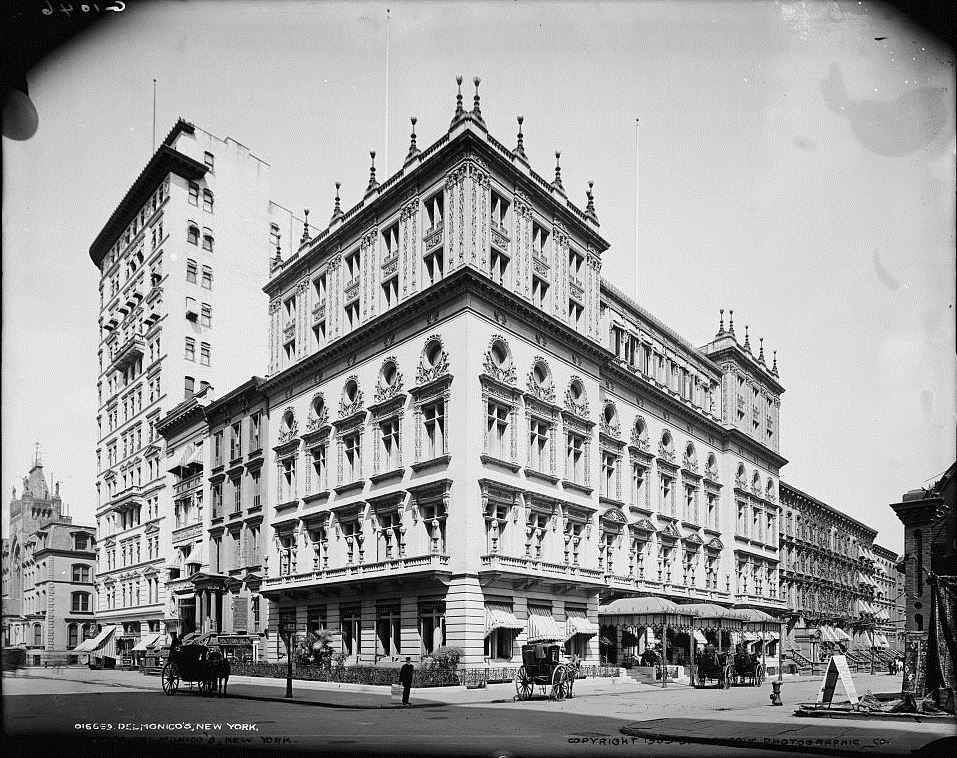
Image context: I used the 1903 archival street photograph because it catches Delmonico's in the correct register: not a plate isolated from history, but a luxury room embedded in street life. Fine dining here is not hidden away in a country estate. It is a public-facing urban machine on a corner, receiving bankers, politicians, club dinners, visiting dignitaries, and ambitious diners who wanted New York to feel legible through service.[1][5]
1. The restaurant made privacy part of the product
Modern diners tend to think of private rooms as an add-on: useful for a board dinner, wedding party, or expense-account celebration. At Delmonico's, privacy was closer to the original engine. The official history highlights third-floor private dining rooms and a basement cellar holding 1,000 bottles of wine.[1] Those details explain the restaurant better than any single signature dish does. This was a place where discretion, selection, and access could be sold alongside beef, oysters, sauces, and sweets.
That mix suited nineteenth-century New York. The city was becoming a financial and social theater, and Delmonico's gave that theater a food language. A guest could dine publicly in a room known by reputation, but also retreat into a managed private space. A host could signal seriousness through wine, menu length, French phrasing, and the ability to gather people away from ordinary tavern noise. In that sense, Delmonico's helped define an American luxury pattern that still exists: the restaurant as a semi-public room where business, courtship, club culture, politics, and self-invention can all borrow the legitimacy of service.[1][4]
The point is not that Delmonico's invented exclusivity. The point is that it systematized it. The restaurant made privacy bookable, menu choice printable, wine collectible, and French technique local enough to become a New York habit.
2. Menus turned abundance into order
The great Delmonico's story is partly a menu story. The New York Public Library's writing on its menu collection shows why these paper objects matter: they preserve not only what people ate, but how restaurants staged ingredients, language, occasion, and hierarchy.[4] In an essay on New York oysters, NYPL points readers toward historic Delmonico's menus, calls the restaurant a vanguard of the city's francophile dining culture, and notes the French phrasing that scattered across those bills of fare.[4] That is the restaurant in miniature. Delmonico's could make local appetite, elite ritual, and French dining vocabulary share one page.
Charles Ranhofer's The Epicurean makes the same point at enormous scale. Its subtitle presents the book as a complete culinary treatise with table and wine service, cooking methods, and selected Delmonico's bills of fare from 1862 to 1894.[2] In other words, Delmonico's was not only serving meals; it was generating a written archive of how a grand American restaurant thought. The book's more than thousand-page bulk matters because it shows the ambition behind the room. Fine dining was not a handful of expensive products. It was classification, sequence, garnish, sauce, service, and occasion turned into a repeatable language.[2]
That is the hidden force of the menu. A long menu can look bloated to a modern tasting-menu reader, but in Delmonico's world it was a map of possibility. It let diners perform sophistication by choosing. It let the restaurant display range. It converted market abundance into social order.
3. The kitchen translated France without becoming France
Delmonico's lineage is often described through French technique, and that is correct as far as it goes. Ranhofer, chef de cuisine from the Civil War era into the 1890s, becomes the clearest figure here because The Epicurean frames his work as a Franco-American culinary encyclopedia.[2] The phrase matters. Delmonico's did not simply import French dining unchanged. It adapted French grammar to New York appetite, New York products, New York banquets, and New York self-display.
Alessandro Filippini's The Delmonico Cook Book helps widen that picture. Project Gutenberg's record describes the book as a late nineteenth-century culinary guide concerned with buying food, cooking it, and serving it, and notes Filippini's experience at Delmonico's.[3] The title itself is wonderfully practical. It does not sell genius alone. It sells competence from market to table: procurement, preparation, presentation, and service.
That is why the restaurant's afterlife should not be reduced to invention claims. Whether a particular dish was born there, perfected there, popularized there, or merely attached itself to the house mythology, Delmonico's larger contribution is clearer. It made an American restaurant look administratively serious. The kitchen had repertoire. The cellar had depth. The rooms had social uses. The menu had reach. The name gathered dishes, banquets, books, and urban memory into one durable brand.[1][2][3]
4. Why the lineage still matters
Delmonico's can feel remote now because contemporary fine dining often values compression: fewer courses, shorter menus, cleaner sourcing narratives, quieter rooms, and a suspicion of old banquet grandeur. But the restaurant's lineage is not obsolete. Many current luxury restaurants still work inside a Delmonico's-shaped problem. They must decide how much choice to allow, how private the room should feel, how openly to signal cellar depth, how to balance local identity with borrowed technique, and how to turn a meal into an event without letting ceremony suffocate pleasure.
That is the restaurant's most useful lesson for 2026. Delmonico's made American fine dining by solving for systems, not just flavors. It understood that luxury depends on more than cooking well. Luxury needs a threshold, a room, a list, a sequence, a host's sense of control, and a guest's feeling that the city has briefly arranged itself around the table.[1][4][5]
The 1903 photograph makes the point with more force than nostalgia can. Delmonico's stands on a New York corner, heavy and confident, while street life moves around it.[5] That is the lineage: fine dining as a room that separates you from the city while proving, every minute, that the city is the reason the room exists.
Sources
- Delmonico's official history page, covering the 1837 Beaver / William / South William opening, private dining rooms, wine cellar, Alessandro Filippini, Charles Ranhofer, and house dish claims.
- Open Library, Charles Ranhofer, The Epicurean, with edition details describing its table and wine service scope and selected Delmonico's bills of fare from 1862 to 1894.
- Project Gutenberg, Alessandro Filippini, The Delmonico Cook Book: How to Buy Food, How to Cook It, and How to Serve It, public-domain ebook record and reading links.
- New York Public Library, Carmen Nigro, "History on the Half-Shell: The Story of New York City and Its Oysters", including Delmonico's menu context and NYPL's "What's on the Menu?" archive.
- Wikimedia Commons, "Delmonico's 1903.jpg", archival photograph used for this article's image.