

A fine-dining plate is handled before it is admired. A cook warms it, a saucier wipes its rim, a server finds its balance, and a dishwasher meets it again after the room has emptied. Only the guest is invited to see a still life. For everyone else, the plate is moving equipment.
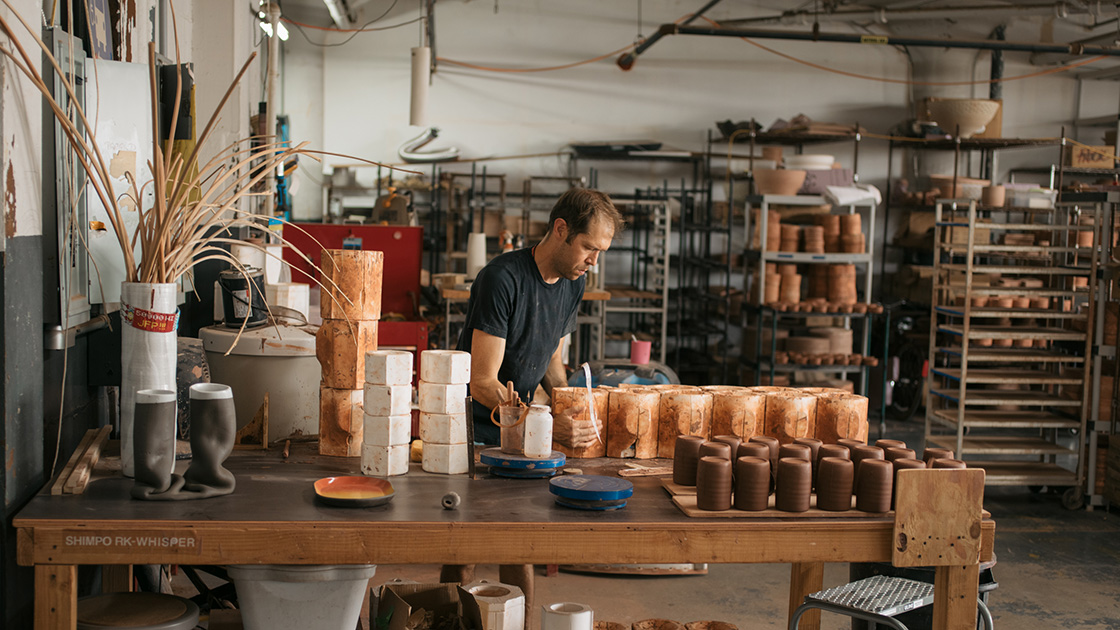
That is what makes the two Eater films in this collection unusually satisfying. One enters Jono Pandolfi's ceramics studio in Union City, New Jersey, where a team produces handmade stoneware at restaurant scale. The other visits Kwangjuyo in South Korea, where inherited decorative methods and tightly controlled firings carry Korean table culture into contemporary dining rooms. One workshop favors an intentionally spare trace of the hand; the other makes carving and glaze part of the vessel's visible memory.[1][2]
Put together, the films correct two easy mistakes. The first is that a plate is merely a blank canvas for a chef. The second is that “handmade” means escaping repetition. A serious restaurant needs the opposite: pieces consistent enough to join a service, distinct enough to give that service a voice, and reproducible enough that a broken bowl does not become an extinct species. The artistry lives inside that tension.
Jono Pandolfi: the hand survives through the system
Pandolfi's studio is a bright former soap factory, not a solitary potter's hut. The Michelin Guide describes clay moving through jiggering, rolling, glazing, sorting, packing, and shipping; Eater reported that the team was making roughly 300 pieces a day when it filmed the process.[1][3] The scale is part of the story: the 6,000-piece NoMad order took 11 months and put Pandolfi's studio on the map; his restaurant work also included the MoMA cafes and Eleven Madison Park.[3][4]
Watch the video first for rhythm rather than finished beauty. Clay is portioned, pressed or shaped into repeatable profiles, trimmed, handled again, glazed, fired, inspected, and gathered on racks. The cinematic pleasure comes from wet curves and earthy color, but the restaurant lesson is in the handoffs. No single gesture makes the plate. Reliability emerges from a sequence that many people can perform without erasing material variation.[1]
The film's most useful idea is that efficiency need not mean impersonality. Pandolfi talks about leaving only the minimum handmade touch because that is enough.[1] A slight glaze drift, a toasted edge, or the evidence of trimming gives the object life; the common profile lets twenty examples behave as one family. Michelin's later studio visit found a catalog built from 50 shapes, two clay-body finishes, and ten glazes. That modular range lets chefs create a combination that feels particular without asking the workshop to reinvent pottery for every course.[3]
For service, that balance matters more than the romance of uniqueness. A bowl can be beautiful and still fail the room if its foot rocks, its rim hides sauce from the guest, or its replacements arrive visibly unrelated to the original set. The video does not turn those constraints into a checklist, but its repeated forms, racks, and inspections keep them in view. This is handmade work designed to reappear.
There is also a social resemblance between the ceramics studio and the restaurant brigade. Pandolfi told Eater that teamwork, coordination, and communication give the workshop its daily rhythm.[1] The plate therefore reaches the pass carrying one organized labor system into another. Its restraint is not emptiness; it is room left for the kitchen to complete the object.
Kwangjuyo: repetition can carry cultural memory
Kwangjuyo begins from a different premise. The company dates to 1963 and was established as a project of Korean ceramic continuity, later linking tableware, food, and traditional liquor under one group. In a Korea.net interview, then-CEO Cho Tae-kwon described opening Gaon and Bicena in 2003 so Korean food could be served in Korean ceramics rather than treating the vessel as interchangeable packaging.[6] Here the plate is not asked to disappear. It is asked to place the meal inside a longer table culture.
The Eater film centers Korean-speaking artisans; the process is visually legible even without sound, and the notes below supply its key sequence. Look for how often decoration is inseparable from manufacture. Forms are thrown and dried, but they are also incised, carved, dipped, and fired into surfaces whose pale celadon, dark line, and irregular depth remain active under food.[2][5]
The written companion to the film names two of those historical techniques, sanggam and bakji, and makes the time structure concrete. After forming and drying, pieces receive a first firing; glaze ingredients are ground for hours, each piece is hand-dipped, and a hotter second firing fixes the final surface. Inspection comes last. Kwangjuyo may offer thousands of variations, but abundance is supported by a disciplined route through the workshop rather than by free improvisation.[5]
That route changes how “traditional” should be read. It does not mean freezing a museum style and placing dinner on top of it. Kwangjuyo's vessels have reached restaurants such as Jungsik and The French Laundry, where the plate must enter a contemporary tasting-menu sequence and work beside food that may not resemble the meals for which the older techniques were developed.[2][5] Continuity, in this setting, is an active negotiation: how much pattern can sit beneath a precise sauce; how a bowl can evoke Korean form without becoming costume; how the same family of glazes can make several courses feel related without making them look repeated.
The Kwangjuyo film is lusher than the Pandolfi film, but it arrives at the same operational truth. Variation only becomes useful when a workshop can control it. A carved line should look alive, not accidental. A glaze break should feel responsive to clay and heat, not like a defect that escaped inspection. The kiln leaves a signature, yet the makers still decide which signatures may reach the table.
The plate is not a frame; it is a collaborator
The contrast between these workshops is real but not absolute. Pandolfi's language begins with adaptable restaurant production and protects a small residue of the hand. Kwangjuyo's begins with cultural inheritance and adapts it to present-day service. One often gives the chef a quiet field; the other can let the vessel speak in a more audible register. Both, however, reject the choice between anonymous uniformity and unusable one-offs.
That makes the chef's task more interesting than “pick a pretty plate.” Food and ceramic edit each other. A dark, matte bowl can make a pale puree feel luminous but swallow the outline of a charred ingredient. A high rim can hold aroma and sauce while changing how a spoon enters. An assertive inlaid pattern can deepen a course's sense of place or compete with fine garnish. These are not universal rules; they are consequences to notice. The right vessel is the one whose visual, tactile, and operational effects belong to the dish and the room.
The films also have a boundary worth naming. They are portraits of making, not procurement audits. Neither tells a chef the breakage rate after hundreds of dishwasher cycles, the reorder lead time after a menu change, or the cost of keeping enough replacements in storage. Those dull questions are precisely where craft becomes hospitality. If the object cannot survive the restaurant's repetition, its beauty becomes a burden carried by cooks, porters, servers, and eventually the guest.
What remains after that pressure is the good kind of luxury: not a plate so flamboyant that every diner photographs it empty, and not a white disc pretending to be neutral. It is an object with enough character to tune attention and enough discipline to do the same job tomorrow night. Pandolfi and Kwangjuyo reach that point by different routes. Both show that the handmade plate earns its place in fine dining when it can repeat without becoming anonymous.
Sources
- Eater, "How a Ceramics Master Makes Plates for Michelin-Starred Restaurants — Handmade" — YouTube video source for the embedded Jono Pandolfi workshop film.
- Eater, "How Kwangjuyo Makes Traditional Korean Ceramic Dishes for Michelin-Starred Restaurants — Handmade" — YouTube video source for the embedded Kwangjuyo workshop film.
- Michelin Guide, "Meet the Ceramicist to the MICHELIN Stars" — Union City studio profile, restaurant clients, production range, and photographic source for the lead image.
- Amy McKeever, "How I Got My Job: Making Custom Ceramics for Restaurants." Eater, 2019 — Pandolfi's career, NoMad commission, studio scale, and restaurant collaboration model.
- Terri Ciccone and Eater Video, "How Traditional Korean Tableware Is Made for Michelin-Starred Restaurants." Eater, 2021 — forming, sanggam and bakji decoration, glazing, firing, inspection, and restaurant use.
- Korea.net, "‘A dining table can change the fate of a nation’" — official interview on Kwangjuyo's history and the group's integration of Korean ceramics, cuisine, and traditional liquor.