The kitchen stage is sold as an exchange. A young cook gives time, obedience, and useful hands; an acclaimed restaurant gives access to techniques that cannot be learned from a recipe. At its best, the arrangement can be electric: the sound of a calm pass at full pressure, the exact moment fish leaves the pan, the silent handoff between sauce and garnish, the hundred small corrections that make a dining room believe dinner happened effortlessly.
But an exchange needs two things moving in opposite directions. When the restaurant sets a roster, assigns repetitive prep, depends on the output, and sells the finished plates—while never naming what will be taught—the romance collapses. The cook is no longer receiving an education in return for observation and practice. The restaurant is receiving labor in return for prestige.
That is the problem fine dining has delayed by hiding it inside a French word. A stage may mean a few hours observing a kitchen, a supervised working interview, a required culinary-school placement, or months of full production. Those arrangements are not ethically or legally interchangeable. The test should begin with a plain question: where is the syllabus?
One word has been covering several bargains
The word comes from stagiaire—trainee or intern—but professional kitchens use it with remarkable elasticity. Eater's reporting on the practice found cooks describing both genuine, career-changing instruction and placements shaped by harassment, exhaustion, or menial repetition. It also identified the stage as a customary entrance into formal fine-dining kitchens, sometimes connected to a culinary-school requirement and sometimes pursued independently for the line on a résumé.[3]
There is a defensible version. A cook spends one service shadowing a station, asks permission before touching anything, watches how a team communicates, and leaves with a clearer understanding of the room. A short, closely supervised skills audition can also tell both parties whether a paid job makes sense. Neither version requires the restaurant to build its production plan around the visitor.
Then there is the industrial version: a rotating body of aspirants cleans, picks herbs, portions ingredients, polishes, labels, plates, and closes for days or months. Each individual is temporary; the unpaid position is permanent. The kitchen may call this exposure, but repetition exposes the real bargain. If tomorrow's reservations require another free pair of hands to occupy the same slot, the restaurant has created a job and declined to price it.
The 2026 reckoning around Noma has made it harder to treat this as an eccentric old custom. Associated Press reporting on René Redzepi's resignation placed the restaurant's years-long use of unpaid interns inside a wider confrontation with fine dining's brigade culture, strict hierarchy, and history of intimidation.[1] Earlier reporting by Vice spoke with chefs who valued what they had learned while also describing an industry in which people traveled, housed themselves, and worked without pay because an elite kitchen name could unlock the next kitchen.[2]
Those two truths can coexist. A stage can teach. A stage can exploit. The existence of learning does not cancel the value of labor any more than a paid commis stops learning because a paycheck arrives.
Prestige is a currency that not everyone can spend
Fine dining often defends the unpaid stage by describing the restaurant's knowledge as payment. That argument has intuitive force. Recipes are the least scarce thing in a serious kitchen; judgment is scarce. A cook may reasonably value proximity to a brilliant saucier, fish butcher, baker, or service team more than a week of classroom demonstrations.
The trouble is that prestige currency cannot pay rent near Copenhagen, New York, Paris, or London. It cannot buy a flight, cover transit after a late close, replace forgone wages, or absorb an emergency. The cook who can accept a famous unpaid placement therefore arrives with invisible backing: savings, family help, cheap housing, another income, or unusual tolerance for debt. The selection process may appear meritocratic inside the kitchen while filtering for financial capacity outside it.[2][3]
That filter changes cuisine. It narrows who can collect the credentials that lead to senior stations, investor attention, media profiles, and eventually restaurants of their own. It also teaches an early professional lesson that should alarm an industry devoted to hospitality: the least powerful person in the room is expected to turn gratitude into consent.
The résumé line is real value, but it is speculative value. The restaurant receives usable work tonight; the stagiaire receives the possibility that somebody else will reward the experience later. When the famous name is the only compensation, the worker carries all the risk while the restaurant consumes the benefit immediately.
The law looks past the romance
Labor rules differ by country, and a kitchen should obtain advice for its jurisdiction. The useful common principle is that a label does not settle status. Calling someone an intern, volunteer, applicant, or stagiaire does not automatically make productive work unpaid.
In the United States, the Department of Labor summarizes the federal approach for for-profit employers through a seven-factor “primary beneficiary” test. The factors ask, among other things, whether the placement resembles educational training, is tied to formal study, accommodates an academic calendar, lasts only as long as beneficial learning requires, complements rather than displaces paid employees, and carries no promise of a paid job. No single factor decides every case; the economic reality of the relationship matters.[5]
The Willows Inn enforcement action shows what happens when the learning label cannot carry the facts. In 2017, the Department of Labor said the restaurant required entry-level kitchen staff to complete a one-month free tryout before possible paid employment. Investigators found stages washing dishes, polishing silver, gathering herbs, preparing vegetables, assembling dishes, cleaning facilities, and painting buildings. The settlement required $74,812 in back wages for 19 workers and the same amount in damages, and the restaurant canceled the program.[4]
The important detail is not only the dollar total. It is the task list. These were ordinary inputs into a functioning hospitality business. The work did not become a seminar because it happened near acclaimed food.
British guidance reaches the boundary through worker status and minimum-wage rules. It says entitlement does not depend on what the arrangement is called, and it distinguishes genuine work shadowing—where the observer performs no work—from a person carrying out duties under a contract or implied bargain. Certain course-linked placements and other specific schemes receive exemptions, but “experience” by itself is not one. The practical boundary is the activity: watching someone else perform a station is different from being required to perform that station's work.[6]
The law is not demanding that every kitchen visitor become a permanent employee. It is demanding that restaurants stop using ambiguity as mise en place.
A syllabus changes the balance of power
A legitimate learning placement should be describable before the cook buys a ticket. Not in the soft language of “exposure” or “an opportunity to see excellence,” but in operational terms. The following five lines would reveal more than a page of brand copy:
- Status and compensation: Is this paid employment, a course-approved placement, a short observation, or a skills audition? Who covers meals, travel, housing, insurance, and required clothing?
- Duration and hours: What are the start and end dates, daily schedule, breaks, and maximum weekly hours? Can the kitchen extend them only with the participant's agreement?
- Curriculum: Which stations, techniques, safety practices, products, and service systems will the cook learn? Which tasks are practice, and which contribute to production?
- Supervision and feedback: Who is the named mentor? When will instruction happen? What review will the cook receive, and what can the cook take away as proof of completed training?
- Exit and reporting: How can the participant stop without retaliation, report harassment or unsafe work, and recover any wages or expenses owed?
This is an editorial standard, not a universal legal formula. Its purpose is to make the exchange testable. A curriculum limits the restaurant's temptation to keep a quick learner on vegetable prep simply because that is where free hands are most useful. A named mentor makes teaching somebody's job rather than everybody's vague intention. Feedback turns proximity into knowledge. A defined end prevents “one more week” from becoming an operating model.
Most of all, compensation removes the false opposition between learning and work. A paid trainee can still sweep, peel, scrub, repeat, and begin at the bottom. The difference is that humility is no longer measured by willingness to subsidize the restaurant.
Paid apprenticeship preserves what the stage claims to love
The case against unpaid production is not a case against apprenticeship. Fine dining needs embodied training. A cook learns consistency by turning fifty artichokes, not by turning one under flattering light. Service judgment emerges through repetition: how quickly a chilled sauce warms, how a garnish behaves after six minutes on the pass, when to ask for help, when to remake rather than rescue.
Structured paid apprenticeships preserve that texture while making education visible. The National Restaurant Association Educational Foundation describes registered restaurant and hospitality programs as “earn and learn” pathways built around paid work, on-the-job learning, related instruction, mentorship, and wage progression. Its account is industry advocacy, not proof that every program succeeds, but the architecture matters: the employer has to name skills and advancement rather than treating endurance itself as the qualification.[7]
A small independent restaurant may not be able to build a national credential. It can still borrow the discipline. Pay the learner for productive hours. Protect scheduled teaching time. Rotate stations according to a written plan. Record competencies. Hold short weekly reviews. Limit the cohort to the number of people the kitchen can actually teach. If the budget supports six unpaid stages but only two paid trainees, the honest brigade has two trainees.
That last sentence is where the tasting menu feels the change. Labor-intensive details may need to be reduced. A garnish may disappear. Prep may be redesigned. Prices may rise, covers may fall, or ownership may accept a smaller margin. None of those choices is painless. They are still more honest than asking young cooks to make the plate's economics invisible.
Diners do not need a kitchen audit—but critics should ask
A guest cannot verify a payroll between the canapé and the first course. Nor should dinner become a ritual of cross-examination. The responsibility sits first with owners and chefs, then with labor authorities, schools, investors, guides, awards bodies, and journalists that convert kitchen reputation into commercial value.
But diners can recognize the shape of the claim. When a restaurant celebrates an army of international interns, calls extreme hours devotion, or presents unpaid access as a prize, the glamour deserves a second look. Critics who describe twelve tweezed components should be willing to ask who made them, under what status, and what the learner was promised in return. Awards that inspect provenance and technique can also examine whether the training system has a curriculum and a wage line.
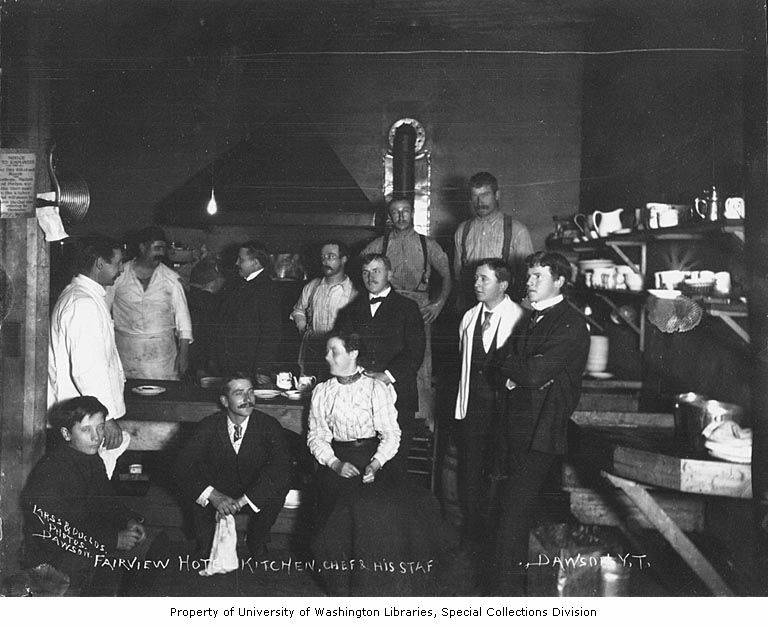
The archival photograph above shows the chef and staff of the Fairview Hotel in Dawson around 1900, arranged inside the working room rather than separated from it. The image cannot tell us how those people were paid or taught. It can tell us that the professional kitchen has always been collective, no matter how singularly its reputation is narrated.[8]
That is the clean boundary. Observation can be brief and unpaid because the visitor is watching. Education can be attached to a formal program with clear protections. An audition can be short, supervised, and limited to what assessment genuinely requires. But when a cook joins the roster, repeats production tasks, and helps send food that the restaurant sells, learning is happening inside work. It is not happening instead of work.
Fine dining should keep the stage's best promise: knowledge passed hand to hand in a live kitchen. It should discard the fiction that knowledge cancels wages. Put the hours, mentor, curriculum, feedback, and compensation on one page before the apron is folded. If a restaurant cannot write the syllabus, it is not offering a school. It is filling a shift.
Sources
- Jocelyn Noveck, “Out of the frying pan? Noma's René Redzepi resigns, and fine dining confronts ‘brigade’ culture,” Associated Press (March 2026) — current reporting on Noma, unpaid interns, hierarchy, and the industry's workplace reckoning.
- Ashwin Segkar, “‘Begging to Work There for Free’: Fine Dining Wouldn't Exist Without Unpaid Labour,” Vice (January 20, 2023) — interviews on the stage's educational appeal, financial burden, and role in elite-kitchen career mobility.
- Bettina Makalintal, “The Pros and Cons of Staging in a Restaurant,” Eater (November 7, 2019) — reported accounts of training value, culinary-school links, harassment, repetitive work, and unequal access.
- U.S. Department of Labor, “Luxury inn on Lummi Island reaches settlement with US Labor Department to pay workers $149K in back pay for overtime, minimum wage violations” (June 26, 2017) — primary enforcement record detailing the Willows Inn stage program, tasks, workers, and settlement.
- U.S. Department of Labor, Wage and Hour Division, “Fact Sheet #71: Internship Programs Under the Fair Labor Standards Act” — official seven-factor primary-beneficiary framework for interns at for-profit employers.
- UK Government, “Minimum wage: work experience and internships” — official guidance on worker status, work shadowing, course-linked placements, and why labels do not determine minimum-wage entitlement.
- National Restaurant Association, “Build Your Workforce With an Apprenticeship Program” (November 16, 2023) — restaurant-industry account of registered paid apprenticeship, structured learning, mentorship, credentials, and wage progression.
- Wikimedia Commons, “Chef and his staff at the Fairview Hotel kitchen, Dawson, Yukon Territory, between 1895 and 1905” — Larss & Duclos Studio archival photograph from the University of Washington Special Collections, used as the article image.