The most consequential choice at Blue by Eric Ripert arrives before the first red prawn or slice of shima-aji: how much of the cellar do you want to let into dinner?
Blue's published 2026 menu prices its five-course seafood sequence at KYD 240. The standard wine pairing is KYD 145. The sommelier selection is KYD 295—more than the food itself.[1][7] Then the restaurant adds a 20 percent gratuity and charges in US dollars at its stated rate of USD 1.25 to KYD 1.[1] That turns one menu into three very different purchases: USD 360 for food, USD 577.50 with the standard pairing, or USD 802.50 with the sommelier tier, using only the charges disclosed on the menu.
None of those numbers makes Blue a bargain. Value here means something narrower and more useful: paying for the version of the restaurant you actually came to experience. For a first visit, the five-course menu is the cleanest full-dinner buy. It preserves choice, shows the kitchen's seafood grammar, and leaves room to decide whether wine should support the meal or become its largest variable.
There is one timing boundary to state clearly. The Ritz-Carlton currently lists Blue as seasonally closed, reopening in early November.[3] The restaurant's live menu and its downloadable Menu 2026 agree on the five-course price and pairing tiers; the live page supplies the current dish list, while the PDF supplies the published gratuity and exchange-rate terms.[1][7] A local menu listing updated in March 2026 independently reflects the same core pricing.[6] Anyone booking the next season should confirm that the dishes, prices and seasonal offers have carried over.
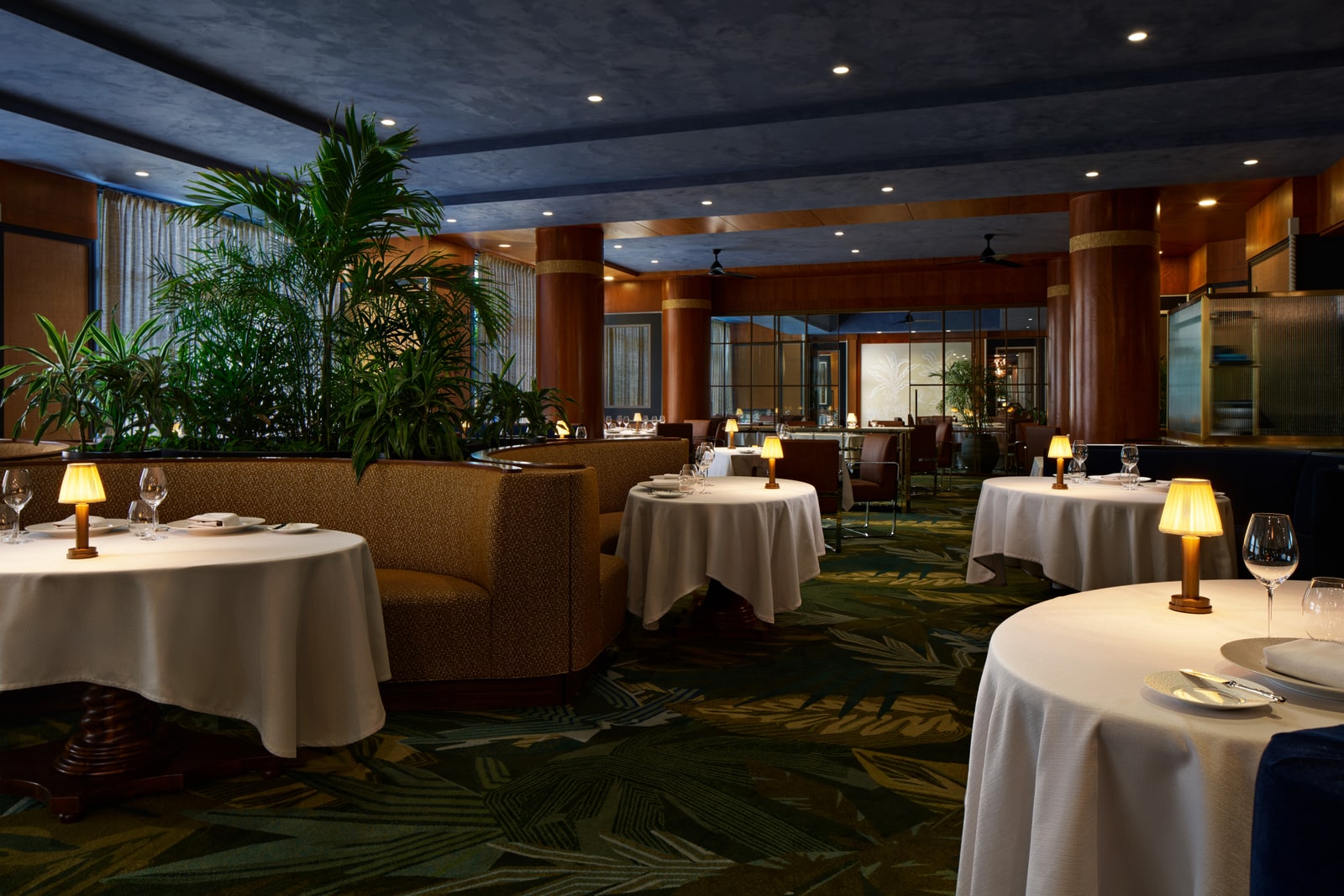
Image context: the cover is Blue's current photograph of the redesigned Grand Cayman dining room. Its low-lit blue, wood and botanical formality matters because much of the bill pays for a resort-night ritual—room, pacing, cellar and service—as well as seafood.[8]
The first KYD 50 buys two courses
The live menu prices the five-course Blue menu at KYD 240, the fixed seven-course Eric Ripert menu at KYD 290, and a separate seven-course vegetarian menu at KYD 190.[7] It also advertises a four-course, Wednesday-and-Thursday Blue Discovery offer at KYD 190, although the Ritz's seasonal-closure notice makes that promotion one to verify rather than plan around.[3][7] For the two principal seafood tastings, the striking number is not the top one; it is the gap. Two additional courses on the signature route cost only KYD 50, or USD 75 after the listed gratuity and exchange rate.[1]
That modest step-up reveals where the bill really stretches. Moving from the standard to the sommelier pairing on the five-course menu adds KYD 150 before gratuity. On the restaurant's published arithmetic, that is USD 225 at settlement—three times the all-in cost of moving from five courses to seven.[1]
This is not proof of Blue's profit margin; the restaurant does not publish wine acquisition costs, pour sizes, staffing allocation or spoilage. It is a map of the guest's bill. The food ladder is compressed. The wine ladder is expansive. A diner who studies only the menu price misses the decision that can more than double it.
The automatic gratuity matters for the same reason. It is easy to mentally treat KYD 240 as the dinner price, then discover that the menu alone settles at KYD 288, charged as USD 360. Blue is unusually explicit about that conversion, which makes the restaurant easier to evaluate before a reservation rather than harder.[1]
Five courses are a real reading of the kitchen
The shorter menu does not read like an abbreviated greatest-hits sampler. It gives the guest a choice at each stage. The first course moves between cured red prawn tartare with zucchini, aji amarillo and caviar, and shima-aji sashimi with cucumber-daikon, avocado and Asian vinaigrette. Then come choices between barbecued lobster with polenta gnocchi and seared scallop with hummus; swordfish with corn, chalaquita and green harissa and dorade with potato, chorizo and clams; hiramasa with beetroot and smoked-fish demi-glace and snapper with red prawns in a curry-coconut sauce. Chocolate and blackberry form the final fork.[7]
That structure buys agency. One diner can build a bright, saline route through sashimi, lobster, dorade and snapper. Another can choose the more roasted, earthy path through prawns, scallop, swordfish and hiramasa. The alternatives are not merely different proteins. They change the evening's weight, temperature and sauce rhythm.
They also show why Blue cannot be understood as Le Bernardin transported intact to a hotel. Eric Ripert's official page gives fish the starring role and describes the cuisine as locally caught or responsibly fished seafood with a Caribbean touch.[2] The live menu's identity is more global than any single island shorthand: aji amarillo, chalaquita, green harissa and curry-coconut prawn sauce sit beside bouillabaisse and smoked-fish demi-glace.[7] The Cayman setting is a platform for those warm-climate accents, not a claim that every plate belongs to one regional canon.
The provenance boundary is worth keeping honest. The 2026 menu says the Ritz-Carlton supports local farmers and fishermen and supports Cayman Sea Sense by buying seafood only from sustainable sources, but it does not assign an origin to every fish on every plate.[1] "Island-minded" is supportable. "Everything is local" is not.
Blue is also in a genuine second act. Regional reporting documented the restaurant's relaunch and the 2025 arrival of Michele Tenzone as chef de cuisine, after a career crossing Italy, Luxembourg and China before Grand Cayman.[3][4] Tenzone said he intended to bring a Southern Italian touch and the flavors of his hometown into the dishes; Blue's current site now calls him executive chef, while the Ritz-Carlton and Forbes Travel Guide profiles likewise place him at the head of the kitchen.[3][4][5][8] The five-course menu is therefore the useful route for seeing how Ripert's fish-first discipline now bends around a different chef and an island address.
Seven courses buy authorship, not just quantity
The Eric Ripert menu removes choice and tightens the house signature. Its seven courses run from the familiar tuna-foie gras construction through langoustine, barely cooked salmon, turbot with caviar, halibut, and two desserts.[1][7] Forbes Travel Guide specifically identifies the thinly pounded tuna over foie gras and baguette as a bridge to Ripert's New York flagship.[5]
At KYD 290, this is the stronger buy for a diner whose purpose is authorship: the canonical tuna dish, a fixed progression, multiple luxury fish, and a sequence that asks to be read as one statement. The additional KYD 50 is small relative to the base menu. What the guest gives up is control. There is no fork between prawn and shima-aji, lobster and scallop, or curry-coconut snapper and smoked-fish-glazed hiramasa.
That trade is why "two more courses" is the wrong shorthand. The five-course menu purchases dialogue; the seven-course menu purchases surrender. Neither is inherently better value. A first-time island visitor curious about Blue as a Cayman restaurant should favor the former. A Ripert devotee looking for the clearest line back to Le Bernardin should favor the latter.
The standard pairing is the coherent luxury
The five-course standard pairing is expensive at KYD 145, yet the live menu shows what it is trying to do. Pazo Barrantes Albariño or Zilliken Riesling meets the opening course. Domaine Ott Clos Mireille or a Clos Saint-Joseph white follows. Rosé Champagne sits beside swordfish or dorade; red Burgundy handles hiramasa or snapper; Pedro Ximénez or mature Rivesaltes closes dessert.[7] The sequence has a readable arc from salt and acid into texture, red-fruit structure and sweetness.
The KYD 295 sommelier tier is harder to judge from the public menu because the separate upgrade wines are not identified there. That does not make it poor value. Rare vintages, small allocations, mature bottles and more generous pours can justify a serious premium. It does mean the diner lacks the evidence to assume the upgrade is automatically better for this particular meal.[7]
The useful move is to ask before committing: Which bottles distinguish the sommelier tier tonight? Are the pours materially different, or is the value mainly rarity? Does the route follow the published dish choices? If those answers excite you, the tier may be exactly the point of the night. If they do not, the standard pairing already gives the menu a complete wine narrative.
There is a quieter option. Blue's current by-the-glass list puts several whites between KYD 26 and KYD 60 and reds between KYD 45 and KYD 65.[1] Two deliberate glasses can therefore preserve conversation between plate and wine without buying five pours. For many diners, that is where value improves: not by refusing the cellar, but by giving it a smaller role.
The vegetarian menu makes the strongest counterargument
Blue's live seven-course vegetarian menu costs KYD 190, less than either principal seafood tasting. Its published plates include local farm tomato, fennel confit with seaweed caviar, eggplant with smoked ricotta, celeriac with summer truffle, chocolate and coconut. More unusually, the page prints a full non-alcoholic progression—green herbs, citrus, rooibos smoke and verjus; Mediterranean herbs, olive and quinine; tamarind and local pineapple; pear, plum and tea; then coffee, cacao, pandan and spice—for KYD 125.[7]
That gives a vegetarian or non-drinking diner something better than accommodation: an authored parallel meal. Applying the downloadable menu's listed gratuity and exchange rate, the current food price plus non-alcoholic pairing settles at KYD 378, or USD 472.50.[1][7] It is still luxury pricing, but the value is legible in the work. Each drink has its own ingredients and its own job against a course; none is described as a glass of juice standing in for wine.
For mixed parties, that menu also tests the restaurant's claim to be about more than prestige seafood. If tomato, fennel, eggplant and celeriac can carry a tasting sequence without imitating fish, then the kitchen's real asset is sequencing and sauce intelligence. On paper, this is Blue's most persuasive alternate route.
Supplements are where restraint earns its keep
Blue's published materials make escalation easy. The live page lists lamb or beef as a KYD 35 substitution or KYD 50 supplement.[7] The downloadable 2026 menu lists oysters at KYD 38 and a 30-gram caviar supplement at KYD 175.[1] Once gratuity and the published conversion are applied, that caviar alone becomes USD 262.50—nearly three quarters of the all-in five-course food price.
The lounge and bar provide a useful pressure release when they reopen. The downloadable 2026 menu lists salmon rillette and halibut arancino at KYD 32, a snapper tostada at KYD 38, and lobster fettuccine at KYD 48, available only in that area.[1] Eric Ripert's official page also presents the bar as an à-la-carte way into the restaurant.[2] For someone who wants to test the room and kitchen rather than stage a destination dinner, that is the actual entry price.
For a full evening, however, piecing together luxury signals is the fastest way to make value disappear. Caviar, a tableside signature cocktail, the sommelier pairing and a substitution can turn a focused seafood progression into a bill assembled from premiums. Blue's five-course menu can already include caviar when the Gambero Rosso route is chosen, alongside lobster or scallop, multiple fish, dessert, and the service architecture of a Forbes Five-Star dining room.[5][7] It does not need rescuing by supplements.
The verdict
Blue's five-course menu is the best first purchase because it keeps the restaurant's central tension alive: Le Bernardin precision versus Caribbean warmth, fixed luxury versus guest choice, resort formality versus fish that should still taste like fish. At KYD 240, it is expensive but coherent. The seven-course signature menu is a rational KYD 50 upgrade for Ripert loyalists. The vegetarian sequence is the sharpest alternate expression.
The pairing decision deserves more skepticism than the course decision. Choose the standard flight when a complete wine arc is part of the occasion. Choose two glasses when food is the priority. Choose the sommelier tier only after learning what the extra KYD 150 actually puts in the glass.
When Blue reopens, the room will still encourage escalation: one more course, a rarer bottle, a spoonful of caviar. The smartest luxury move is to know which part of the evening you came to buy—and let everything else remain beautifully optional.
Sources
- The Ritz-Carlton, Blue by Eric Ripert — Menu 2026 — downloadable tasting-menu and pairing prices, lounge menu, sustainability statement, gratuity and exchange-rate terms.
- Eric Ripert, "Blue by Eric Ripert" — official restaurant overview, fish-first philosophy, Caribbean framing and bar format.
- The Ritz-Carlton, Grand Cayman, "Dining" — current seasonal-closure notice, early-November reopening note and Michele Tenzone biography.
- Caitlin Sullivan, "Eric Ripert's Legendary Caribbean Eatery Has a New Chef de Cuisine," Caribbean Journal, February 11, 2025 — relaunch context, Tenzone appointment and Southern Italian direction.
- Forbes Travel Guide, "Blue by Eric Ripert" — independent Five-Star profile, current chef, seafood focus and signature tuna-foie gras context.
- Cayman Good Taste, "Blue by Eric Ripert Dinner Menu" — local March 2026 menu snapshot and independent confirmation of the core price ladder, updated March 10, 2026.
- Blue by Eric Ripert, "Menu" — live official tasting-menu prices, current dishes, named standard wine pairings, vegetarian route and Blue Discovery offer.
- Blue by Eric Ripert, "About" — current dining-room photograph, redesigned-room context and Michele Tenzone's executive-chef role.