

The easiest way to flatten Geranium is to describe it as a vegetable-forward Nordic temple and stop there. That catches one visible fact, but it misses the restaurant's stronger move. Geranium does not simply remove meat and replace it with moral seriousness. It edits the whole dinner toward lift. The official site says the kitchen is "lucid, light and dynamic," and the location matters just as much as that sentence does: the restaurant sits on the eighth floor in Fælledparken, where the room looks into tree crowns, copper roofs, and the wind line toward Oeresund.[4] Height is not scenery here. Height is part of the palate.
That is why Geranium feels different from many high-end dining rooms that also talk about seasonality, biodynamic farms, or sensory immersion.[4][5] The restaurant's food may be local and the craft may be exact, but the larger editorial choice is atmospheric. The meal is designed to feel aerated before the first course lands. Window light, service calm, vegetal color, and a menu structure that refuses meat all work in the same direction.[4][5] The result is not abstinence. It is a particular kind of luxury, one that tries to rise instead of settling.
The World's 50 Best profile makes this easier to see because it connects the room, the menu, and the product choices in one frame.[5] Geranium's Universe menu runs for a minimum of three hours and about 20 courses, but it does not use length to produce heaviness.[5] In 2022, Rasmus Kofoed made the restaurant meat-free, concentrating on local seafood and vegetables from organic and biodynamic farms.[5] That shift matters less as a lifestyle headline than as a structural clarification. Geranium has spent years trying to make fine dining feel clearer, quieter, and more vertical. Removing meat reads as the logical tightening of that project rather than as a publicity stunt.
That is also why Video Collection is the right mode here. One clip can show Geranium's dining room. Another can show the discipline and internal pressure behind Kofoed's cooking. A third can reduce the whole philosophy to one finished plate. Watched together, the videos argue that Geranium's achievement lies in turning elevation into method: room, philosophy, and dish are all edited toward the same feeling of upward release.[1][2][3][4][5]
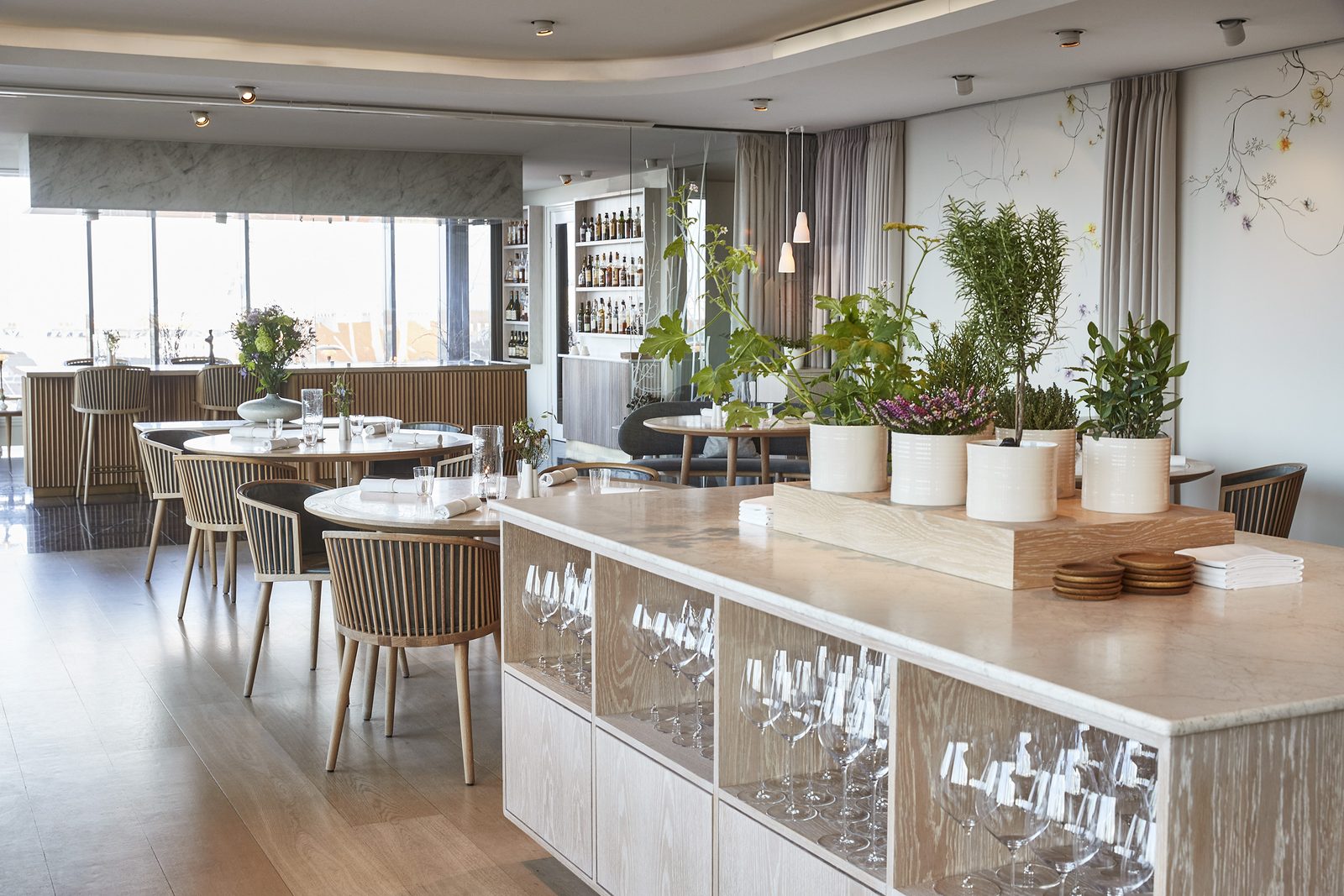
Image context: the lead image uses a real interior photograph from Geranium's official gallery. That choice fits the article because the dining room is not neutral packaging around the food. The pale wood, planted centerpieces, and broad window light are part of the restaurant's argument about how luxury can feel airy without becoming vague.[6]
Video 1: Søren Ledet's restaurant presentation shows that the room is doing real culinary work
The first useful Geranium video is not a dish clip but a house-introduction piece fronted by co-owner and wine director Søren Ørbek Ledet.[1] That matters because Geranium has always depended on more than cuisine alone. Ledet's presence helps define the restaurant's tone: warm, composed, and exact without stiffness. Before the food is analyzed, the house has already decided how tension should be managed.
That is important because Geranium's room is not just attractive; it is functional. The official welcome page's line about "Dinner in the canopy" is not branding fluff when you put it next to this video.[4] The restaurant is situated high above the park so the guest is suspended between city and landscape, between polished interior and seasonal movement outside.[4] The site even defines Geranium's vision through "the area of tension between the urbane and the natural."[4] In Ledet's video, that tension looks resolved rather than theatrical. The room feels softened, but never vague. It is calm enough to open the senses and controlled enough to keep the meal from drifting into wellness cliche.[1][4]
This is the first reason Geranium's no-meat structure works. Many vegetable-led tasting menus still feel heavy because the room around them remains coded as old luxury: velvet, darkness, prestige hush, or a tone of solemn deprivation. Geranium goes the other way. The light is bright, the textures are pale, and the hospitality is articulate rather than grand.[1][4][5] By the time the menu starts, the diner has already been taught how to read it. Lift, here, is not only flavor. It is a full-room setting.
Video 2: the MAD talk makes clear that Geranium's elegance is built on pressure, not softness
If the Ledet video explains the external atmosphere, the MAD film on Rasmus Kofoed explains why the food does not dissolve into prettiness.[2] The title itself, Passion & Prison, is revealing. Geranium's calm surface is supported by a harsher internal discipline: repetition, exactness, and a refusal to let the plate get lazy.
That pressure matters because Geranium can otherwise be misread as serene in an unearned way. Kofoed's food often photographs as delicate, even fragile. The risk of that visual language is that outsiders start to treat the restaurant as a place of effortless purity, as though clarity were simply the natural form of Scandinavian produce.[2][4][5] The MAD video blocks that mistake. Kofoed comes across there as someone using control to strip away drag. The menu is light because he works hard to remove the dead weight, not because lightness arrives by default.
This is where the 2022 meat-free turn becomes easier to interpret.[5] Geranium was not abandoning force when it removed meat. It was clarifying what kind of force it wanted. Kofoed's interest lies in tension without density, in intensity without the sluggish prestige signals that often accompany meat-centered luxury.[2][5] Seafood, vegetables, seeds, herbs, and fermentation fit that pursuit better because they let the kitchen build verticality through salinity, bitterness, smoke, acidity, and texture rather than through sheer mass. The cuisine rises because the discipline is compressive. Everything unnecessary gets cut before the dish reaches the table.
In that sense, Geranium's elegance is not softness at all. It is the visible result of an editing instinct severe enough to keep beauty under pressure. The room makes the meal feel weightless; the kitchen ensures it still lands.
Video 3: the hake dish proves that "light" at Geranium still has to eat like conviction
The third video is the most concrete test in the set: Rasmus Kofoed presents a hake dish at the 3 Michelin star restaurant Geranium.[3] House philosophy only matters if it can survive reduction to one plate. This clip is valuable because it forces Geranium's airy language into a bite-sized proof.
The important thing to notice is not just refinement. It is ranking. In a weaker luxury restaurant, a fish course can become an excuse for foam, flowers, and a polished story about purity. Geranium's hake dish reads differently because the plate is built to maintain line tension. The fish stays central. Garnish behaves like calibration rather than decoration. Texture and brightness sharpen the main ingredient instead of distracting from it.[3] "Light" here does not mean small or apologetic. It means nothing on the plate is allowed to slump.
That aligns exactly with the larger restaurant frame laid out by the written sources. Geranium's menu structure, its meat-free commitment, and its eighth-floor room all point toward a style of luxury that values transparency over abundance.[4][5] The hake video shows what that looks like in practice. Kofoed is not plating absence. He is plating concentration. The dish has enough restraint to feel airborne and enough conviction to keep from floating away.
This is where Geranium separates itself from restaurants that simply swap one prestige code for another. A meal cannot live forever on ideas like nature, biodynamics, or sensitivity. At some point it must become edible authority. The hake course does that work. It makes clear that Geranium's atmosphere is backed by culinary force, not by mood alone.[3][5]
What the collection reveals when watched together
Seen in sequence, these videos show that Geranium's real subject is not vegetables in isolation, nor Scandinavian produce as a virtue signal. Its subject is edited elevation. Ledet's presentation explains how the room places the diner between city and canopy, making openness feel like part of dinner rather than a view attached to dinner.[1][4] The MAD film shows the counterweight: Kofoed's elegance is driven by exacting pressure, not by soft-focus naturalism.[2] The hake video proves that this two-part system cashes out on the plate, where lightness still has to taste decisive.[3]
That is why Geranium remains such a strong fine-dining case study. Plenty of restaurants can be local. Plenty can be luxurious. Plenty can announce a meat-free or vegetable-heavy philosophy. Geranium's distinction is stricter. It coordinates architecture, service tone, menu structure, and plate design so completely that the whole meal seems to rise in one direction.[1][4][5] Height is part of the seasoning because the restaurant has made height into a method. What the guest finally tastes is not just produce from Denmark and Scandinavia. It is a carefully engineered feeling of lift.[4][5]
Sources
- wbpstarscom, "Søren Ørbek Ledet presents the 3 Michelin star restaurant Geranium," YouTube video.
- MAD, "Passion & Prison | Rasmus Kofoed, Head Chef and Co-Owner of Geranium," YouTube video.
- wbpstarscom, "Rasmus Kofoed presents a hake dish at the 3 Michelin star restaurant Geranium," YouTube video.
- Geranium, official welcome page — restaurant statement on a "lucid, light and dynamic" kitchen, the eighth-floor Fælledparken setting, and the tension between the urbane and the natural.
- The World's 50 Best Restaurants, "Best of the Best | Geranium" — profile on the eighth-floor dining room, the three-hour twenty-course Universe menu, and the 2022 meat-free shift toward seafood and vegetables.
- Geranium, official gallery page containing the interior photograph used as this article's lead image.