The easiest way to flatten Frantzén is to treat the pairings as one more three-star luxury accessory. That reading misses the more interesting mechanism. At Frantzén, the glass program is there to keep a long, multi-room evening from collapsing under its own richness.
The restaurant's current public framing already hints at that structure. The official site lists 23 seats, 3 floors, a fixed menu at SEK 5,500 per guest, and both alcoholic and non-alcoholic beverage pairings, with the same menu served at lunch and dinner.[1] Michelin's current listing adds the movement: ring the bell, start with an aperitif in the top-floor lounge while the day's ingredients are explained, then move into the dining room with counter seating, where service "works like clockwork."[2] Once you put those details together, the drinks stop looking optional. They read as part of the staircase.
That is why the current sommelier signal matters. In Michelin's June 17, 2025 Nordic Countries release, Andre Bekker of Frantzén received the region's Sommelier Award.[5] The point is not trophy collecting. The point is that Frantzén's beverage logic has become visible enough to be recognized as part of the restaurant's authorship.
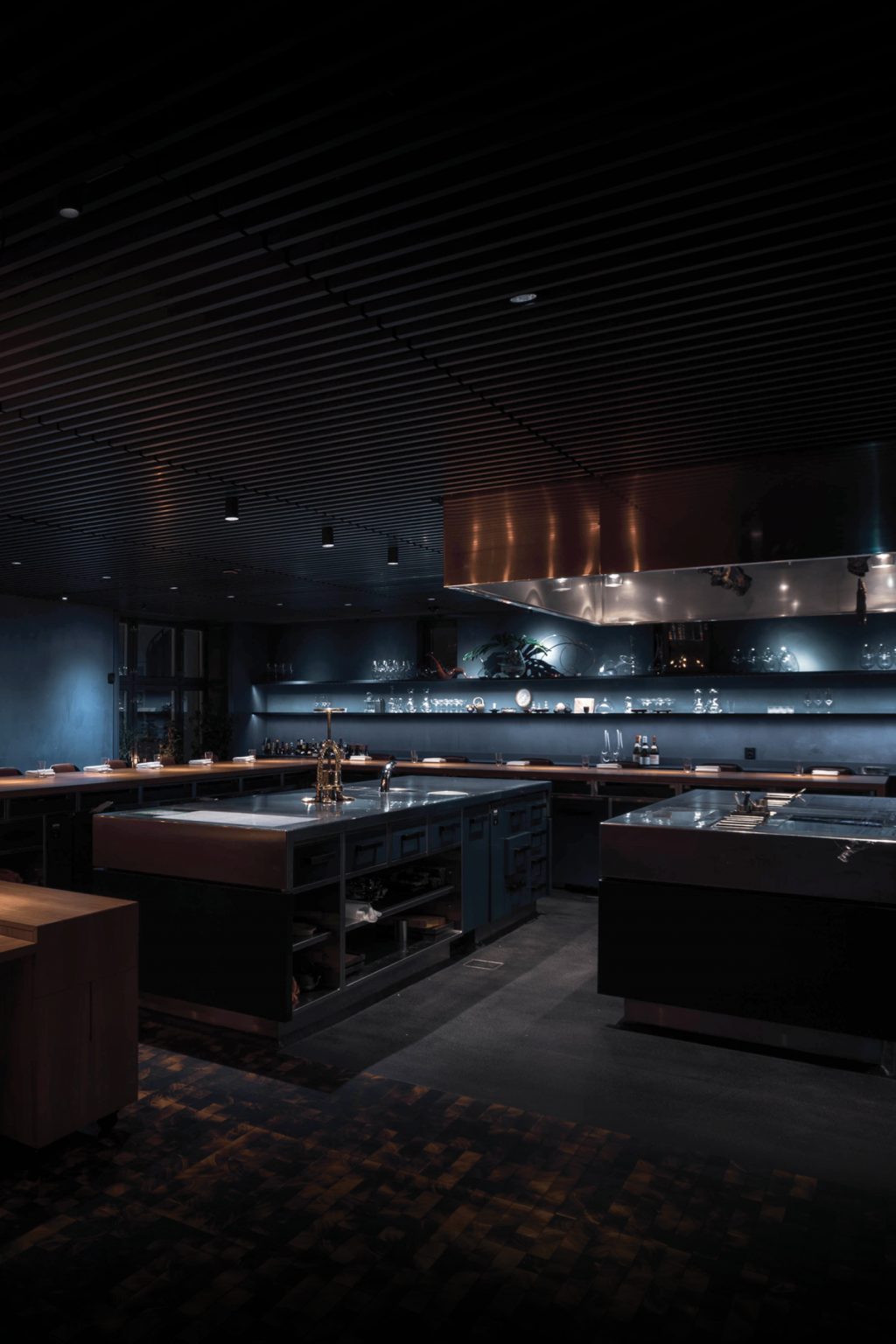
Image context: the lead image uses an official Frantzén room photograph because this article is really about pacing inside architecture. The glass matters here because the guest is moved from lounge to counter to later-room release, and the drinks have to carry that change without breaking the meal's line.[1]
1. Frantzén's pairings are built for movement before they are built for prestige
Michelin's current description of Frantzén is unusually useful because it frames the restaurant as an immersive sequence rather than a static counter room.[2] You do not simply sit down and start eating. You enter by bell, take an aperitif upstairs, hear about the ingredients, then settle into the counter-facing dining room as the chefs work in front of you.[2]
That matters because each room asks something different from the drink in your hand. A lounge aperitif can wake the palate and loosen the guest into the evening. A counter-side pairing has a harder task: it must sharpen focus while dishes arrive in close succession, at close visual range, under the heat and pressure of the kitchen. Later in the meal, the program has to widen again so the whole night feels complete rather than mechanically technical.[1][2][3]
Frantzén's beverage intelligence starts there. The drinks are not simply matched to flavors. They are matched to phases of attention.
2. Andre Bekker's public description shows a very specific spine
The strongest written source for the actual pairing architecture is Andre Bekker's November 3, 2024 interview with Meiningers Sommelier.[4] It is specific enough to move the conversation beyond generic talk about a "great cellar." Bekker says roughly 70% of guests order one of the wine pairings, and he describes the sequence in practical terms: after Champagne in the lounge, the pairing almost always moves into Riesling, sometimes dry and often Kabinett, with an occasional Gruner Veltliner from Wachau. From there, the spine very often includes white Burgundy and red Burgundy, with American Pinot Noir appearing when the menu asks for it.[4]
That is a remarkably disciplined outline. It tells you Frantzén is not trying to impress by swerving wildly from region to region just because it can. The house is using an acidity-and-texture ladder. Champagne lifts the opening. Riesling gives line and tension. Burgundy provides both white precision and red depth without turning the meal thick or blunt.[3][4]
This also helps explain why Bekker says "Champagne and Burgundy" sit clearly at the top of guest demand in Stockholm and on the Frantzén list itself.[4] Those categories are not only fashionable. In Frantzén's format, they are structurally useful.
3. The smartest pairings at Frantzén solve dishes, not status anxiety
Bekker's interview becomes even more interesting when he stops talking in categories and starts talking about problem dishes.[4] He identifies the onion-and-almond course as a signature that is genuinely difficult to pair, and says the best answer is Madeira. He also points to lobster with an intense aromatic sauce, where his preferred pairing is South African Chenin Blanc, specifically FMC from Ken Forrester.[4]
Those examples matter because they show what Frantzén's pairing program values. It is not prestige for its own sake, even in a room full of prestige ingredients. It is functional contrast. Madeira works because oxidative depth and savory sweetness can hold the onion course without drowning it. Chenin works because texture and aromatic lift can stand next to concentrated shellfish sauce while still keeping the palate alive.[4]
Michelin's own reading of the food lines up with this. The current listing describes a meal that can move from the "wisely restrained" hamachi with ponzu and wasabi to a hyper-detailed chawanmushi, all built on seafood and vegetables of the highest quality.[2] That kind of menu needs a drinks program capable of moving between purity and density without making either side feel clumsy.
Seen that way, Frantzén's beverage program is less about bottle flex than about load management.
4. Even the prestige cues are being used to keep the meal readable
Frantzén is still a luxury restaurant, and the wine program does not pretend otherwise. Bekker says the restaurant is a Krug Ambassadeur, and identifies Jacques Selosse Initial and Krug Grande Cuvée among the strongest sellers.[4] But even here, the point is not mere name-checking. Champagne at Frantzén is doing real work. It opens the evening upstairs, it sets a vertical tone before the guest reaches the counter, and it gives the house an elegant way to begin with precision instead of force.[2][4]
The older Michelin feature from May 28, 2018 still helps on this point because it describes the restaurant's wines as a "superb selection" where French wines, Burgundies in particular, are a strength.[3] Read together with Bekker's later interview, that older line looks less like magazine gloss and more like a durable house position.[3][4]
That durability is what makes Frantzén's pairings worth noticing in 2026. The restaurant has a three-floor choreography, a counter-dining core, luxurious ingredients, open fire, and enough technical intensity to overwhelm a weaker drinks program.[1][2][3] Instead, the pairings appear designed to keep the whole evening rising in one controlled arc.
How to read the pairings before you book
Book Frantzén's alcoholic pairing if what you want is the restaurant's clearest house reading: Champagne in the lounge, then a structured run through high-acid whites and Burgundy-centered depth, with occasional departures when a dish genuinely needs them.[4] Choose the non-alcoholic pairing if the architecture is what interests you more than the cellar. The official site's insistence on offering both lanes at the same level suggests the house understands pacing as a broader hospitality problem, not a wine-only problem.[1]
That is Frantzén's real beverage lesson. The pairings are not memorable because the cellar is expensive, though it plainly is. They are memorable because they hold together a restaurant that keeps changing rooms, temperatures, textures, and emotional registers. The glass program gives the guest one continuous line through the whole ascent.[1][2][4][5]
Sources
- Restaurant Frantzen official site, covering the current 23-seat, three-floor format, SEK 5,500 fixed menu, and alcoholic/non-alcoholic beverage pairings served with the same menu at lunch and dinner.
- MICHELIN Guide, "Frantzen" - current restaurant listing covering the bell-at-the-door arrival, aperitif in the top-floor lounge, counter dining room, and service that "works like clockwork."
- MICHELIN Guide, "Zooming in on Three Stars: Frantzen in Stockholm" (May 28, 2018) - feature covering the living-room aperitif, L-shaped counter, roughly ten-course tasting structure, and the house strength in French wines, especially Burgundy.
- Meiningers Sommelier, "Champagne und Burgund stehen ganz oben" (November 3, 2024) - interview with head sommelier Andre Bekker covering pairing uptake, the lounge-Champagne start, Riesling and Burgundy structure, signature dish pairings, and bestselling bottles.
- MICHELIN Guide Nordic Countries 2025 press release PDF (June 17, 2025), naming Andre Bekker of Frantzen as the year's Sommelier Award winner.