The easiest way to misread L'Arpege in 2026 is to treat its plant turn as a sudden capitulation to fashion. The headlines from 2025 made the switch sound abrupt: Alain Passard's Paris flagship had moved to a menu built around the plant world, extending a path that had already pushed red meat aside years earlier.[5] That account is true as news. It is incomplete as history.
Arpege makes more sense when the recent plant-based framing is placed inside a much longer house line. Passard's own official biography still begins with flame, slow-roasted meat, and the identity of a world-class rotisseur; it says Arpege became one of Paris's leading rotisseries and earned three Michelin stars in 1996 on that basis.[2] The garden came later, but it did not arrive as a rejection of craft. It arrived as a reassignment of craft.
That is why the current room still feels so singular. The official site continues to announce Passard's most famous proposition in one line: "I want to elevate the humble vegetable to a grand cru."[1] Read against the chef page, the kitchen-garden page, the live 2026 dinner menu, and Passard's own older reflections on seasonality, the line stops sounding like slogan copy. It starts sounding like the summary of a twenty-five-year transfer of prestige from roast to root, from protein hierarchy to harvest hierarchy.[1][2][3][4][6]
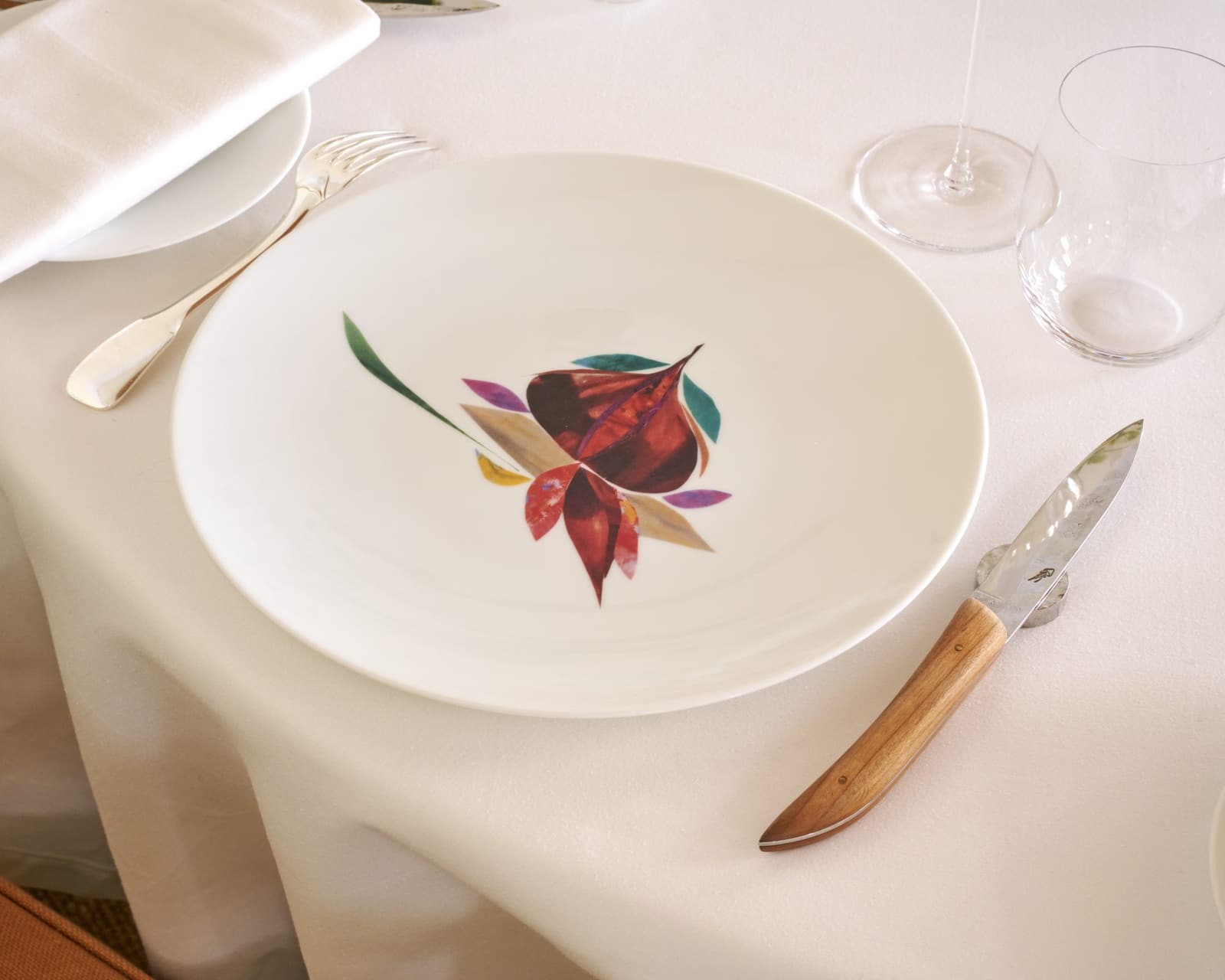
Image context: the lead image uses an official Arpege dining-room photograph because the article is about continuity under transformation. Passard's vegetable revolution did not leave behind the codes of a serious Paris restaurant; it rewired them from within.[1]
1. Arpege began with fire, and the fire never really left
The chef page is unusually clear about the house origin story.[2] Passard is described there as a cook attached to his stoves for almost 35 years, formed by a grandmother's transmission of flame, low-temperature roasting, and meat cookery. In that account, Arpege first becomes important as a rotisserie, not as a vegetable temple.[2]
That matters because too much writing on Arpege treats the vegetable turn as if it erased everything before it. It did not. The earlier school of fire still explains the later cooking. A great rotisseur learns timing by feel, heat by patience, and concentration by deciding how much force an ingredient can tolerate before it loses itself. Those judgments do not disappear when the ingredient changes from pigeon or lamb to beetroot, leek, onion, celeriac, or asparagus. They migrate.[2][4]
This is one reason Arpege never reads like generic wellness dining. The restaurant's vegetable authority was not built by stepping around classical discipline. It was built by dragging classical discipline into an area that French luxury dining had often treated as secondary. Passard's old education in roast and sauce gave him a way to make vegetables carry the pressure that meat once carried.
2. The garden was an awakening, but also a logistical decision
Passard's own biography describes the early 2000s as a creative rupture: he rediscovered the garden, realized he had not given fruits and vegetables enough room, and changed course so they could stand at the center of his cooking.[2] That is the psychological story. The operational story is just as important.
The official kitchen-gardens page says Arpege now relies on two 100% organic kitchen gardens, tended by nine gardeners under Sylvain Picard, with work guided by nature and aimed at disturbing it as little as possible.[3] The same page stresses a sustainable loop in which peelings, cuttings, and other natural waste return to the gardens after daily deliveries.[3] That language is practical, not mystical. It describes a supply chain and a rhythm of replenishment.
Passard's 2019 conversation with 50 Best shows that this garden logic had already become the base of the restaurant years ago.[6] There he speaks about multiple sites across France, everything harvested in the morning, and gardeners as the foundation of the kitchen itself.[6] The specific public framing has shifted over time, but the deeper point has stayed constant: Arpege does not use gardens as decorative provenance. It uses them as authorship.[3][6]
That is the real historical turn. Many luxury restaurants buy excellent produce. Arpege reorganized the prestige structure of the kitchen so the gardener moved closer to the center of the plate. Once that happened, seasonality stopped being an elegant restraint and became a governing force.
3. The 2026 dinner menu still speaks like a grand restaurant
The live March 2026 dinner menu is the clearest proof that Passard's plant world is not a retreat into austere purity.[4] The page heading calls the menu "CUISINE DE LA TERRE", warns that it may change depending on the gardeners' harvests, and prices it at 380EUR service included.[4] That is crucial. The restaurant is not presenting vegetables as a side project beside a hidden luxury core. The earthbound menu is the luxury core.
More important, the dishes themselves still move with the pacing and tonal variation of a major French tasting menu.[4] "Celadon kohlrabi & rainbow radishes" opens with precision and color; "Farewell to winter" turns leek and pear into a seasonal hinge; white asparagus arrives hay-smoked; celeriac returns twice, once as risotto and later with "five garden spices"; a spring-vegetable medley gathers snow peas, spring onions, and green peas into a burst of green release before dessert.[4] The language is lyrical, but the underlying structure is classical: tempo, sequence, contrast, concentration, and relief.
That is where the rotisserie memory is still visible. A lesser vegetable-forward room often mistakes moral seriousness for enough drama. Arpege still understands that a great menu needs heat, shadow, sweetness, smoke, fatigue, recovery, and an ending with perfume. The materials changed; the appetite for ceremony did not.
The official menu page and homepage reinforce the same reading. "Our menus are guided by the seasons," the site says, while also insisting that every ingredient comes with passport, provenance, and known experts behind it.[1] This is not anti-luxury language. It is luxury language rebuilt around traceability, harvest timing, and trust rather than around the old protein ladder alone.[1]
4. The 2025 plant-based headline matters because it confirms the long drift
The recent news still matters. Verdict reported in July 2025 that Passard had transformed Arpege's menu by eliminating almost all animal products, building on the chef's earlier decision to remove red meat in the early 2000s.[5] That is a real threshold, not a fake one. But the threshold feels intelligible only because Passard had spent decades teaching diners to accept vegetables as the emotional and technical center of a grand meal.
This is where the 50 Best interview from 2019 becomes especially useful.[6] Passard says there that nature writes the most beautiful cookbook, that produce should stay in season, and that kitchens should stop crossing seasons in the pan.[6] Read in 2019, the statement sounds like a manifesto for better seasonality. Read after the 2025 plant turn, it looks more like a doctrine reaching its logical end.
Even the shape of the current room supports that conclusion. The official site still presents Arpege as a three-star Paris destination open Monday to Friday for lunch and dinner, with a formal dining room full of mirrors, framed art, and white tablecloth calm.[1] Passard did not move the restaurant into a farm shed to make his point. He kept the codes of high French dining in place and then forced them to answer to the garden.
That is why Arpege still matters beyond Paris. Plenty of restaurants now build menus around plants. Fewer can show how classical luxury habits were slowly made to serve a different hierarchy of value. Passard's achievement is not that he discovered vegetables are beautiful. It is that he made a room trained on flame, meat, and prestige learn to read beauty through harvest, soil, and fleeting season instead.
Arpege's plant turn, then, should be read less as a break than as a culmination. The old rotisserie discipline is still there, only displaced into onion gratin, beetroot, asparagus, pear, celeriac, mushrooms, and herbs.[2][4] Fire still matters. Sauce judgment still matters. Timing still matters. What changed is the object that receives all that seriousness. That is a much harder and more durable revolution than a headline about going vegan can capture.[2][5][6]
Sources
- L'Arpege official homepage and menu section, covering the restaurant's current three-star framing, Passard's "humble vegetable" line, ingredient-provenance language, opening days, and the official dining-room image used here.
- L'Arpege, "Alain Passard" - official chef biography covering Passard's rotisserie identity, the restaurant's three Michelin stars in 1996, and the early-2000s awakening that moved vegetables to the center of the cuisine.
- L'Arpege, "Kitchen gardens" - official page covering the two 100% organic kitchen gardens, Sylvain Picard's team of nine gardeners, seasonal production, and the compost-and-delivery loop that links the restaurant to the gardens.
- L'Arpege, "Dinner menu" PDF (March 2026) - current menu document covering the live "Cuisine de la terre" framing, harvest-dependent warning, dish sequence, and the 380EUR dinner price.
- Verdict Food Service, "Alain Passard's Arpege restaurant embraces plant-based menu" (July 28, 2025) - report on the restaurant's near-total move away from animal products and its continuity with Passard's earlier withdrawal from red meat.
- The World's 50 Best Restaurants, "Alain Passard on winning the Chefs' Choice Award 2019 and what it means to listen to the songbook of the seasons" - interview covering Passard's farm-and-garden infrastructure, morning harvest logic, and his season-first philosophy.