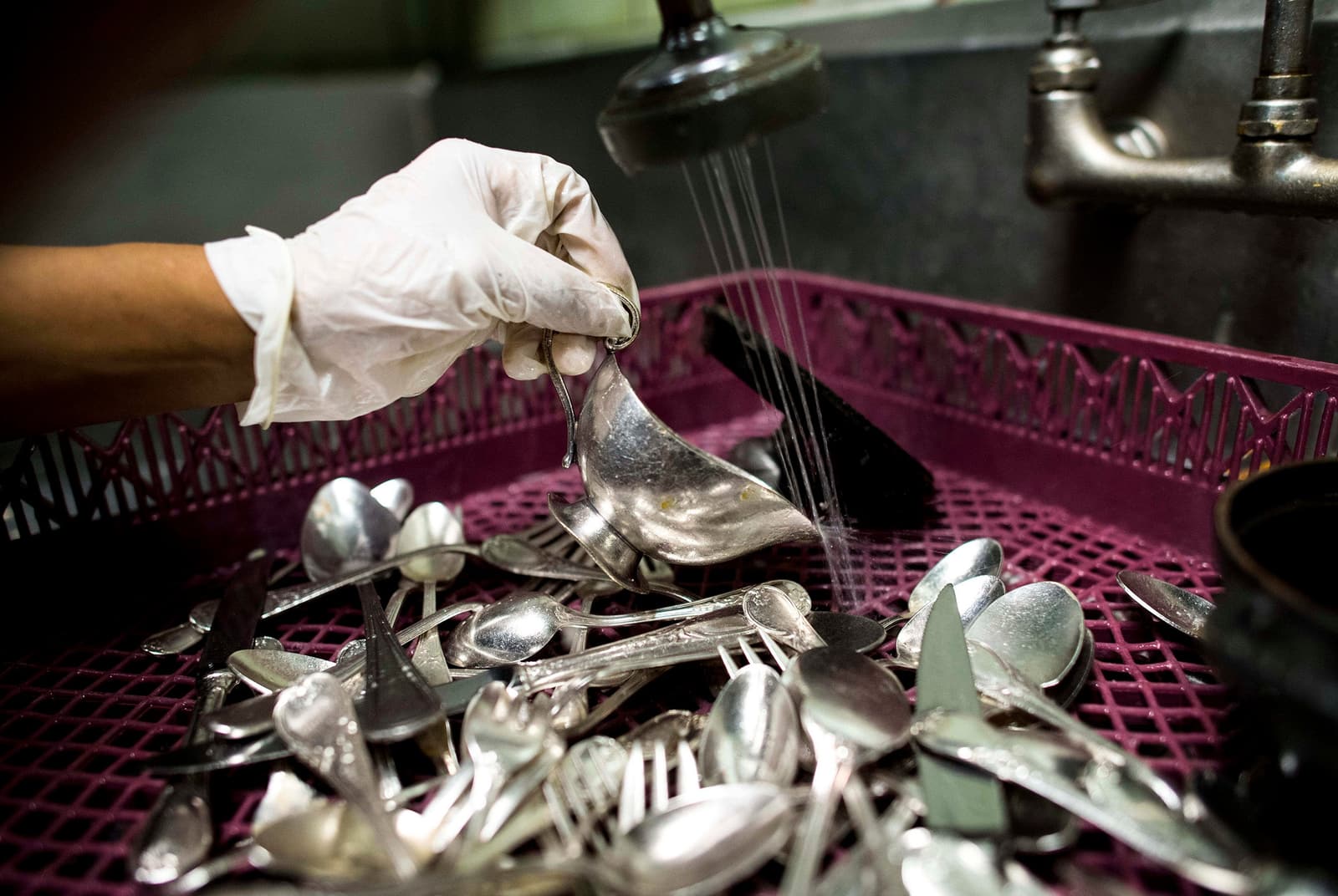
At Daniel in Manhattan, a gloved hand lifts a silver sauce boat beneath a hard stream of water. Spoons and forks flash in a magenta rack; a second gravy boat waits upside down. Nothing in Melina Mara's photograph resembles the composed calm of the dining room, yet every object in the frame belongs to that calm.[1]
Fine dining has two passes. At the famous one, cooks inspect a finished plate, wipe the rim and release it to the floor. At the other, less photographed pass, the plate returns carrying sauce, crumbs, lipstick, candle wax or the stubborn architecture of a garnish. It is scraped, sorted, washed, sanitized, dried, checked and sent back into circulation.
The first pass makes a plate ready for a guest. The second makes the restaurant ready for its next course. Treat the dish pit as an aftermath and a tasting menu eventually runs out of the very objects that make it possible.
The return line is part of service
A reported shift at Caracol, Hugo Ortega's 250-seat Houston restaurant, makes the geography vivid. An L-shaped counter accepted dining-room wares on one side and kitchen equipment on the other. Workers rinsed and sorted, sent racks through a conveyor machine, sorted again on the clean side, and returned objects to the stations that needed them. On the observed night, 77 reservations were on the books and three people worked the pit instead of the usual four.[1]
That description turns “washing dishes” into a traffic system. Dirty objects arrive from two directions and in different rhythms. Prep bowls appear before the doors open. Pots arrive when a station changes tasks. A table sends back several settings at once. Glassware and silver may leave the clean side for another polishing step, while pans and plates have to find the correct kitchen shelf before a cook reaches for them.
The National Restaurant Association's job description catches this wider responsibility. It includes washing and sanitizing, but also handling wares to prevent damage, organizing and restocking them, maintaining the dish area, removing waste, addressing hazards and helping elsewhere when needed.[2] The verb that matters is restocking. A plate is not useful merely because it is clean. It must be clean, intact, in the right place and back before the next demand.
This is why a skilled porter seems to know the menu without cooking it. The worker learns which bowl disappears fastest, which tray belongs to pastry, which pan a sauce station cannot spare and which stack must never be allowed to lean. The knowledge is tactile and temporal: weight, shape, fragility, destination, urgency.
A tasting menu multiplies the journey
The guest experiences a tasting menu as a forward sequence. A porcelain cup arrives, then a shallow bowl, then a warm plate, perhaps a new fork, perhaps another glass. The dish pit experiences the same menu as return waves. Every new vessel creates a second appointment after the course has been cleared.
Unusual tableware makes those waves harder to absorb. In the Caracol account, white plates were easy to rinse and rack; ridged, snail-shaped guacamole bowls resisted both.[1] That small contrast exposes an operating truth. A chef can choose a vessel for drama, but its underside, depth, glaze, rim and ability to sit securely in a rack become somebody else's repeated hand movement. The menu's visual grammar has a reverse side.
Good dish-room mise en place begins before the machine. Servers scrape where the system expects them to scrape and group like objects rather than delivering unstable sculptures. Cooks do not bury a knife in cloudy water or abandon a pan without warning that it is hot. Daniel Boulud has been reported demonstrating to servers how to arrange dirty wares so porters receive a workable station, a useful reversal of the usual idea that mise en place belongs only to cooks.[1]
That cooperation is not courtesy added to operations. It is operations. The fastest machine in the building cannot fix a return line whose inputs arrive tangled, dangerous or impossible to identify.
Clean is a sequence, not a shine
Restaurant lighting is forgiving. Sanitation is not. The City of Minneapolis tells food businesses to treat washing, rinsing and sanitizing as distinct steps, to verify chemical concentration in low-temperature machines, and to verify that utensil surfaces in a high-temperature machine reach at least 160°F. The number refers to the ware's surface, not merely a glowing gauge or the water somewhere inside the machine.[3]
Drying has an order too. California's retail food code requires cleaned and sanitized utensils to air-dry or drain adequately before food contact; cloth polishing comes only after air-drying, with a clean, dry cloth.[4] In a polished dining room, it is tempting to think that a hand-buffed shine is the final proof of cleanliness. The code draws a cleaner line: sanitizing and drying establish the safe sequence; polishing may follow for appearance.
The distinction changes the shape of the room. The clean side needs enough landing space for racks to drain without being stacked wet. Fragile pieces need a route that avoids chipping. A rushed stack is not efficiency if moisture is trapped or a rim disappears beneath the plate above it. The second pass has its own pacing, and forcing it faster can simply move the delay—or the risk—downstream.
Steam is not atmosphere
Fine-dining prose loves heat when it belongs to coals, planchas and copper pans. In the dish pit, heat is a workplace condition. OSHA's restaurant clean-up guidance names burns and scalds, cuts, electrical hazards, chemicals, slips, and strains among the risks. It warns that steam can burn, that continuous-feed machines need guarding, that knives should not vanish into sinks, and that wet, repetitive work needs deliberate control of reach, load and footing.[6]
Those hazards converge in a few square meters. Water meets electricity. Broken glass hides among intact stems. A bus tub becomes heavier one plate at a time. Detergent, sanitizer and food residue share the air. The floor is wet precisely when the room is busiest.
A luxurious dining room cannot outsource its roughness to an unsafe corner. If the restaurant protects a handmade plate more carefully than the hands cleaning it, its idea of craft is upside down. A well-designed station makes dangerous objects conspicuous, keeps clean and dirty traffic from crossing, gives steam somewhere to go and allows the worker to stand close enough to the task without folding into it.
Water and time move rack by rack
The machine is also a utility decision hidden inside the menu. Current ENERGY STAR criteria set different water and idle-energy ceilings by machine type. For high-temperature models, the water limit is 0.86 gallons per rack for an undercounter machine, 0.89 for a stationary single-tank door machine, and 0.70 for a single-tank conveyor model. These are qualification limits, not a claim about every machine already installed in a restaurant.[5]
That boundary matters. “Commercial dishwasher” is not one scale of equipment, and the right rhythm for a small counter restaurant is not the rhythm for a hotel or a 250-seat room. What remains constant is that water, heat, chemistry, rack composition and labor meet in each cycle. A half-planned menu can waste all five.
The dish pit therefore reads service pressure early. A shortage of racks, a slow-draining vessel, a clogged spray path or a broken machine does not remain a cleaning problem for long. It becomes a missing sauté pan, an absent wine glass, a cold course waiting for its bowl. The return line is where an elegant sequence discovers whether it has enough physical memory to repeat.
Entry level should not mean minor
“Kitchen porter” is a broader title than it first sounds. The UK's National Careers Service describes work that can include food preparation, deliveries, storeroom organization, appliances, surfaces, floors and walls; it also describes progression toward junior-chef, management, bar or food-service roles.[7] The National Restaurant Association likewise places the dishwasher inside the culinary team rather than outside it.[2]
Restaurants like to tell ascent stories, and some are real. The 2017 report noted that Noma made longtime dishwasher Ali Sonko a partner, that The French Laundry's staff honored dishwasher Jaimie Portillo with a company award, and that cooks at several restaurants had advanced from the pit.[1] Those examples show possibility, not a dependable industry ladder. Respect cannot be postponed until a porter becomes a chef.
The more revealing test is how the role is treated tonight: whether it is staffed for the expected covers, included in communication, equipped safely, paid and credited as necessary work, and helped when the return wave crests. Promotion is one form of recognition. Designing a good present-tense job is another.
The clean plate is the hidden encore
At the end of a course, the guest sees subtraction. The server lifts the bowl; the table becomes white and quiet again. Behind the door, subtraction turns into sequence: scrape, sort, rinse, wash, sanitize, drain, inspect, return.
That sequence is fine dining stripped of its flattering light. It reveals whether the room's beauty can survive repetition, whether a chef's chosen objects actually work, whether safety extends to the least visible station and whether “team” still means something when the task is wet, hot and unglamorous.
The next perfect plate does not begin when tweezers touch the garnish. It begins when a dirty one reaches the other pass and somebody knows exactly what to do with it.
Sources
- Tom Sietsema, “Chefs say the pot washer can make or break a restaurant. So I signed up for a shift.” The Independent, August 15, 2017 — reported dish-pit workflow at Caracol, staffing, tableware handling, career paths, and Melina Mara's source photograph from Daniel.
- National Restaurant Association, “Restaurant Industry Job Descriptions” — dishwasher responsibilities covering sanitation, safe handling, restocking, workplace order, waste, and cross-team support.
- City of Minneapolis Health Department, “Food Contact Surfaces,” updated February 6, 2025 — wash-rinse-sanitize sequence, chemical testing, machine checks, and the 160°F utensil-surface verification point.
- California Legislative Information, Health and Safety Code § 114105 — official air-drying, adequate-draining, and post-drying polishing requirements.
- ENERGY STAR, “Commercial Dishwashers Key Product Criteria” — current qualification thresholds by machine type for idle energy and water consumption.
- U.S. Occupational Safety and Health Administration, “Young Worker Safety in Restaurants — Clean-up” — dish-room hazards and controls for heat, sharps, chemicals, wet floors, machinery, and repetitive handling.
- UK National Careers Service, “Kitchen Porter” — scope of the role, working conditions, entry routes, day-to-day duties, and career progression.