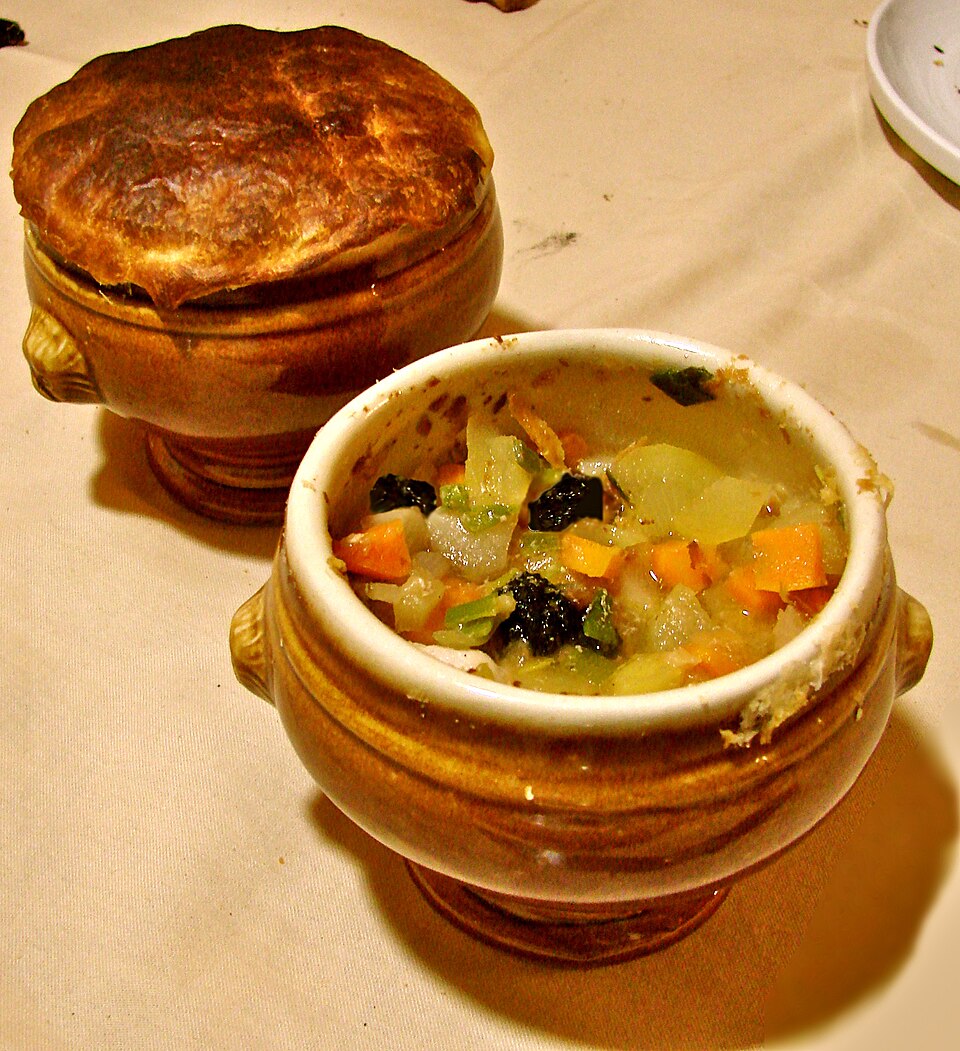
Paul Bocuse's Soupe aux truffes noires VGE is easy to misread as old luxury: truffle, foie gras, consomme, pastry, porcelain, Elysee Palace. The ingredients are expensive and the origin story is grand, but the dish's power is smaller and more exact than that. It is a bowl that asks the dining room to wait. The soup arrives sealed, not shown. The guest has to break the crust before the aroma is released. Spectacle is there, but it is trapped under a lid.
That restraint is why the soup still matters. Bocuse imagined it in 1975 for the meal connected to his Legion d'honneur ceremony with President Valery Giscard d'Estaing; the Grande Chancellerie de la Legion d'honneur describes the VGE soup as one of the chef's signature dishes from that moment.[1] Arts & Gastronomie's 50th-anniversary account gives the scene more color: a presidential lunch, a chef asked to make something exceptional, and a dish later bound to the initials of the president who honored him.[2] But if the story stopped at presidential proximity, the soup would be a souvenir. It became a fine-dining lesson because the bowl turns ceremony into technique.
The classic construction is almost architectural. Wikimedia Commons' file note for the photographed dish describes a portion built around fresh black truffle, foie gras, poached beef shoulder or chicken breast, Noilly Prat, double beef or poultry consomme, and a butter-cooked matignon of carrot, onion, celery, and mushroom.[5] Epicurious' kosher adaptation preserves the useful engineering even while omitting fresh foie gras: broth, finely diced vegetables, chicken, truffles, vermouth, and a puff-pastry disk sealed over an ovenproof bowl before baking.[3] The point is not merely richness. The point is enclosure.
The lid is the first course
A normal soup announces itself immediately. It steams, perfumes the table, shows its color, and tells the spoon what kind of meal has begun. VGE soup delays all of that. The puff pastry is not a garnish floating on top. It is a locked door. It browns in the oven, grips the rim, and makes the diner perform the opening move.
That one move changes the social rhythm of the dish. The server does not have to pour sauce from a height or carve something at the table. The guest completes the reveal. When the spoon cracks the pastry, the sealed aroma escapes upward: truffle first, then consomme, buttered vegetables, poultry or beef, and the quiet sweetness of cooked pastry. Fine dining often tries to create theater by adding action. Bocuse's soup creates theater by withholding action until the diner is ready.
This is also why the pastry has to remain disciplined. If it is too thick, the bowl becomes a bakery trick. If it is too thin, it collapses or fails to hold the perfume. If it browns without sealing, the central promise is broken. The crust must be edible, fragrant, and functional at once. It is part roof, part bread, part invitation.
The result is luxurious without behaving like a display case. You do not see shaved truffle scattered over a white plate. You do not see foie gras set apart as a trophy. The most valuable ingredients are submerged and perfuming the broth. Bocuse turns cost into atmosphere.
Why this is Bocuse, not just truffle soup
Bocuse's official biography emphasizes two training principles from Fernand Point: simplicity and total mastery of cooking methods.[4] VGE soup sits exactly at that crossing. It is simple in silhouette: a small bowl under pastry. It is not simple in execution. The consomme has to be clear and deep. The vegetables have to contribute sweetness without muddying the broth. The meat or poultry has to give substance without turning the bowl into stew. The truffle has to perfume, not bully. The pastry has to bake while the contents beneath it stay integrated.
That balance keeps the dish from becoming a caricature of French grandeur. It belongs to a chef often framed as both a guardian of tradition and a public face of modern French cooking.[1][4] The VGE soup does not reject old signals: consomme, foie gras, truffle, porcelain, pastry, presidential naming. Instead, it edits those signals into a single service object. The guest does not receive a parade of luxury. The guest receives a sealed bowl.
The restraint matters because truffle can easily become a blunt instrument. Modern restaurants sometimes use it as a table-side cloud: a server shaves until the dish looks expensive. Bocuse's soup takes the opposite route. The truffle's role is not only visual abundance but aromatic saturation inside a closed space. By the time the lid breaks, the perfume has done work that garnish alone cannot do.
A dish made from two memories
Arts & Gastronomie reports Bocuse's own explanation as inspiration rather than pure invention: a beef consomme with grated truffles tasted with an Ardeche truffle collector, and a truffle covered with pastry in the manner of a chicken pie served by Paul Haeberlin in Alsace.[2] That origin is more interesting than a clean eureka story. It makes the soup a translation machine.
From the country consomme, it takes depth, thrift logic, and the idea that truffle can transform broth rather than sit on top of it. From the pastry-covered truffle, it takes surprise, heat, and enclosure. From the Elysee setting, it takes occasion. From Bocuse's Lyonnais identity, it takes the confidence to let a generous bowl carry the whole argument.
The dish therefore feels ceremonial without being abstract. It is not a sculpture made only for a photograph. It asks for a spoon, a broken crust, and a broth that can stand up to its own legend. That is why the best way to understand it is not as a recipe for luxury, but as a recipe for pacing.
Seasonality keeps the icon alive
One danger with famous dishes is that they become museum pieces: always available, always photographed, gradually detached from the conditions that made them good. Arts & Gastronomie notes that Restaurant Paul Bocuse now serves the Elysee truffle soup only in the heart of truffle season, from early December to late February, framing that restriction as a quality choice rather than a retreat from the classic.[2] That matters. A dish built on perfume is only as strong as the ingredient that perfumes it.
The seasonal boundary also makes the soup feel less like nostalgia. It reminds diners that the icon still depends on supply, timing, and judgment. The pastry lid can hide the soup for a minute, but it cannot hide weak truffle. The ceremonial name can bring people to the table, but it cannot season the consomme.
In that sense, the soup is stricter than its reputation. It does not simply say: here are expensive things. It says: here is how expensive things should behave when they are made to serve one idea. The foie gras enriches. The consomme carries. The vegetable dice give a low, sweet base. The Noilly Prat cuts through with aromatic lift. The pastry traps and then releases. Each element is subordinate to the moment when the lid breaks.
The quiet version of table theater
Many iconic fine-dining dishes are remembered because they move: a duck press turns, a sauce is poured, a cloche is lifted, a cart arrives. VGE soup is quieter. Its drama is not in the server's flourish but in the bowl's built-in suspense. The guest is made aware that something has been held back.
That is the lesson worth keeping from Bocuse's dish in 2026. Fine dining does not need every gesture to be louder. A better gesture can be smaller, clearer, and more consequential. The pastry lid is useful because it changes aroma, temperature, texture, and timing. It is beautiful because it solves a problem.
The soup's political origin gives it a story, but the service design gives it durability. The initials VGE attach the bowl to a president; the sealed crust attaches it to a dining-room experience that can be repeated. Break the lid and the dish becomes present tense again. For a few seconds, the table is not thinking about awards, star histories, or culinary mythology. It is thinking about the smell rising from the bowl.
That is Bocuse's neatest trick here. He built a monument that has to be broken before it can work.
Sources
- Archives de la grande chancellerie de la Legion d'honneur, "Paul Bocuse" - official profile covering Bocuse's decorations, Michelin-starred career, 1975 VGE soup, Bocuse d'Or, and wider gastronomic legacy.
- Arts & Gastronomie, "La soupe aux truffes noires Elysee a 50 ans !" - 2025 anniversary feature on the 25 February 1975 Elysee origin, Bocuse's inspirations, ingredients, and current seasonal service window.
- Epicurious, "Black Truffle Soup Elysee" - recipe adaptation preserving the pastry-sealed bowl method, broth base, vegetable dice, truffle, vermouth, and baking sequence.
- Restaurant Paul Bocuse, "Paul Bocuse" - official biography covering Bocuse's Lyon roots, training under Eugenie Brazier and Fernand Point, Michelin history, nouvelle cuisine role, and cooking principles.
- Wikimedia Commons, "File:Soupe aux truffes noires VGE.jpg" - real 2013 photograph by Classiccardinal of Soupe aux truffes noires VGE, with file notes on composition, creation date, and licensing.