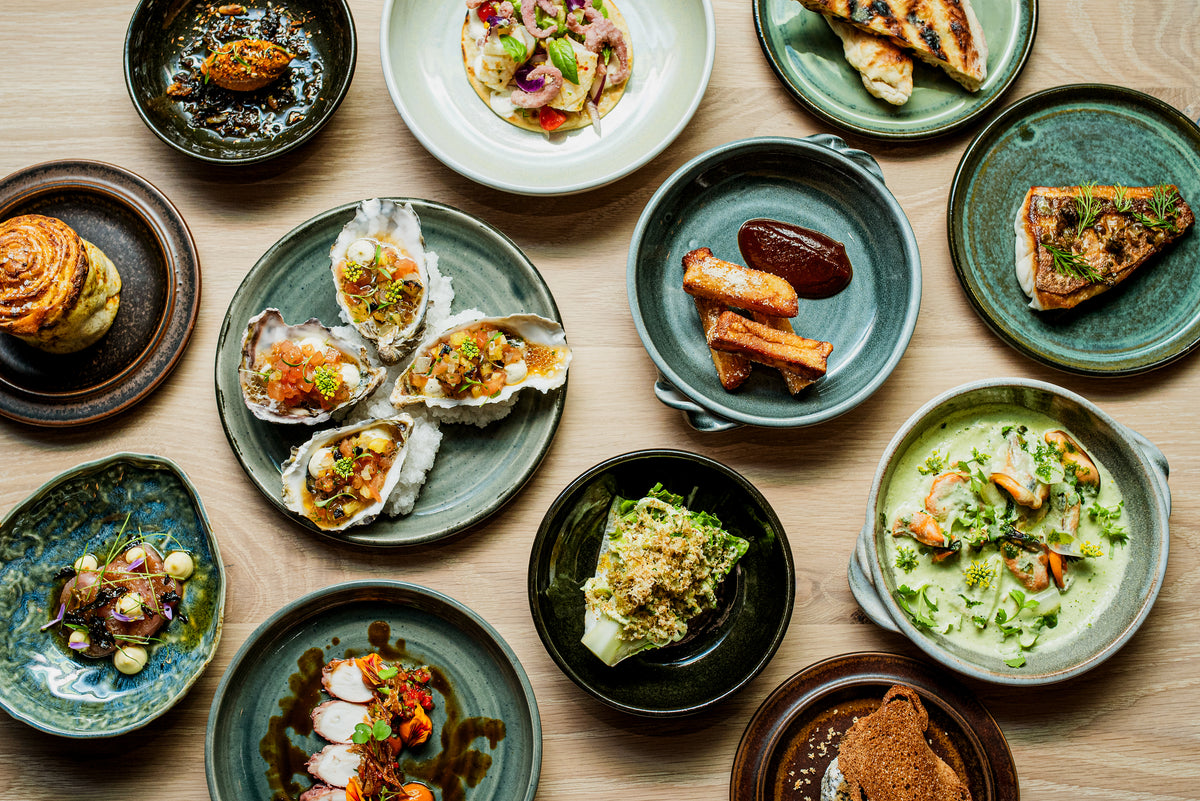
In Galjoen's official table photograph, pleasure arrives as a crowd. Oysters glisten in rough shells. A charred fillet sits skin-side up. Bread coils inside a dark dish, and a green shellfish pot looks built for dipping. The plates do not match, but their sea-glass blues and iron greys make the spread feel as if it washed in with the tide.
One fish is missing. It is the fish above the door.
The galjoen is South Africa's national fish and a legal no-sale species. A commercial restaurant cannot buy it, and a recreational fisher cannot sell a permitted catch.[3] Cape Town's Galjoen therefore named itself after the one local fish its kitchen must refuse. That paradox is more than a clever conversation starter. It contains the restaurant's whole operating idea: the coast is not an unlimited luxury pantry, and a serious seafood menu begins with the word no.
Owners Anouchka Horn and Neil Swart, with head chef Isca Stoltz, have turned that refusal into a compact restaurant rather than an ethics lecture. There is no imported salmon or prawn to stabilize the menu when local boats land something less familiar. There is no à la carte escape route if the day's sequence asks a diner to trust snoek, mussels, line fish, sea vegetables, smoke, curry, bread and vinegar. The achievement is not restriction for its own sake. It is making restriction taste generous.
Image context: the cover is a real photograph supplied on Galjoen's official site, not a reconstruction of one current menu. Its abundance matters precisely because the restaurant's species and preparations can change with the catch.[1]
The sign is a stop sign
The namesake is unusually exact. WWF-SASSI identifies Dichistius capensis as a near-threatened national fish found along southern Africa's coast and classifies it as recreational no sale: buying or selling it anywhere in South Africa is illegal.[3] Galjoen the restaurant did not merely decide that the fish was unfashionable or too scarce for one season. It built a permanent prohibition into its identity.
When the restaurant opened in 2023, Swart explained that the name was intended to raise awareness and start a conversation about seafood sustainability.[2] That can sound like tidy launch copy until the consequence is considered. Most restaurant names promise possession: the house of beef, the oyster room, the lobster grill. Galjoen promises attention to a creature by keeping it off the plate.
The distinction protects the idea from sentimentality. A national symbol is not automatically dinner, and local pride does not overrule a damaged stock or a no-sale rule. The sign makes that boundary visible before service begins. It also sets a standard against which the rest of the restaurant can be judged. The name alone certifies nothing about another fish. Every alternative catch still has to earn its place.
The boat edits the menu
Galjoen's current statement is wonderfully blunt: it serves only seafood that is responsibly caught locally, and if it is not from South Africa, it does not go on the menu.[1] The opening account shows what that meant in practice. Farmed mussels came from Saldanha Bay, while ABALOBI and Greenfish supplied fish caught largely by self-employed artisanal fishers; the number and composition of courses changed with the weather and the boats.[2]
This reverses the usual luxury transaction. In a conventional seafood room, the chef writes a dish and procurement is expected to make the named species appear. Here, the landing writes first. Size, fat, texture and volume arrive as variables. The kitchen has to decide whether a particular fish wants coals, batter, curry, curing or a slower use of its trim. Consistency has to live in judgment and seasoning rather than in ordering the same fillet forever.
Traceability can make that flexibility legible instead of vague. ABALOBI's Fish With A Story system lets a diner scan a tag and see who caught a fish, what it is, where it was landed and how it was caught.[5] The sources establish Galjoen's relationship with that supply network at launch, not a public ledger for every plate served today.[2] That boundary matters. “Local” and “sustainable” are not synonyms, and even a short journey says nothing by itself about stock health or fishing method. The meaningful questions remain species, origin, gear, fisher and date.
For the diner, uncertainty becomes part of the pleasure. You are not surrendering to a chef's whim so much as accepting the coast's edit. The menu can keep its promise only by giving up the fantasy that every desirable species should be available on demand.
Isca Stoltz cooks memories, not a catalogue
Stoltz gives the constraint an appetite. Galjoen's official profile describes her belief in using South African produce first, knowing small suppliers by name and finding a use for every part of an ingredient.[1] At the restaurant's opening, she traced her seafood instincts to childhood holidays in Mozambique: shellfish gathered along the shore and fish bought fresh from the market.[2] That memory does not function as a fixed recipe. It supplies a way of recognizing freshness, conviviality and the taste of eating near water.
The recurring dishes reported around the restaurant show how she makes variable catch feel familiar. In 2026, The Infatuation found line fish folded into viskerrie, a Cape Malay fish curry fragrant with turmeric, cumin and coriander; mussels and confit tuna belly turned bread service into a course; seasonal snoek became an unusually polished pâté.[6] A separate winter review found roosterbrood with a mussel pot, then a choice of battered or grilled hake framed as vis, chips en slaai—fish, chips and salad—before a warm tipsy-tart ending.[4]
These are snapshots, not a checklist for a future booking. Their value lies in the repeated grammar. Curry, bread, snoek, coals, batter, salt and vinegar give an unfamiliar landing a recognizable social life. Refinement does not mean disguising the fish beneath imported luxury markers. It means controlling smoke, crispness, acid and sauce closely enough that a changing species can enter a dish with deep local memory and still feel complete.
That is why the restaurant's refusal of imported seafood does not read as austerity. The kitchen replaces the security of a famous species with the security of a familiar form. A diner may not know which line fish is coming, but understands the invitation contained in hot bread and mussel liquor, or in a crisp piece of fish sharpened by vinegar.
One clock for a volatile catch
The dining room reinforces the same logic. Galjoen is an intimate room of about 30 seats, with an open kitchen, semi-industrial surfaces and a wall of small-production wines.[4] Its official booking page currently gives lunch and dinner fixed start times—12:30 and 18:45—and the set menu moves the room together.[1] Arrive late and this is not the sort of sequence that can simply begin again at course one.
That synchronized sitting is an operational choice with culinary consequences. A small kitchen working through one sequence can portion a finite landing across the room, coordinate a coal fire and bring every table to a fragile piece of fish at the same point. It can also make whole-ingredient use easier to plan. None of that guarantees low waste, but it gives Stoltz's stated opposition to waste a practical service shape.[1]
The trade is real. Diners give up choice, timing flexibility and the expectation that a favorite dish will return. The restaurant owes them something in exchange: pacing warm enough not to feel like a production line, servers able to explain an uncommon species without reciting a sermon, and a sequence generous enough that ethics never becomes a request to admire deprivation.
The room helps. Its nautical references are playful rather than themed: woodwork recalls a hull, a central light fitting evokes rod and line, and ceramic fixtures borrow the form of buoys.[2] In recent reporting, daylight, plants, brick and the open kitchen keep the semi-industrial space relaxed.[4] The effect is not a shrine to threatened fish. It is a lively urban dining room that lets the sourcing rule stay present without putting it in neon.
Sustainability has to survive the next delivery
Galjoen is strongest when its claim is treated as a method, not a halo. Refusing imports is easy to understand, but geography alone cannot settle whether a catch is responsible. WWF-SASSI's entry for the restaurant's namesake demonstrates why species-level rules matter; ABALOBI's model demonstrates why origin and method should travel with the fish.[3][5]
The restaurant's public materials make its boundary unusually falsifiable. A Norwegian salmon on the menu would plainly violate it. Serving the national fish would be illegal. The harder work happens between those obvious lines, where a legal South African species may still require questions about stock, gear and season. Galjoen deserves credit for designing a menu that can change when the answer changes. It should also be read with the sensible limit that public profiles cannot verify each day's procurement.
That limit does not weaken the restaurant profile; it reveals the craft. The luxury product here is not unrestricted access to the ocean. It is a chain of people capable of receiving the right unknown fish, tracing it, cooking it without wasteful vanity, and making a roomful of guests glad that the obvious substitute never arrived.
The empty place at the table
Nearly three years after its June 2023 opening, March and May 2026 reviews still described Galjoen as a changing, locally rooted seafood restaurant rather than as an idea that outlived its cooking.[4][6] The most persuasive evidence is not an award or a fixed signature plate. It is that documented 2026 cooking moved through snoek pâté, line-fish curry, winter mussel broth, hake and tipsy tart while the central promise remained readable.
Restaurant profiles usually search for the dish a chef owns. Galjoen is more interesting for the fish it leaves alone. Its absent namesake forces every other species to arrive with a reason, and its small room turns that reason into curry, coals, bread, vinegar and convivial abundance. The sign says there are limits. The table answers that limits can still feed an imagination.
Sources
- Galjoen, official restaurant site — current sourcing statement, set-menu format, seating times, chef profile, address and the official photographic image used for the article.
- Food & Home Magazine, “New Cape Town restaurant Galjoen places spotlight on sustainable fishing” (June 28, 2023) — opening history, chef and owner roles, changing catch-led menu, named suppliers, namesake rationale, fish-and-chips idea and room design.
- WWF Southern African Sustainable Seafood Initiative, “Galjoen” — species identity, national-fish status, near-threatened assessment and legal no-sale classification.
- Selene Brophy, “Review: Galjoen, Harrington Street,” Time Out Cape Town (May 12, 2026) — current room, seating format and winter-menu observations.
- ABALOBI, “From hook to cook: Fish With A Story” — consumer-facing traceability fields for fisher, species, landing place and catch method.
- Richard Holmes, “Galjoen,” The Infatuation Cape Town (March 20, 2026) — independent review of line-fish curry, bread service and seasonal snoek preparations.