
The easiest way to flatten Ikoyi is to call it "category-free" and leave the phrase untested.[1][4] The label is real enough. The restaurant's own site says it builds a spice-based cuisine around British micro-seasonality, with slowly grown vegetables, sustainable line-caught fish, aged native beef, and a foundation of spices focused on sub-Saharan West Africa.[3] The 50 Best list page describes Jeremy Chan's cooking as a style that defies categorization, borrowing herbs, spices, and techniques broadly while sourcing proteins and fresh produce from the UK and its waters.[4] Taken at headline level, though, those lines can make Ikoyi sound like a highly intelligent act of fusion vagueness.
The two videos in this collection make a stricter case. The short 50 Best profile explains the restaurant's public philosophy: constant evolution, an attachment to produce, West African flavor memory, and a refusal to recreate any existing cuisine.[1] Eater's much longer Mise En Place segment then shows what that refusal costs in labor: plantain judged to the half-centimeter, a five-month-aged rib from Cornwall broken down to produce different steaks for different guests, and a tiny kitchen forced to simulate the luxuries of bigger restaurants through sequencing and intent.[2] Watched together, the clips suggest that Ikoyi's freedom is not loose at all. It is engineered.
That is why Video Collection is the right mode here. One film can explain the restaurant's rhetoric, but not the discipline that keeps the rhetoric from drifting into mush.[1] The other can show kitchen process, but without the larger philosophical frame it might look like obsessive craftsmanship for its own sake.[2] Put side by side, they show a house style built on deliberate asymmetry: familiar products rendered strange, bold heat anchored to local supply, and category refusal made convincing by exactness rather than by attitude.[1][2][3][4]
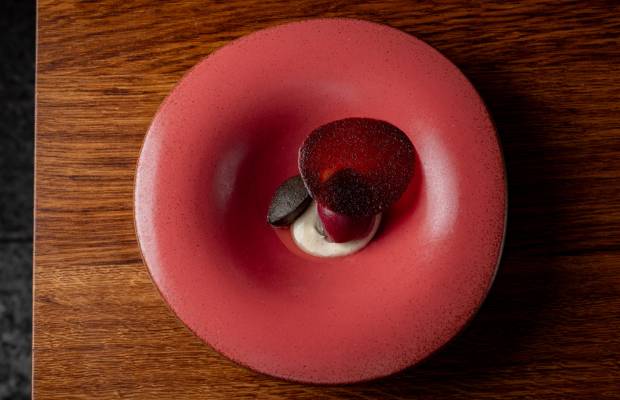
Image context: the cover uses The World's 50 Best Restaurants' official Ikoyi dish photograph from the 2025 list page. A plated course is the right lead image because this article is about synthesis. Ikoyi's argument only works if the finished plate makes several systems read as one: British product discipline, spice memory, and a dining-room level of polish strong enough to stop the cuisine from feeling improvised.[4]
Video 1: the 50 Best profile explains why Ikoyi refuses inherited categories
The 50 Best short begins with Jeremy Chan introducing Ikoyi as a restaurant that is "constantly evolving and changing" with the world, with produce, and with how the team understands things.[1] That is a more important opening than it first sounds. Many restaurants use change as a glamour word, meaning only that menus rotate and ideas travel. Chan uses it more narrowly. The restaurant is different from last year and from the year before, not because it needs novelty at any cost, but because its relationship to ingredients keeps changing.[1] Read beside the official site's language about produce in its optimal state, the statement suggests that Ikoyi treats ingredients as moving targets rather than as vessels for a fixed ethnic or national style.[3]
Around the one-minute mark, the profile sharpens that argument. Chan says that growing up in West Africa shaped the flavors he likes, while Iré Hassan-Odukale describes the restaurant as a way of sharing both founders' cultures and their appreciation of ingredients.[1] Chan then gives the line that matters most for reading Ikoyi: the goal is to share an understanding of beautiful produce without recreating an existing cuisine.[1] The phrase can sound evasive if lifted out of context. Inside the video it lands as a boundary condition. Ikoyi does not want to become a London museum of West African nostalgia, nor a British seasonal restaurant that borrows African flavor as accent. It wants a third thing whose obligations are to taste, intensity, and formal coherence first.[1][3]
The 50 Best written profile supports that reading with more material detail. The restaurant, launched by Chan and Hassan-Odukale in 2017, moved from its original cramped site to 180 The Strand, where David Thulstrup's interiors use copper, oak, limestone, and a curved metal ceiling to echo the tension between spices and British produce.[4] The same page says Chan gleans herbs and spices from across Africa and Asia, uses techniques from around the globe, and calls the result a journey through bold heat.[4] That mix could easily become diffuse. The video's real achievement is to show the opposite. Ikoyi's category refusal is not a shrug. It is a refusal backed by a positive standard: if a dish cannot make unusual combinations feel inevitable, it does not belong.
Video 2: Eater's kitchen footage shows the labor that keeps Ikoyi's freedom from turning vague
If the 50 Best profile gives Ikoyi its philosophy, Eater's Mise En Place episode gives it the friction that philosophy usually hides.[2] The film opens on the now-famous plantain dish, and Chan immediately calls it a symbol of the restaurant because so much discipline and technique are applied to that one ingredient.[2] The kitchen's idea of the perfect plantain is not metaphorical. It is measured: 13 centimeters, then corrected by a cook to 13.5 centimeters, with brushing, flouring, and shaping carried out so the surface stays even rather than clumpy.[2] That exchange is funny, but it also tells you what kind of restaurant this is. Ikoyi wants a familiar ingredient to arrive with enough precision that it becomes newly legible.
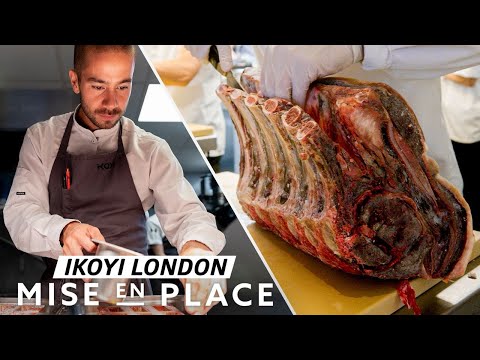
The video gets more revealing when it moves from plantain into butchery. Early in the morning the team breaks down a five-month-aged beef rib from Philip Warren in Cornwall, working in a kitchen Chan describes as too small for separate meat, fish, and cold-room stations.[2] Instead of wishing for the infrastructure of a larger operation, Ikoyi develops methods that "simulate those luxuries" through order and timing.[2] Different muscles from the same rib become different styles of steak for different guests, while excess fat is turned into an aromatic cooking medium for other dishes.[2] Put against the official site's promise of aged native beef and British micro-seasonality, the point becomes clear: locality at Ikoyi is not pastoral decoration. It is a raw material that must survive highly interventionist handling.[3]
That same tension shows up later in the Eater film when the kitchen moves into spring-green sauces and the final seasoning of dishes.[2] Seasonal vegetables from partner farms are processed into sauces, pastes, and broths that read more like flavor architectures than like rustic accompaniments.[2] This is where the first video's language about not recreating existing cuisine starts to feel earned. Ikoyi is not category-free because it avoids structure. It is category-free because it subjects British products and West African flavor memory to a structure more exacting than most restaurants would risk. The goal is not to make the familiar comfortable. It is to catch the guest, as Chan says in the plantain section, in a moment of unsettling and then push that sensation into pleasure.[2]
What the collection reveals when watched together
Watched in sequence, the two videos correct two common errors about Ikoyi. The first error is to treat the restaurant as conceptually radical but physically vague, a place where big language about Africa, Britain, and spice does the work the plate cannot.[1][3][4] The second is to treat it as pure technical fetish, where centimeter measurements and aggressive prep simply signal seriousness.[2] The collection shows something more convincing. Ikoyi's idea only holds because philosophy and process are locked together. The 50 Best profile supplies the intellectual boundary: evolve with produce, honor West African flavor memory, refuse to recreate a settled cuisine.[1] The Eater kitchen film supplies the enforcement mechanism: measure harder, trim harder, sequence harder, and make each guest's experience feel intentional at the level of the cut, the sauce, and the temperature of surprise.[2]
That helps explain why the restaurant's current public facts matter. The official site prices the full tasting menu at £380 and a shorter menu at £170, with lunch and dinner windows kept relatively tight.[3] Those numbers make sense only if Ikoyi is selling more than exoticism or prestige scarcity. It is selling a very controlled form of asymmetry. British product comes in through Cornwall beef, seasonal vegetables, and fish from nearby waters.[2][3] West African orientation enters through flavor memory and a spice archive assembled over years.[1][3] The room at 180 Strand, as 50 Best describes it, translates that tension into copper, limestone, and oak instead of into overt thematic theater.[4] Nothing is asked to perform identity alone. Each part of the system makes the others more exact.
That is the value of this collection in 2026. Ikoyi's category refusal is not interesting because categories are old or because fusion is newly fashionable. It is interesting because the restaurant has found a way to make mixed references feel earned. Plantain is handled like luxury product. British beef is cut into differentiated guest portions. Spice does not excuse imprecision; it exposes imprecision if the kitchen slips.[2][3] The result is a house that feels freer than most fine dining while actually being stricter than most of it. That is why Ikoyi's asymmetry holds.
Sources
- 50 Best, "Why Ikoyi is One of the World's Most Exciting Restaurants," YouTube video.
- Eater, "Chef Jeremy Chan's Two Michelin-Starred Restaurant Is Secretly a Steakhouse — Mise En Place," YouTube video.
- Ikoyi official website, covering British micro-seasonality, sub-Saharan West African spice focus, and current tasting-menu formats and pricing.
- The World's 50 Best Restaurants 2025 list page for Ikoyi, covering the 180 Strand move, David Thulstrup interior, bold-heat framing, and the official dish photograph used here.