Fresh wasabi is not expensive because it is hotter than the green paste beside supermarket sushi. That is the wrong comparison. Its luxury is quieter and more severe: the best flavor exists only after the rhizome is damaged and only for a short span after that. A fine-dining room that serves it honestly is not just buying a premium condiment. It is accepting a small service clock.
That clock changes the ingredient's meaning. A quenelle of paste squeezed from a tube can wait. Fresh hon-wasabi cannot behave that way. It has to be held whole, grated with intent, rested briefly if the kitchen wants the aroma to bloom, and then placed where its green sweetness, volatile heat, and grassy lift can meet the fish, beef, soba, tempura, or broth before fading. The diner experiences a condiment; the restaurant manages perishability in public.
The Farm Comes First
The romance of wasabi usually begins at the sushi counter, but the harder story starts in cold water. FAO's Globally Important Agricultural Heritage Systems page identifies Shizuoka's traditional wasabi cultivation as a GIAHS site since 2018 and describes wasabi, Eutrema japonicum, as a native Japanese Brassicaceae plant whose stems have long been prized for the sharp flavor released when grated.[1] The same source places the origin of worldwide wasabi cultivation in Shizuoka, beginning roughly 400 years ago during the Keicho era in what is now the Aoi district of Shizuoka City.[1]
That history matters because it keeps wasabi from becoming a generic "Japanese heat" signal. The ingredient is tied to a landscape system. FAO describes Shizuoka wasabi fields as terraced mountain fields built from traditional knowledge, with high water-holding capacity, disaster resilience, downstream flood-protection benefits, and habitat value for endemic species.[1] In the 2016 production figures cited there, the proposed area accounted for 113.8 hectares of cultivation, 227.5 tonnes of stem production, and about 40 percent of national production.[1] Those numbers make scarcity concrete. This is not an herb that can be scaled like parsley.
Kameya Wasabi's account of its Kakita River Springs setting supplies the restaurant-side image of that constraint: plants hand planted and harvested in terraced paddy-like fields fed by clean spring water flowing from Mount Fuji.[2] A producer page is not neutral scholarship, but it is useful evidence of how serious wasabi sellers themselves frame quality. They do not lead with raw heat. They lead with water, geography, manual planting, and the difference between a living rhizome and an anonymous paste.
Why The Paste Is Usually Something Else
Most diners meet wasabi through imitation before they meet the plant. Chemical & Engineering News puts the point bluntly: the pistachio-green paste on the plate is often a mixture of European horseradish, mustard, and coloring rather than real wasabi.[5] The reason is not only deception. It is logistics. Real wasabi is limited, expensive, fragile, and less convenient than a stable horseradish-based product that can sit through distribution, service, and half a refrigerator life.
The substitute is not absurd. Wasabi and horseradish are related flavor technologies. Sultana and Savage's comparison paper explains that both plants liberate volatile isothiocyanates when tissue is mechanically disrupted, and that both therefore produce a hot, pungent effect.[4] But the same paper also explains why they are not interchangeable. Wasabi is cultivated primarily for rhizomes because those stems carry more flavor than other plant parts, while horseradish is grown for its root; their different isothiocyanate profiles create different aromas.[4]
That distinction is where fine dining has a real reason to care. If all a kitchen needs is a quick nasal burn under a California roll, horseradish can do the job. If the dish depends on a green, slightly sweet, leafy, fast-moving aroma around raw fish or gently cooked shellfish, the substitution starts to show. Kinjirushi's component guide contrasts wasabi's fresh green scent and slightly sweet aroma with horseradish's higher concentration of beta-phenethyl isothiocyanate, which it associates with a raw-turnip-like aroma.[3] The difference is not moral. It is sensory.
Grating Is The Moment Of Creation
The most important technical fact about wasabi is that its defining flavor is made at the last second. The compounds responsible for the heat are not simply sitting in the intact rhizome waiting to be served. Chemical & Engineering News explains that when the cell wall is disrupted, myrosinase hydrolyzes glucosinolates and produces isothiocyanates, including allyl isothiocyanate, the major heat compound.[5] Sultana and Savage describe the same mechanism in more formal terms: crushing, chewing, or grating releases myrosinase, which converts glucosinolates into volatile sulfur compounds.[4]
That chemistry explains why the grater is not a prop. The act of grating is when wasabi becomes wasabi as the diner understands it. Too coarse, and the transformation is incomplete. Too early, and the aroma runs away before the plate arrives. Too much, and the dish starts to taste like a luxury garnish trying to prove its price.
Kinjirushi USA's grating-technology page gives the operational clock in unusually useful terms. It says fresh wasabi's aroma and pungency have a life span of about 10 minutes after grating, with peak aroma and pungency at about 2.5 minutes.[7] Chemical & Engineering News gives a similar practical boundary through industry commentary, saying freshly grated wasabi is good for at most 15 minutes and should be grated as needed.[5] These are not identical measurements, and they come from different contexts, but they point to the same service truth: fresh wasabi is a condiment with a countdown.
What Fine Dining Buys
The restaurant is buying three things when it buys real wasabi. First, it buys farming difficulty: cool water, terraces, slow growth, manual care, and supply that cannot be casually expanded.[1][2] Second, it buys aromatic specificity: not merely heat, but green, sweet, grassy, pungent compounds that differ from horseradish's profile.[3][4][5] Third, it buys service pressure: the need to grate near the eating moment and deliver the ingredient while it is still alive.
That third purchase is the most interesting one. Fine dining often hides labor by making every plate look inevitable. Fresh wasabi does the opposite if the room lets it. At a counter, the grating motion can be part of the pleasure. The diner sees the rhizome, the oroshigane or sharkskin-style surface, the small paste forming, and the immediate placement beside the course. The service says: this flavor is being made for this bite, not scooped from yesterday's mise en place.
The ingredient also disciplines chefs who might otherwise use heat crudely. Fresh wasabi is not a green exclamation point. Its short life makes it better as a precise accent than as a thick mound. With raw fish, it should lengthen sweetness and clean fat. With beef, it can sharpen richness without dragging the dish into mustard heaviness. With soba or clear broth, it should lift aroma and then disappear. Its best work is brief, not timid.
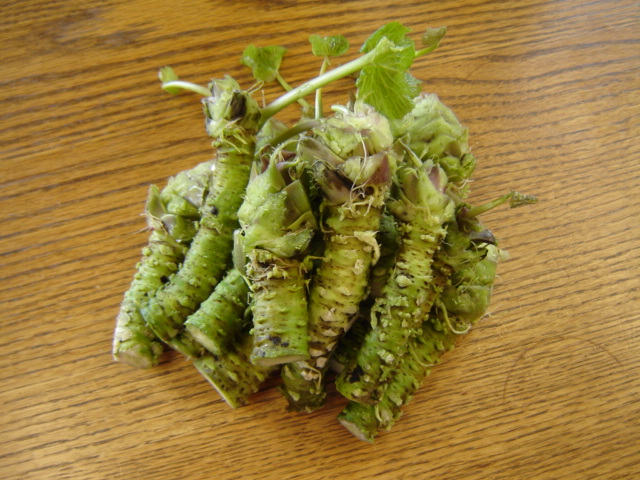
That brevity is why the article image matters. The 2006 Wikimedia Commons photograph shows fresh Daruma sawa wasabi rhizomes, not a prepared paste.[6] The stems look plain, almost rootlike, and that plainness is instructive. The luxury is not visual spectacle. It is potential energy. Until the cells are broken, the ingredient is mostly waiting. Once the cells are broken, the restaurant has minutes.
The Better Way To Read The Price
Fresh wasabi is easy to turn into a purity test: real versus fake, serious versus casual, sushi master versus tube. That framing gets boring quickly. The more useful question is whether the dish needs the ingredient's actual behavior. Many dishes do not. A horseradish-based paste can be honest enough for convenience food, a sauce base, or a setting where the wasabi note is only a broad heat signal. Demanding hon-wasabi everywhere would be culinary posturing.
But when a restaurant does use fresh wasabi well, the price becomes easier to understand. The diner is paying for a chain of constraints: mountain water, terraced cultivation, harvest, cold handling, whole-rhizome storage, a grater, a service rhythm, and a few minutes of aroma before the compound balance changes. That is a different luxury from caviar, truffle, or wagyu. Those ingredients often announce cost through abundance or rarity. Wasabi announces cost through timing.
In that sense, fresh wasabi is one of fine dining's cleanest tests of whether a kitchen respects small things. It cannot carry a bad course by itself. It cannot wait politely while the dining room loses focus. It cannot be explained into freshness after the fact. The kitchen either makes the moment or misses it.
The best fresh wasabi bite is therefore almost modest: a little green paste, freshly grated, placed where it can bloom and vanish. It should not burn like punishment. It should rise, sweeten, sting, clear, and leave the main ingredient more vivid than before. That is why the clock matters. Fresh wasabi is not luxury because it lasts. It is luxury because it does not.
Sources
- Food and Agriculture Organization of the United Nations, "Traditional Wasabi Cultivation in Shizuoka, Japan" - GIAHS profile covering the 2018 designation, cultivation origin, terraced mountain fields, sustainability role, and 2016 production figures.
- Kameya Wasabi, "Our Pure Water" - producer account of Kakita River Springs, Mount Fuji water, hand planting, and terraced paddy-like wasabi fields.
- Kinjirushi Wasabi, "Wasabi Components" - component comparison of real wasabi and horseradish, including wasabi's fresh green aroma and horseradish's beta-phenethyl isothiocyanate emphasis.
- Tamanna Sultana and G. P. Savage, "Comparison of flavour compounds in wasabi and horseradish" - paper explaining glucosinolate-to-isothiocyanate flavor chemistry and measured compound differences.
- Bethany Halford, "What's wasabi, and is your fiery buzz legit?", Chemical & Engineering News, 2010 - chemistry-focused explainer on imitation wasabi, myrosinase, allyl isothiocyanate, volatility, and grating practice.
- Wikimedia Commons, "File:Fresh wasabi rhizomes.jpg" - 2006 real photograph of fresh Daruma sawa wasabi rhizomes used as the article image.
- Kinjirushi Wasabi International USA, "Ultra Cold Grating Technology" - producer explanation of the short post-grating aroma window, peak timing, and freezing approach.