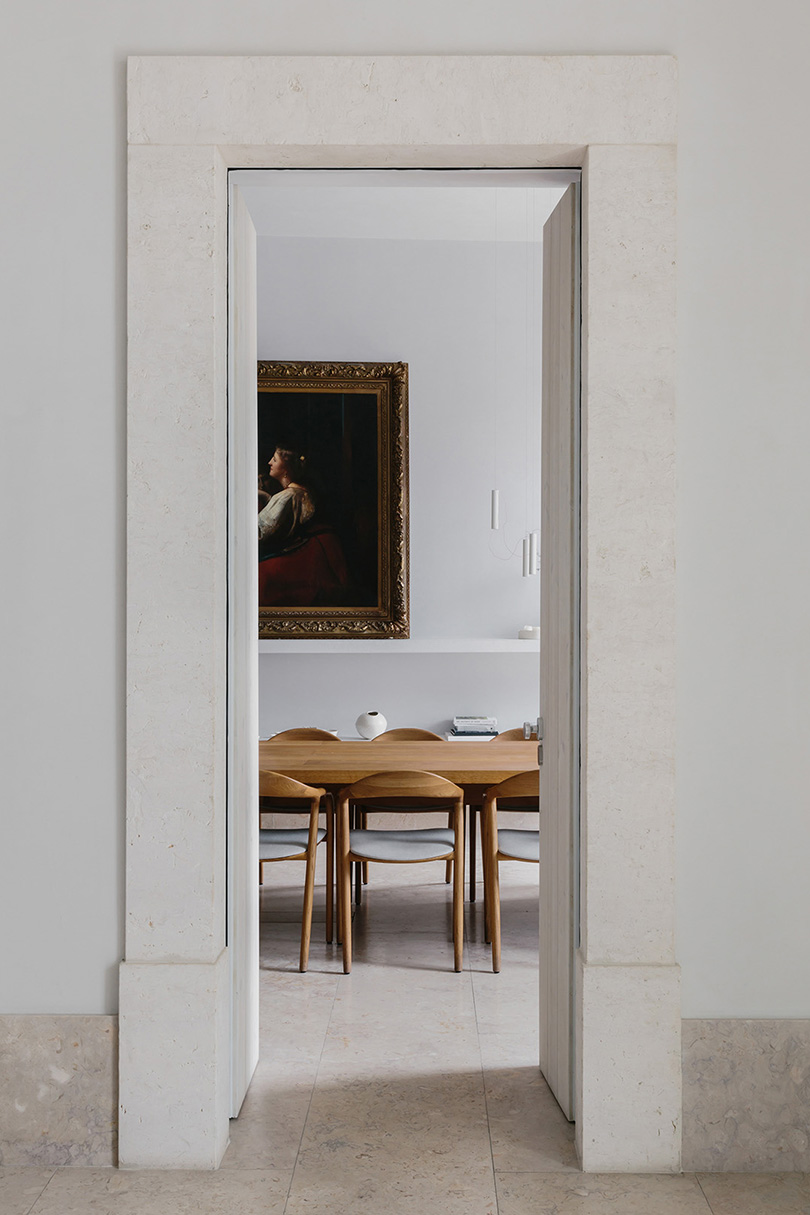
The interesting thing about Ceia is that it does not try to hide the social fact of fine dining. Most top-end rooms still sell privacy first: your table, your script, your cocoon of controlled attention. Ceia organizes the night in the opposite direction. At Silent Living's Santa Clara 1728 in Lisbon, the restaurant is built around one shared table, one shared menu, and a room that asks diners to treat supper as a collective event rather than a sealed luxury purchase.[1][2]
That sounds softer than it really is. In practice, it is a demanding piece of restaurant design. Shared-table dining only works when the room, the pacing, and the conceptual frame all pull in the same direction. Otherwise it collapses into enforced friendliness. Ceia matters because the format is not a side note attached to the food. The format is the product.[1][2]
1. The table is the restaurant's real signature
Ceia's own description is unusually clear about what it is selling. A selected group gathers around one table, shares the same menu and the same space, and spends the evening inside a single sequence of exchanges.[1] That phrasing is useful because it moves the value proposition away from course count or luxury ingredients alone. The meal is designed as a supper in the older sense of the word: a gathering with timing, conversation, and shared attention built into it.
The name itself helps. Ceia notes that the Portuguese word for supper carries associations of comfort, tradition, friendship, and the pleasure of preparing food for people one cares about.[1] Many restaurants borrow domestic language as a branding trick. Here the house format gives that language actual weight. Santa Clara 1728 already asks guests to use the property like a home with a communal table, shared common spaces, and only a small number of rooms.[2][3] The restaurant is therefore not inserted into an anonymous hotel shell. It grows out of a building that already privileges proximity.
That is what makes the room feel sharper than the usual "chef's table" theater. A chef's table often promises backstage privilege while still preserving the diner's social bubble. Ceia pushes in a different direction. It compresses the whole night into a shared social lane and then asks the kitchen to make that compression feel warm, calm, and deliberate.
2. The house edits the meal before the first course lands
The Santa Clara 1728 setting matters more than the usual restaurant-profile background paragraph. Silent Living describes the property as an 18th-century Lisbon building renovated with architect Manuel Aires Mateus, now operating as a six-suite house rather than a conventional large hotel.[2] The house page stresses intimacy, generous windows, a secluded garden, and a communal dining table as the place where people gather daily to dine, laugh, and share.[2]
That architectural language explains why Ceia can avoid the stiffness that often shadows destination dining. The room does not need to manufacture intimacy through dim lighting, exaggerated hushedness, or aggressively scripted service patter. The building has already narrowed the social scale. By the time dinner begins, the diners are already inside a house logic rather than a lobby logic.[2][3]
The FAQ page makes the same point from an operational angle. Silent Living says explicitly that Santa Clara 1728 is not intended to behave like a traditional hotel, that guests share the freedom of the house with a small number of other people, and that meals are treated as moments of sharing rather than occasions for room service.[3] That is a meaningful boundary. The house is not trying to satisfy every private preference at every minute. It is trying to hold a particular rhythm.
In fine-dining terms, that rhythm is the luxury. Ceia is less about exclusivity in the crude sense of separation and more about exclusivity as concentration. The room removes many of the usual branching options and puts more pressure on sequence, tone, and trust.
3. The food story works because it is bigger than farm rhetoric
If Ceia were only a shared table plus picturesque Lisbon architecture, the concept would risk turning sentimental. What keeps it alive is that the menu has a live intellectual frame. On the restaurant page, Silent Living maps Ceia through chapters. The first focused on regenerative agriculture and holistic management at Herdade no Tempo; the second, "The Last Harvest," widened the lens to planetary boundaries and environmental fragility; the current third chapter, "The Garden of Earthly Delights," is presented as a meditation on abundance, fragility, and balance under head chef Tiago Ramos.[1]
This matters because it gives the restaurant a larger argumentative structure than the standard farm-to-table claim. Many restaurants say they care about soil, seasonality, or local sourcing. Ceia goes one step further and tries to turn those concerns into narrative architecture.[1] The concept can easily become heavy-handed in weaker hands, but here it suits the house format. A shared table needs a common subject, some reason for diners to feel that they are participating in the same story rather than merely consuming adjacent plates. The chapter model provides that shared subject.
There is also a practical advantage. A small-format room with a fixed menu can make sourcing and conceptual continuity feel tighter because there are fewer concessions to fragmentation. Ceia's table does not need to split into five separate agendas. That allows the kitchen to push a single argument more cleanly through the night.
4. Why this room feels current in 2026
The strongest reason to pay attention to Ceia now is that it offers a different answer to a problem that many high-end restaurants face: how to keep meaning alive once technique, product quality, and service polish are already assumed. The easy answer has been escalation, longer menus, stranger ingredients, more spectacle, more private prestige. Ceia's answer is reduction. Fewer people, one table, one narrative lane, one house that already knows how to host collectively.[1][2][3]
That positioning also makes the booking logic clearer than in many destination rooms. According to 50 Best Discovery, Ceia serves dinner Wednesday through Saturday and lists a tasting menu from $131.[4] Silent Living's own language suggests a highly intentional, advance-planned experience rather than a walk-in urban luxury restaurant.[1][3] The result is a room that feels destination-worthy without needing to become monumental.
For Lisbon, that is a useful distinction. The city does not need another restaurant whose entire ambition is to imitate the international luxury template with Portuguese ingredients layered on top. Ceia's sharper move is to make Portuguese supper culture, house hospitality, and regenerative thinking part of the actual operating format.[1][2] The meal does not float above its setting. It is pinned to it.
5. Who should book Ceia, and who probably should not
Ceia is best for diners who like a restaurant to shape the evening rather than simply serve it. If you want to compare pairings against supplements, optimize privacy, or keep the table's emotional weather under your own control, there are more conventional luxury rooms that will fit better. Ceia asks for a little surrender. The night works when you accept that the table is shared, the pacing is collective, and the house is trying to host a supper, not just execute a menu.[1][3]
For the right diner, that is exactly the appeal. Fine dining often talks about hospitality while insulating guests from one another. Ceia takes the riskier route and uses hospitality to make people briefly inhabit the same frame. In a market full of private theater, that shared-frame discipline is what makes the room memorable.
Sources
- Silent Living, "Ceia" - official concept page describing the shared-table format, the chapter structure, regenerative agriculture at Herdade no Tempo, and the current "Garden of Earthly Delights" menu under head chef Tiago Ramos.
- Silent Living, "Santa Clara 1728" - official house page covering the 18th-century building, Manuel Aires Mateus renovation, six-suite format, and the communal dining table at the center of the house.
- Silent Living, "FAQs" - house-format details on Santa Clara 1728 as a shared home rather than a traditional hotel, meal-sharing logic, and Ceia's Wednesday-to-Saturday operating window.
- 50 Best Discovery, "Ceia" - listing with key information including dinner days, Lisbon location, and tasting-menu entry price.