The easiest way to misunderstand Atelier Moessmer Norbert Niederkofler is to call it a beautiful mountain restaurant and stop there. The view matters. The villa matters. The Dolomites matter. But the restaurant's sharper idea is less scenic than operational: what happens when fine dining accepts altitude as a constraint rather than using it as atmosphere?
That is why Atelier Moessmer feels important in 2026. It is not simply another destination room with local produce and expensive calm. It belongs to a broader high-altitude movement in which scarcity, short seasons, preservation, and regional limits are being turned into a new form of luxury.[5] Niederkofler's version has unusually clear rules. The official site frames the restaurant around "Cook the Mountain," places the project inside the former Moessmer manor house, and says the room does not accommodate more than 30 people.[1] Michelin's 2026 Italy release confirms the restaurant among Italy's continuing three-star addresses, while local tourism material also notes its Green Star and the 6,000-square-meter park around the villa.[3][4]
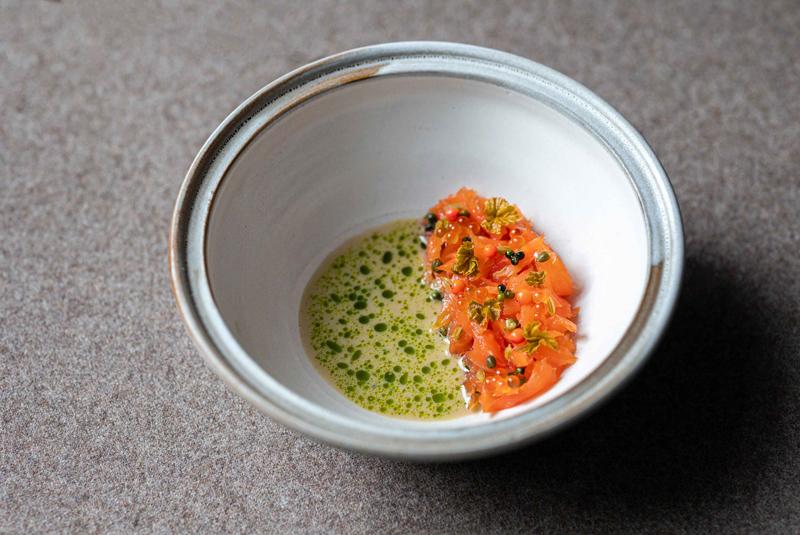
Image context: the lead image is a real 50 Best photograph of an Atelier Moessmer salmon trout dish credited to Dalge. It works here because the article is about a cuisine that makes constraint visible without turning it into austerity: a pale bowl, a precise fish, a green sauce, and enough empty space to let the mountain pantry speak.[5]
1. The movement starts when abundance stops being the default
Most luxury restaurants still inherit a soft assumption: if the budget is high enough, the pantry can be almost global. Citrus can arrive in winter. Olive oil can stand in as a default sign of Mediterranean polish. Greenhouse vegetables can smooth over the season's awkward gaps. The mountain movement begins by refusing that comfort.
The 50 Best high-altitude feature makes Niederkofler's original proposition unusually explicit: when he introduced "Cook the Mountain" in 2008, it meant giving up olive oil, citrus, and greenhouse vegetables, and focusing on produce within 50 km of his South Tyrolean restaurant.[5] That detail is the hinge. A radius is not a mood. It is a rule that changes flavor, procurement, menu design, and guest expectation.
Atelier Moessmer carries that rule into a newer setting. 50 Best Discovery describes one tasting menu focused on the region's mountain produce, with dishes changing frequently and working symbiotically with the seasons.[2] In warm months, appetisers can move into the garden; in the main dining room, courses named after core ingredients such as trout, sweetbread, or Tyrolean beef keep the menu close to material identity.[2] The point is not rustic minimalism. It is discipline. The restaurant has to make a limited pantry feel complete without pretending the limits are not there.
2. The building keeps the food from floating away
Atelier Moessmer's setting could easily become decorative: a handsome villa, a famous chef, a mountain address, a polished dining room. The stronger reading is that the building gives the cuisine a second kind of constraint.
The official site says "Cook the Mountain" has found its home within the walls of the former Moessmer manor house, born from a collaboration between Niederkofler and Moessmer Woolen Mill president Paul Oberrauch.[1] It also explains that the Moessmer wool mill, founded in 1894, is the oldest industrial concern in the Puster Valley and remains one of the few textile companies to process wool through the full production cycle.[1] That history matters because it gives the restaurant a built-in analogy: raw material enters, is transformed through craft, and leaves with its origin still legible.
Bruneck's tourism page adds the physical frame. It places Atelier Moessmer in the 19th-century Villa Moessmer, surrounded by a 6,000-square-meter park, and describes the restaurant as a stage for Niederkofler's sustainable vision of cooking and living.[4] The site is therefore not just a backdrop for a tasting menu. It is a reminder that mountain luxury depends on process: wool, weather, preservation, labor, and time all leave traces.
That is why the restaurant's room count matters. A thirty-seat ceiling makes the movement feel credible.[1][4] A larger room would risk turning mountain limitation into branding. A smaller, tightly managed room lets scarcity remain legible as hospitality instead of becoming shortage.
3. Preservation is not nostalgia here
The mountain pantry becomes interesting once preservation stops sounding like heritage cosplay. In high-altitude cooking, preservation is not an old-fashioned garnish. It is the answer to an environment where seasons are short and product windows close fast.
The 50 Best feature connects Niederkofler to a wider set of mountain restaurants where fermentation, smoking, drying, and cellaring function as adaptive intelligence.[5] For Atelier Moessmer, the examples are concrete: the story notes lamb charcuterie with preserved radichetta on a mountain potato pancake, and char in beurre blanc infused with sauerkraut and speck after the restaurant's 2023 move to Brunico.[5] Those dishes are not interesting because they sound quirky. They are interesting because they make preserved flavor do structural work. Salt, smoke, lactic acidity, and animal fat become ways to build depth without importing a different climate.
This is where the trend differs from ordinary farm-to-table language. Farm-to-table often promises freshness. Mountain cuisine has to promise judgment. It asks what should be eaten immediately, what should be saved, what should be fermented, what should be smoked, and how much intervention is needed before a humble ingredient can carry a three-star course.[2][5]
For diners, that changes the pleasure. The meal is not simply "local." It is local under pressure. A trout course can carry cold water, preservation logic, and precise sauce work at the same time. A root, herb, dairy element, or cured meat is asked to deliver emotional intensity usually assigned to caviar, truffle, lobster, or luxury beef.[5] The restaurant's wager is that precision can make essentiality feel more luxurious than opulence.
4. Why this feels current rather than backward-looking
Atelier Moessmer's importance is not that it invented mountain cooking by itself. The stronger claim is that it makes a movement legible at the highest end of the restaurant economy. In the current fine-dining climate, guests have become fluent in the old signals: rare imports, long menus, open kitchens, natural wine, sustainability language, and regional storytelling. Those cues still matter, but they are easier to imitate than a genuine constraint system.
The Michelin confirmation gives the restaurant institutional weight.[3] The 50 Best ranking gives it global visibility.[2] The official site gives the operating boundaries: rooms with distinct phases, an open kitchen, dinner from Wednesday to Friday, lunch and dinner on Saturday, Sunday lunch, Monday and Tuesday closure, and no more than thirty guests.[1] None of those facts alone explains the restaurant. Together, they show a room built around concentration rather than sprawl.
That concentration is why the high-altitude trend has teeth. A restaurant can decorate itself with mountain imagery; it cannot fake a pantry that has to obey terrain for years. If a chef removes default ingredients, accepts short seasons, depends on preservation, and still asks international guests to treat the meal as luxury, the cooking has to be exact.[5]
Atelier Moessmer's lesson is therefore useful beyond Brunico. Fine dining does not need another vague promise of place. It needs places that impose consequences. Niederkofler's mountain grammar works because it turns those consequences into pleasure: fewer ingredients, more responsibility; less abundance, more precision; less scenery, more structure.[1][2][5]
That is the movement worth watching. The future of luxury may not look poorer, but it may look narrower. At Atelier Moessmer, narrowness is the point. The mountain does not decorate the meal. It edits it.
Sources
- Atelier Moessmer Norbert Niederkofler official site - current overview of the Cook the Mountain philosophy, former Moessmer manor house, room sequence, opening hours, Brunico address, and thirty-guest limit.
- 50 Best Discovery, "Atelier Moessmer Norbert Niederkofler" - venue profile covering the No.20 ranking in The World's 50 Best Restaurants 2025, the former textile-factory setting, one tasting menu, seasonal mountain produce, and example dishes.
- Michelin, "MICHELIN Guide Italy 2026" (November 20, 2025) - official release confirming Atelier Moessmer Norbert Niederkofler in Brunico among Italy's Three MICHELIN Star restaurants.
- Bruneck Kronplatz Tourism, "Atelier Moessmer Norbert Niederkofler" - local tourism listing covering Villa Moessmer, the 6,000-square-meter park, three Michelin stars, Green Star, thirty seats, and address details.
- Joel Hart, "The rise of high-altitude fine dining." The World's 50 Best Restaurants, January 13, 2026 - feature covering Niederkofler's 2008 Cook the Mountain radius, the 2023 Brunico move, high-altitude preservation logic, and the salmon trout image used here.