Fonio can disappear beneath the tip of a finger. Each pale grain is roughly a millimeter long, finer than couscous and easy to mistake for background texture once a chef has tucked it under sauce, fish, or a neat spoonful of vegetables.[1] Its journey to that plate is anything but small.
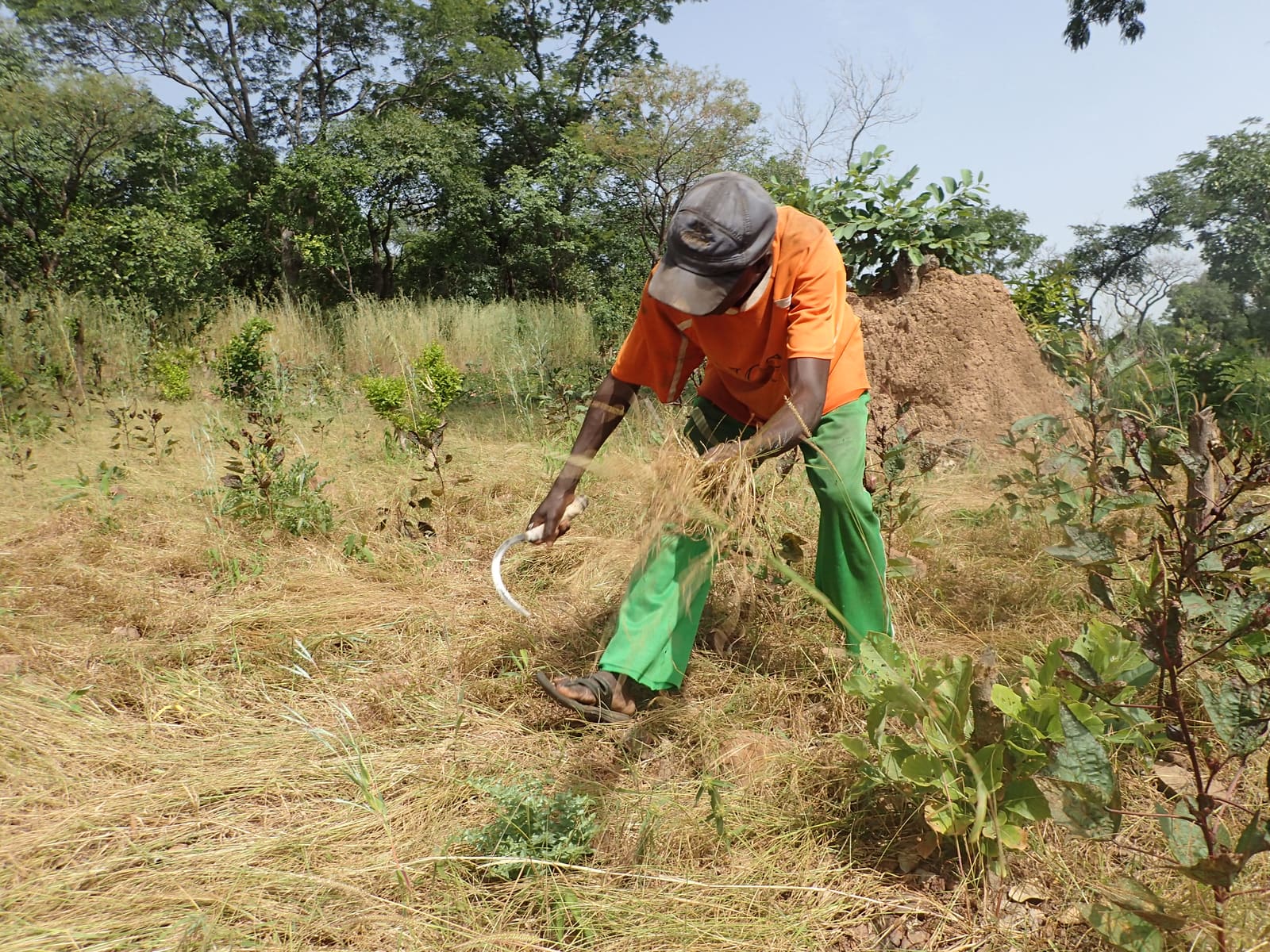
The cover photograph begins where a restaurant menu usually does not. In a field outside Tumania in southeastern Senegal, Amadou Diallo bends into dry stalks, holds a bundle in one hand, and cuts with a sickle in the other.[8] The orange of his shirt is the loudest color in the frame. Fonio itself reads as straw, almost vanishing into the ground. This is the first useful correction to the ingredient's fashionable new life: it was work before it was novelty.
A handful of chef-led projects now form a visible pattern around the grain. Pierre Thiam put fonio into a salad and jollof at New York's Teranga.[6] Fatmata Binta has made it central to a Fulani culinary experience and a farmer-training initiative in Ghana.[7] Adejoké Bakare has served it as ice cream at Michelin-starred Chishuru and built a five-course event around a fonio beer.[4][5] These are not identical projects, and they should not be inflated into a single “African supergrain” boom. What connects them is more interesting: chefs are treating fonio as cuisine, infrastructure, and authorship at the same time.
The movement is not a discovery
Fonio does not need a European or American dining room to confer importance on it. Digitaria exilis is indigenous to West Africa, and cultivated varieties reflect climatic, geographic, and ethnolinguistic histories across the region.[1] Some mature in about 70 to 90 days; the crop can grow in hot, dry, nutrient-poor environments where a more demanding cereal may struggle.[1] That agronomic promise is real, but “climate miracle” is too easy a slogan. The 2020 genome study describes potential for dryland agriculture while also identifying tiny seeds, shattering, and incomplete domestication as targets for future improvement.[1] Resilience does not cancel difficulty.
Nor is fonio a blank canvas waiting for an inventive chef. In the southern Mali value-chain study by Charlie Mbosso and colleagues, producers described it as food for the lean interval before other cereals mature and as a grain with ceremonial value in marriage and sacrifice.[2] Chef Binta's Dine on a Mat work draws on Fulani foodways, and her 2023 collaboration with FAO spotlighted fonio in a special dining experience in Accra.[7] A restaurant kitchen can change the grain's form. It cannot truthfully claim to have invented its meaning.
That boundary is what separates a movement from ingredient tourism. The weakest version sprinkles fonio onto a plate, calls it ancient, and lets the guest feel adventurous. The stronger version names who cooks it, where it comes from, what work makes it usable, and why this particular texture belongs in this particular course.
Before the pass comes the processing line
The grain's size gives it delicacy in a bowl and difficulty everywhere else. In the Mali study, men performed most field tasks while women held the primary role in winnowing, dehulling, and removing sand. Respondents described production as labor-intensive and reported missing tools, especially threshing equipment, across all eight surveyed villages.[2] Clean, dried fonio commanded a better price than unprocessed grain, so the hardest steps were also the steps that created market value.[2]
This is the hidden hinge of the dining trend. A chef needs a product that is clean, consistent, traceable, and available in service quantities. A farmer or processor needs that demand to pay for more than an evocative menu note. Between them sit hullers, washers, dryers, packaging, quality control, import rules, and buyers willing to build repeat orders. Without that middle, fonio remains easy to praise and difficult to procure.
Regulation changed one part of the route. In December 2018, the European Union authorized decorticated Digitaria exilis grain as a traditional food from a third country, citing its history of safe use in Guinea, Nigeria, and Mali.[3] The legal language is dry, but the culinary consequence is concrete: “decorticated fonio” could enter the Union list of authorized foods and be sold as an ingredient.[3] A border opened on paper. The work of producing a clean, valuable grain still remained in West Africa.
Chef Binta's Ghana project makes that remaining work visible. Announced with FAO in 2024, it was designed to train about 100 women in cultivation, harvesting, packaging, and market access; the farmers sit inside her wider “culinary village” initiative rather than outside it as anonymous suppliers.[7] Here, chef prestige points backward along the chain. The dinner helps create attention, but training and processing decide whether attention becomes income.
A grain, a frozen dessert, and a glass of beer
Chef-led dining is most useful here when it reveals range without erasing identity. Bakare's Chishuru offers the clearest compact example. Michelin's interview with Bakare and restaurant manager Matt Paice places the restaurant inside a growing West African movement in London, although the team resists the stiffness implied by “fine dining” and even prefers “set menu” to “tasting menu.”[4] That resistance matters. The grain does not need white-tablecloth theater; it needs a chef with enough control to show several of its registers.
By 2024, fonio ice cream was a recurring Chishuru dessert. For a limited collaboration, Bakare then paired the restaurant's food with a lager brewed from fonio without barley or bittering hops, used the beer in a dish, and stretched the idea across five courses.[5] The event was promotional, and Carlsberg's own release is not an independent verdict on the beer. Still, the collaboration demonstrated a serious culinary point: fonio could enter the same restaurant as beverage, cooking ingredient, and recurring dessert rather than being trapped in the role of worthy side dish.
That range is more persuasive than a list of nutritional claims. Across these examples, fonio appears as cooked grain in salad and jollof, a recurring frozen dessert, and fermentable material for beer.[5][6] Those transformations do not amount to one universal tasting note. They show a kitchen choosing the form that a dish or drink needs instead of asking the guest to admire versatility as an abstract virtue.
Thiam's Teranga supplies the fast-service counterpoint. When the Harlem restaurant opened, its menu used fonio in a beet-and-pickled-carrot salad and as the base for jollof.[6] Teranga was designed for fast service, not ceremonial luxury. That distinction strengthens the story. An ingredient has a healthier future when it can travel between an ambitious dining room and an everyday bowl without becoming a different cultural object at each price point.
Luxury attention is only valuable if it travels backward
The danger arrives when prestige outruns accountability. A restaurant can purchase a bag of imported grain, attach the words “ancient” and “climate-resilient,” and borrow moral seriousness from a supply chain it has not examined. The diner sees the final spoonful; the menu omits the person with the sickle, the women removing hull and sand, and the processor responsible for consistency.
The evidence argues for a more exact claim. Fonio has useful dryland traits, fast-maturing varieties, and remarkable culinary range.[1] It also has production bottlenecks, labor burdens, post-harvest losses, and uneven access to equipment and markets.[2] Mechanization can reduce punishing work and improve cleanliness, but scale alone does not guarantee that farmers and women processors retain more of the value. That last point is an inference from the value-chain evidence, not a result the restaurant can assume.[2][7]
So the best menu note would be less grand and more specific. It would name Senegal, Mali, Guinea, Ghana, Nigeria, or another actual origin rather than “Africa.” It would distinguish fonio from the chef's technique applied to it. It might name the producer group or processor. Most of all, the restaurant would know whether the purchase is repeatable and whether greater demand is reaching the people who made the grain market-ready.
This does not make dinner a procurement seminar. It makes pleasure more situated. A spoonful of grain, the coolness of an ice cream, or the faint bitterness Bakare noted in the fonio beer can still arrive first.[5][6] Context should sharpen appetite, not scold it.
In Courtright's photograph, Diallo's sickle is caught just above the cut stalks.[8] The image has none of the polished stillness of a plated course. That is precisely why it belongs at the front of this story. Fonio's new restaurant life is most convincing when the line between field and table remains unbroken—when the grain gets smaller on the plate without its history shrinking with it.
Sources
- Michael Abrouk et al., “Fonio millet genome unlocks African orphan crop diversity for agriculture in a changing climate,” Nature Communications 11 (2020) — grain size, maturation, dryland potential, genetic diversity, and breeding constraints.
- Charlie Mbosso et al., “Fonio and Bambara Groundnut Value Chains in Mali: Issues, Needs, and Opportunities for Their Sustainable Promotion,” Sustainability 12, no. 11 (2020) — fieldwork on labor, gendered processing, equipment gaps, sand removal, prices, and ceremonial use.
- European Union, Commission Implementing Regulation (EU) 2018/2016 (December 18, 2018) — authorization and labeling rules for decorticated Digitaria exilis grain as a traditional food from a third country.
- MICHELIN Guide, “Chishuru's Adejoké Bakare On Her MICHELIN-Star Success” — interview on Chishuru's set-menu philosophy, West African ingredients, hospitality, and London's emerging West African restaurant movement.
- Carlsberg Group, “Carlsberg and Brooklyn Brewery launch first ever lager where all barley is replaced with drought-resistant fonio grain” (July 25, 2024) — primary account of the limited fonio beer, Bakare's five-course pairing event, and Chishuru's recurring fonio ice cream.
- MICHELIN Guide, “Teranga From Chef Pierre Thiam Opens in NYC” — opening report documenting fonio in the restaurant's beet salad and jollof, and the fast-service Pan-African menu context.
- Food and Agriculture Organization of the United Nations, “FAO and chef Fatmata Binta announce new project to empower women fonio producers in Ghana” (March 29, 2024) — producer training, market access, Dine on a Mat, and the culinary-village initiative.
- Wikimedia Commons, “File:Harvesting Fonio.jpg” — James Courtright's 2017 documentary photograph of Amadou Diallo harvesting fonio near Tumania, Senegal, used as the article image.