The useful question is not which restaurant makes Vietnamese food look most expensive. It is what each room believes refinement is for.
At Gia, refinement lets a memory unfold slowly. At Nén Danang, it makes room for ingredient research and explanation. At CieL, it gives a young chef enough technical freedom to stop choosing between French training and a Vietnamese pantry. At Ănăn Saigon, it compresses the noise of a wet market, a tube house, street snacks, and tasting-menu pacing into one vertical night.
These are not four rungs on a prestige ladder. They are four different contracts with tradition. That distinction matters in a country whose Michelin selection had already grown to 181 establishments by its third edition in 2025, including nine one-star restaurants and two Green Stars.[1] A badge list can tell you where inspectors found quality. It cannot tell you which kind of evening you actually want.
This guide can. It is based on the restaurants' live menus and booking pages, Michelin's reporting, and local coverage—not on a pretend composite visit. Practical details were checked on July 15, 2026 and should be reconfirmed before booking.
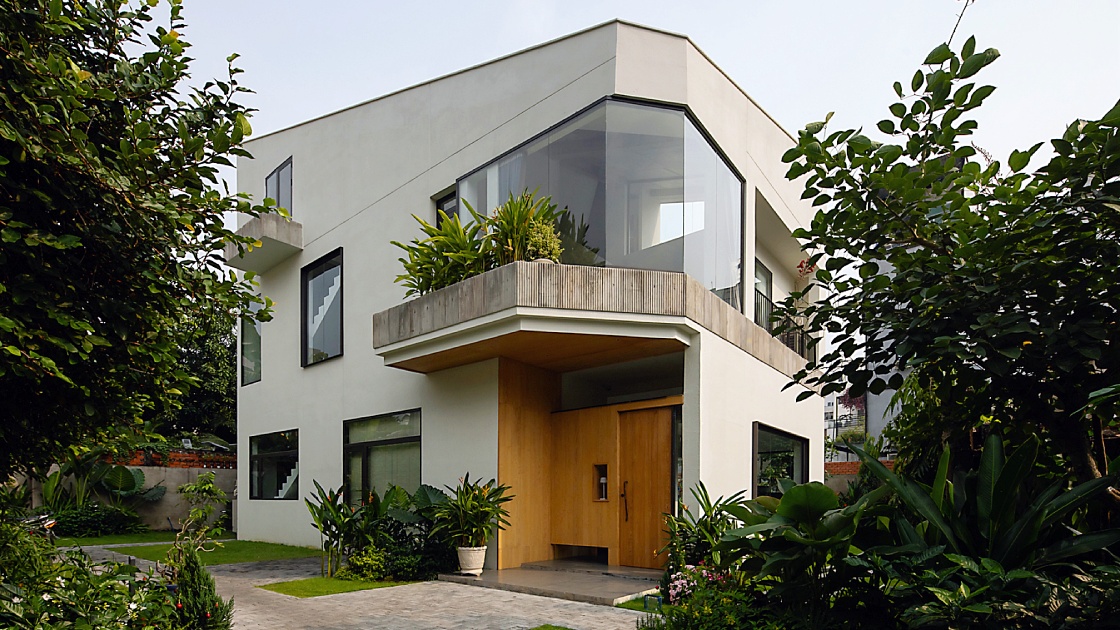
Image context: the cover photograph shows CieL's modern white villa nested into a green lane in Thảo Điền. The threshold feels closer to visiting a house than entering a prestige machine. It suits the larger story because all four restaurants make their operating format—seasonal menu, story cards, counter, or market-side tube house—carry part of the meaning.
The four-room answer in thirty seconds
- Choose Gia in Hanoi when you want the most composed, all-in tasting experience: one seasonal sequence, a quiet room, and Vietnamese memory expressed through pairings rather than replicas.
- Choose Nén Danang when you want the meal to behave like fieldwork: local ingredients, a farm across from the restaurant, and a menu that explains why each course exists.
- Choose CieL in Ho Chi Minh City when you want counter proximity, a relaxed house atmosphere, and a chef using French technique as grammar rather than identity.
- Choose Ănăn Saigon when you want the city left switched on: recognizable street-food forms, an old-market address, two tasting-menu depths, and an à la carte escape hatch.
1) Gia: tradition as family grammar
Gia sits at 61 Văn Miếu, opposite Hanoi's Temple of Literature. That location could easily become decorative heritage—the sort of address a restaurant uses as instant gravitas. Gia makes a quieter choice. Its name points toward gia đình, family, and Michelin links that idea to chef Sam Tran and Long Tran's longing for home while they were abroad.[3] The room is not selling a tour through famous dishes. It is asking how the logic of home cooking survives when dinner becomes a long, controlled sequence.
The current menu reads almost like a set of whispered coordinates: tofu and peanut; smoked pork and eel; clam and lemongrass; swordfish and luffa; cabbage and egg; cold noodles and pickle; fish porridge and salted greens; egg coffee.[2] Those pairings are specific enough to be Vietnamese, but open enough that the kitchen can work with texture, temperature, and surprise. Michelin's description emphasizes seasonal ingredients, acidity, and texture rather than visual spectacle.[3]
That makes Gia the strongest choice here for the diner who likes continuity. A course can be new without pretending it has no ancestors. Egg coffee at the end does not need to arrive as a literal café glass to close the circle; the name already carries roasted bitterness, sweetness, foam, and Hanoi recognition into the room.
The commitment is real. Gia's live page lists dinner at 3.5 million VND++ per guest, with separate nonalcoholic, alcoholic, and wine pairings; a shorter lunch is listed at 2.5 million VND++ and is served only on Friday and Saturday.[2] Dinner runs Tuesday through Saturday, and there is no à la carte route on the published menu.
Book Gia if: you want one authorial sequence and enjoy discovering how familiar flavor relationships have been edited.
Choose another room if: your table needs independent ordering, a fast exit, or the bustle of the city to remain audible through dinner.
2) Nén Danang: tradition as research material
At Nén, the explanatory card is part of the mise en place. Michelin describes a single set menu, adjusted every few months and fully renewed about twice a year, with a hand-drawn card introducing the inspiration and ingredients behind each course.[4] That could sound like homework. In practice, it signals the restaurant's central bet: context can sharpen appetite when the story grows from the ingredient instead of being pasted over it.
The restaurant calls its format a Sto:ry Menu. More important than the branding is the physical research loop around it. A 2025 report in Báo Đà Nẵng places Nén Farm directly across from the restaurant and says it supplies roughly 30 percent of the two Nén restaurants' ingredients, shifting with the seasons rather than planting to a fixed luxury-menu script.[5] Summer might bring large quantities of Malabar spinach; banana supports a twice-sunned banana ice cream; ginger, lemongrass, lime, and perilla move through the menu as working materials rather than national-cuisine ornaments.[5]
This is the room for a diner who wants specificity before polish. Nén's official page says the complete experience takes about 2.5 hours and offers no à la carte menu.[4] That duration gives the cards, produce, and courses time to build a cumulative argument. It also means the restaurant should not be squeezed between a late beach return and an early flight.
Nén is the least star-centered choice on this list. Michelin recognized it as Vietnam's first Green Star recipient in 2024, but the more durable fact is the local system underneath the distinction: a nearby farm, seasonal limits, ingredient research, and an explicit effort to connect growers to the dining room.[4][5] Awards can change their categories; a supply relationship still has to work next week.
Book Nén Danang if: the sentence “Where did this leaf come from?” makes you hungrier, not less patient.
Choose another room if: you dislike narrated meals or want to build dinner from spontaneous à la carte choices.
3) CieL: tradition as permission
CieL is the newest room in this quartet and the one whose photograph opens the article. Chef Viet Hong Le opened it in September 2024 after training that included Ferrandi Paris and stages at noma, SÉZANNE, and Disfrutar.[6][7] That résumé could produce an anxious tasting menu full of borrowed signatures. CieL's better idea is to treat training as permission: use technique fluently, then stop making technique the subject.
The restaurant's own account describes French cooking as Le's foundation, but native herbs, spices, farmers, and Vietnamese and Japanese ingredients as the experiences that changed his senses.[6] Michelin's inspector found the same duality in the room: a green, two-story villa with a counter and kitchen view downstairs, a more formal space upstairs, and a seven-course, dinner-only menu whose service felt relaxed rather than stiff.[7]
The emblematic dish is fish maw with a dashi-based custard—a Chinese-Vietnamese luxury ingredient and a home-soft texture placed inside a globally trained kitchen.[7] The point is not that Western technique “elevates” fish maw. The interesting movement runs the other way: fish maw gives technical polish something personal to say.
CieL is therefore the best choice for proximity. Take the downstairs counter if available. The current official page lists service Tuesday through Sunday, with dinner beginning at 6:30 p.m. and the last seating at 8:30 p.m.[6] Michelin notes that the house has one evolving menu and that repeat guests may receive more flexibility, but first-time diners should expect to surrender to the sequence.[7]
Book CieL if: you want to watch a young kitchen think in real time and prefer warmth to white-tablecloth ceremony.
Choose another room if: the menu must be legible in advance or your group needs broad individual choice.
4) Ănăn Saigon: tradition as productive collision
Ănăn is not trying to protect dinner from the street. It occupies a narrow tube house in Chợ Cũ Tôn Thất Đạm, an old wet market in central Ho Chi Minh City, then stacks its ideas upward: restaurant below, drinking culture above, rooftop city view higher still.[8] Herbs, meat, fruit, vendors, cocktails, tasting courses, and traffic belong to the same address.
Chef Peter Cường Franklin's menu makes that collision explicit. The Saigon tasting sequence includes modern readings of bánh mì, bún chả, and turmeric fish; the longer chef's menu travels through regional dishes from north to south. An à la carte list pushes the play further with bánh xèo taco, Đà Lạt street-style pizza, cơm tấm Saigon, Mekong Delta fish, and fish-sauce ice cream.[8]
This is the most immediately recognizable cooking language in the group—and potentially the most polarizing. A taco-shaped bánh xèo can feel like wit, compression, or needless costume depending on the diner. The right way to read it is not as a claim that the new form replaces the street dish. Ănăn's argument is that a cook can preserve the sourness, herbs, crackle, smoke, and social energy of a familiar food while changing its scale and service context.
It is also the easiest room here to calibrate. The live page lists the Saigon tasting menu at US$115 and the longer Chef Peter menu at US$145, both before pairings; tasting menus require advance selection, while à la carte remains available.[8] The restaurant suggests booking two weeks ahead and offers 5:30 p.m. and 8:30 p.m. tasting-menu seatings. There is no dress code.
One practical limit deserves more prominence than it usually receives in luxury-dining copy: the restaurant says the small walk-up building is not wheelchair accessible and cannot accommodate children under twelve.[8] That is not a footnote for the affected guest; it is a deciding condition.
Book Ănăn if: you want fine dining to keep its elbows out, its jokes intact, and its connection to the market visible.
Choose another room if: playful reformats irritate you, stairs are a barrier, or your ideal tasting menu creates a sealed world outside the city.
The real choice is a verb
Do not choose among these restaurants by asking which one is “most Vietnamese.” That question turns a living cuisine into a purity test and rewards whichever dining room performs tradition most visibly.
Choose by the verb you want the meal to perform.
- At Gia, tradition remembers: family associations and Hanoi flavors are stretched across a seasonal sequence.
- At Nén Danang, tradition investigates: a farm, local products, and story cards make sourcing part of the pleasure.
- At CieL, tradition authorizes: technical fluency gives Viet Hong Le the freedom to make fish maw and steamed egg feel personal rather than dutiful.
- At Ănăn Saigon, tradition collides: the wet market and the tasting menu remain close enough to unsettle each other.
That is why a ranking would be less useful than a guide. Gia offers the most controlled arc. Nén makes the ingredient trail most visible. CieL gives you the closest view of a new kitchen finding its voice. Ănăn leaves the city most alive inside the meal.
Four rooms, then, but no single answer. Modern Vietnamese fine dining is more interesting when tradition is not a museum object carried carefully into the room. In these restaurants it is a grammar, a research question, a permission slip, and a live wire.
Sources
- Michelin, “The 2025 Michelin Guide Hanoi | Ho Chi Minh City | Da Nang Celebrates Vietnam's Culinary Ascent” (June 6, 2025) — third-edition selection totals and distinctions.
- Gia Hanoi, current menu and reservations page — courses, prices, pairings, and service times, checked July 15, 2026.
- Michelin Guide, “Gia” — restaurant setting, family-name context, seasonal format, and the kitchen's emphasis on acidity and texture.
- Nén Restaurants, “Nén Danang Restaurant” — Sto:ry Menu format, meal duration, à la carte boundary, farm, and restaurant history.
- Hoàng Nhung, “Nén Danang: Hành trình từ trang trại đến bàn ăn,” Báo Đà Nẵng (January 26, 2025) — local reporting on Summer Le, Nén Farm, seasonal output, and ingredient sourcing.
- CieL, official site — Viet Hong Le's culinary statement, restaurant timeline, address, and current service hours.
- Michelin Guide, “Inspectors Reveal All on CieL, Ho Chi Minh City's New One-Michelin-Star Restaurant” (2025) — training, room format, seven-course menu, fish maw dish, service, and cover-photo context.
- Ănăn Saigon, official site — old-market and tube-house setting, menu formats, current prices, seatings, booking guidance, and accessibility limits.