The quietest luxury in a dining room is that the plate knows where to go.
No server arrives holding two nearly identical courses and asks who ordered the one without shellfish. No runner calls out “lamb?” over the end of a story. A warm plate glides down in front of the right person, oriented neatly, while the rest of the table keeps talking. It can feel like memory or intuition. Usually, it is neither. The table has coordinates.
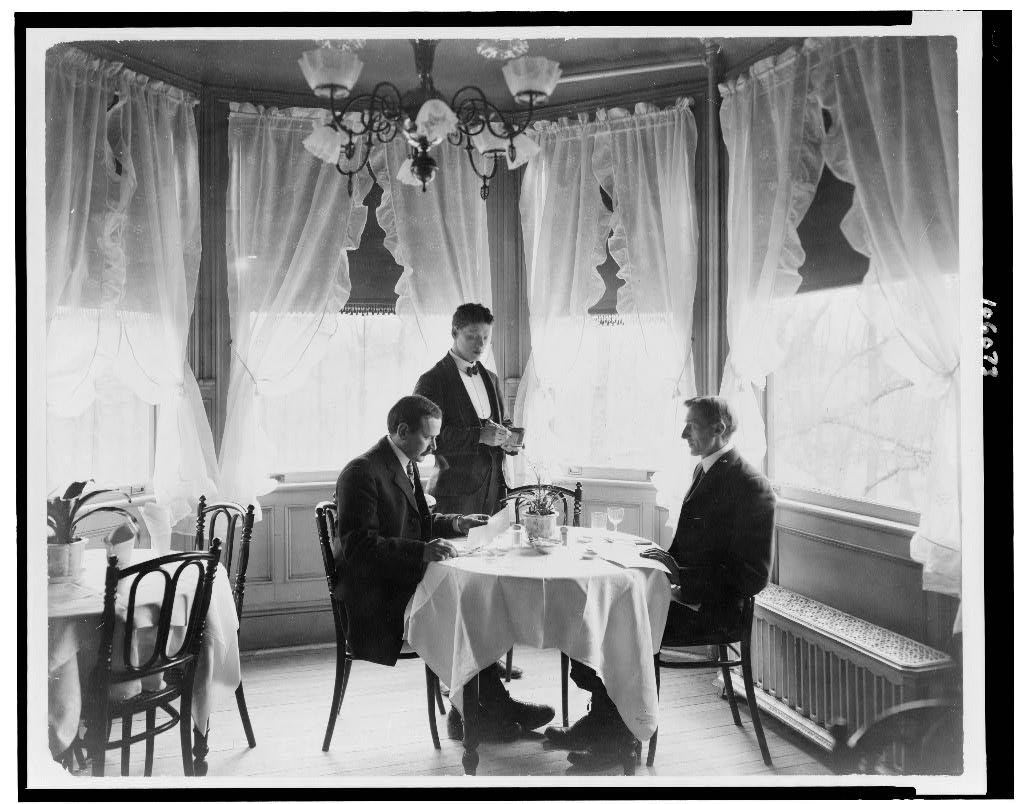
The cover photograph, made around 1906, shows a waiter taking an order from two seated men.[5] It catches the moment when hospitality becomes information: a preference leaves the guest, enters the restaurant's working memory, and later has to return as the correct dish. The notebook, ticket, and modern point-of-sale screen are different tools for the same relay. Lose the guest's position anywhere along it and the dining room has to ask the table to reconstruct its own order.
That is why seat one matters. It is not the most important guest. It is a fixed point from which everybody else becomes findable.
One fixed point makes the whole table legible
A common restaurant convention is the pivot-point system. The house chooses a stable reference for each table—perhaps the seat facing the kitchen, an entrance, a window, or another architectural feature—calls that position one, then numbers the remaining positions clockwise. The exact compass direction is less important than consistency. Nicolet College's dining-room training text reduces the resulting order to a compact address: “Table 12, seat 3, salmon.”[1]
Table number and seat number solve different problems. The first gets a server to the right island in the room. The second gets a plate to the right person once the server arrives. National Checking's guide to restaurant order pads shows how that address can persist through several hands: the order taker records each guest clockwise, enters the items by seat, and sends a ticket on which the kitchen and a different food runner can still see the positions.[2]
The system is almost comically small. There is no visible technology at the table, no flourish, no speech. Yet a single shared reference point lets the captain, sommelier, kitchen, expediter, runner, and cashier discuss one diner without relying on a name, a shirt color, or the memory of whoever first took the order.
It also makes absence legible. An empty chair should not cause every position after it to slide around in the team's imagination. If a four-top has only three guests, the house needs one rule about whether it numbers physical places or occupied guests and must teach that rule before service. A pivot system fails when each employee uses a sensible convention of their own.
The food auction is a tiny break in the spell
“Who had the turbot?” sounds harmless. Sometimes it is the safest possible question. But when it follows every course, it reveals that the restaurant has handed its sorting problem back to the guests.
The trade calls this a food auction: a runner names dishes and waits for diners to claim them. National Checking presents pivot points as the antidote because the same seating diagram can travel from handwritten order to kitchen ticket to the person carrying the food.[2] What disappears is not only a question. So do the pointing, the half-raised hands, the interruption, and the brief uncertainty over whether the dairy-free plate has been set in front of the right diner.
Fine dining magnifies that benefit. A tasting menu may ask several people to arrive at once with plates from different stations. Nicolet's service text treats simultaneous delivery as the critical rule for keeping hot food hot and recommends coordination when one server cannot carry every plate for the table.[1] Seat positions give that little landing operation a script. Each runner can approach already knowing the destination, and the group can place together instead of clustering at the table edge to negotiate.
This is the useful paradox of formal service: the more disciplined the backstage communication, the less procedural the meal feels. Accuracy creates ease. A guest experiences recognition, while the restaurant experiences a well-maintained coordinate system.
A seat number becomes a route through the restaurant
Modern restaurant software makes the hidden map explicit. Lightspeed's table-service documentation allows an item to be assigned both to a seat and to a course. The seat can carry notes and allergen warnings; the course can be held until a server fires it to the kitchen. Once sent, that information appears on printed tickets or the kitchen display system.[3]
Imagine four guests deep into a long menu. Seat two needs the crustacean-free variation. Seat three has accepted a supplemental course. Seat four is drinking the non-alcoholic pairing. Those facts do not belong in one server's head as three separate favors. They need addresses that survive a shift change, a sommelier handoff, a runner helping another section, and the noisy minute when the next course is called at the pass.
Seat-level records create that continuity. A course note can tell the kitchen what changes now. A seat note can tell the room for whom it changes. The distinction is operationally elegant: course is when; seat is where.
It also clarifies pacing. Lightspeed's workflow lets a server fire the next course when the guests are nearly finished with the current one.[3] At a four-top, that action concerns the table as a shared clock, but the plates within the course still have individual destinations. Good tasting-menu service therefore runs on two scales at once: the room reads whether the group is ready, while the seat map preserves each person's version of what comes next.
The system is only as true as its last update. Guests trade places to see the room better. A child moves beside a parent. A late arrival takes the open chair. Somebody carries a wineglass to the banquette and stays there. When bodies move, the record must move with them. Otherwise the very tool designed to prevent guessing gives the mistake an air of confidence.
An allergy is not just another modifier
Seat numbers are especially valuable when plates differ for safety reasons, but this is also where their limit has to be stated plainly: a position is an address, not an allergy protocol.
Food Allergy Research & Education's restaurant guidance calls for a designated staff member, ideally a manager, to communicate the diner's needs to the kitchen; a written, highly visible notation on the ticket; attention to cross-contact; and direct delivery of the special order by the designated person. It warns that writing only “no cheese” is not equivalent to telling the kitchen that the guest has a milk allergy.[4]
The seat map can answer where does the approved plate go? It cannot answer was the cutting board clean, did the sauce contain the allergen, was the garnish changed, or did another dish brush against this one? Those are ingredient, process, supervision, and handling questions. A restaurant that attaches “allergy” to seat two but treats it as an ordinary preference has digitized the danger rather than controlled it.
The correct chain is layered. First, the restaurant establishes what the guest cannot eat and whether it can accommodate the request. Then the kitchen marks and prepares the order under its allergy procedure. Finally, a stable seat address helps the designated person deliver it without auctioning the special plate across the table. The number is strongest when it supports human confirmation rather than pretending to replace it.
That boundary also explains when a quiet question is good service. If guests have moved, the ticket is ambiguous, or the runner has any doubt about a safety-critical plate, breaking the spell is cheaper than preserving the choreography. Silent service is an outcome of reliable information, not a vow of silence.
The map should make people feel seen, not sorted
There is a temptation to call every recorded preference personalization. The pivot system is more modest and more useful. It does not need to know a diner's biography. It needs to keep the immediate promises of this meal attached to the right place: the ordered dish, the chosen pairing, the skipped course, the allergy protocol, the birthday plate held until the whole table is ready.
That modesty is part of its grace. A dining room can use seat data to reduce interruption without turning the table into a dossier. Notes should be accurate, necessary, and written so that the next colleague can act on them. “Seat three: no alcohol” is operational. A speculative judgment about why belongs nowhere on the ticket.
The 1906 photograph cannot tell us which notation system its waiter used.[5] What it preserves is the older human shape of the problem: one person listens beside the table, two people trust that listening, and the restaurant must later convert words into correct service. Today's screens can carry far more detail, but they have not changed the essential test.
A great dining room does not look efficient in the manner of a conveyor belt. It looks attentive. Plates arrive together. Variations land without announcements. The server can name the dish instead of asking who owns it. The guest feels remembered because the restaurant has built a memory that does not depend on one person remembering everything.
Seat one is the beginning of that memory. It gives the table an invisible north, then lets the room stop guessing.
Sources
- Nicolet College Pressbooks, “Chapter 4: American Service” — culinary-student training text covering pivot-point selection, clockwise guest-position numbering, coordinated delivery, and simultaneous service.
- National Checking Company, “How seating diagrams on the GuestCheck order pad benefit restaurants” — operational walkthrough of recording seats, transferring position numbers to kitchen tickets, and avoiding the food auction.
- Lightspeed Restaurant, “Adding orders in Table Service mode” — product documentation for assigning items, notes, and allergen warnings by seat; organizing items by course; and firing later courses to production.
- Food Allergy Research & Education, Welcoming Guests with Food Allergies — front-of-house guidance on written ticket alerts, cross-contact, designated staff, and direct delivery of special orders.
- Library of Congress, “Waiter taking an order from two men in restaurant” — catalog record and digitized photographic print created around 1906, used as the article image.