A coulibiac invites a small act of suspense. The pastry arrives closed; the knife reveals what the cook has arranged inside. Fish, grain and other fillings can make a slice feel like several preparations meeting at once. Its appeal belongs as much to the cut surface as to the golden crust.
Yet there is no single filling that explains its travels. Read across the recipes and this Russian pie changes size, acquires different doughs and reaches the table with different companions. The history is especially revealing because French cookbooks preserve the changes. Coulibiac entered their repertoire through adaptation, and later cooks kept finding room inside it.[1][2][3]
Before Escoffier, another cook was watching
Culinary historian Christianne Muusers traces an early account to Carême's Le Pâtissier royal parisien of 1815. After watching the Russian ambassador's cook, Carême described a pie containing salmon, goose liver, egg and rice. The Russian cook said it needed no sauce; Carême proposed a brown sauce alongside.[1]
Even what to put beside the pie was open to negotiation.
Muusers also reproduces small chicken coulbacs from the fifth volume of L'Art de la cuisine française, completed by Armand Plumery after Carême's death and published in 1844. Rice, egg, mushrooms and horseradish join the chicken inside puff pastry.[1] The earlier repertoire already contained variety.
A place in the grand kitchen
Escoffier's A Guide to Modern Cookery, first published in English in 1907, gives salmon coulibiac a numbered place in the professional repertoire: recipe 789. The digitized copy is a later impression of the revised edition, so it is that surviving text we can inspect directly.[2]
Its outer casing is unsweetened brioche. Inside go salmon, mushrooms, onion, chopped hard-boiled eggs, grain and vesiga, a dried sturgeon ingredient.[1][2] Escoffier allows either semolina kache or rice cooked in consommé. Even here, in a book associated with culinary codification, the cook receives a choice.[2]
The grain deserves attention. Calling the dish salmon in pastry leaves it sounding like a fillet with a decorative jacket. In Escoffier's instructions, grain begins and ends the stack of filling. Between those layers, the fish shares space with several separately prepared ingredients. The slice is a composition; salmon supplies only part of it.
Vesiga reveals how much work could disappear under the crust. Escoffier specifies dried vesiga, a minimum four-hour soak and a further three and a half hours of cooking in consommé or water. Only then is it ready for the filling. The assembled brioche must rise, too, before baking.[2] The finished pie conceals a sequence of preparations that started long before anyone rolled out the dough.
His final instruction is gloriously lavish: add freshly melted butter after the coulibiac leaves the oven.[2] Imagine what that does to the reading of a slice. The browned casing promises a breadlike bite, while the interior holds moist grain, fish and butter. This is a substantial, enclosing form of luxury, with much of its detail revealed only after service begins.
The recipe documents Escoffier's version; it establishes no claim to the dish's first arrival in France. Codification is one moment in a longer exchange.[1][2]
A pie fit for the buffet
James Beard approached the dish with the person holding a plate in mind. In the recipe preserved by his foundation, he praised coulibiac for slicing neatly and being manageable with a fork at a buffet.[3] Ease of eating becomes part of its elegance.
His version keeps brioche but changes the interior. Unsweetened crêpes separate layers of white fish, butter and parsley, with salmon at the center. The recipe omits the grain and vesiga of Escoffier's preparation, and melted butter accompanies the finished roll.[3]
Read beside the earlier recipe, this is a useful reminder of how traditions remain recognizable while their contents move. Beard preserves the generous enclosed form and the pleasure of a composed slice. His introduction also changes the imagined setting: the pie must behave well after someone has carried a portion away from the serving table.
The whole pie becomes one person's dinner
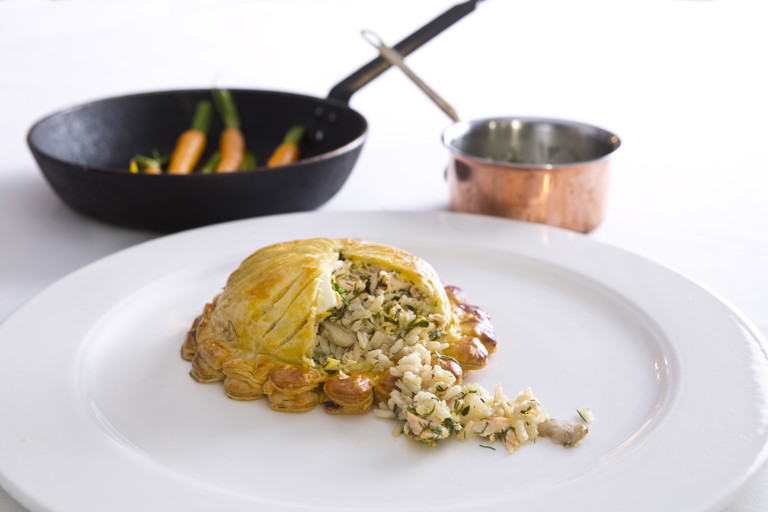
The photograph shows another adjustment. Andrew MacKenzie's recipe, published by Great British Chefs in 2015, makes individual puff pastry pies. Cooked salmon is flaked and mixed with brown basmati rice, mushrooms and chopped egg. Dill sauce and glazed vegetables arrive alongside.[4]
A mound of mixed filling gives a different cut surface from Escoffier's ordered layers. An individual casing also gives each diner a whole decorated top and sealed edge. These are changes a guest can experience directly, before knowing anything about the recipe's ancestry.
MacKenzie retains fish, grain and the enclosing crust, while choosing a portion that needs no carving at the table.[4] His pie belongs in this story as a documented adaptation, rather than a reconstruction of the older versions.
Following these recipes makes coulibiac more interesting to encounter on a menu. Its name opens a conversation about choices: what fills it, what surrounds it, how it is divided, and what arrives beside it. The pleasure of the first cut remains. What the knife reveals can tell you which part of a long, adaptable tradition this particular cook has chosen to carry forward.
Sources
- Christianne Muusers, “Coulibiac with chicken, a recipe from Carême,” Coquinaria — historical discussion and transcription of the 1844 chicken recipe.
- Auguste Escoffier, A Guide to Modern Cookery, first published 1907; revised edition, 1920 impression, Project Gutenberg — recipe 789, “Coulibiac de Saumon,” and publication history.
- James Beard Foundation, “Coulibiac of Salmon” — Beard's buffet-service introduction and brioche, crêpe and fish preparation.
- Andrew MacKenzie, “Salmon fish pies,” Great British Chefs, first published 2015 — individual coulibiac adaptation and source photograph.