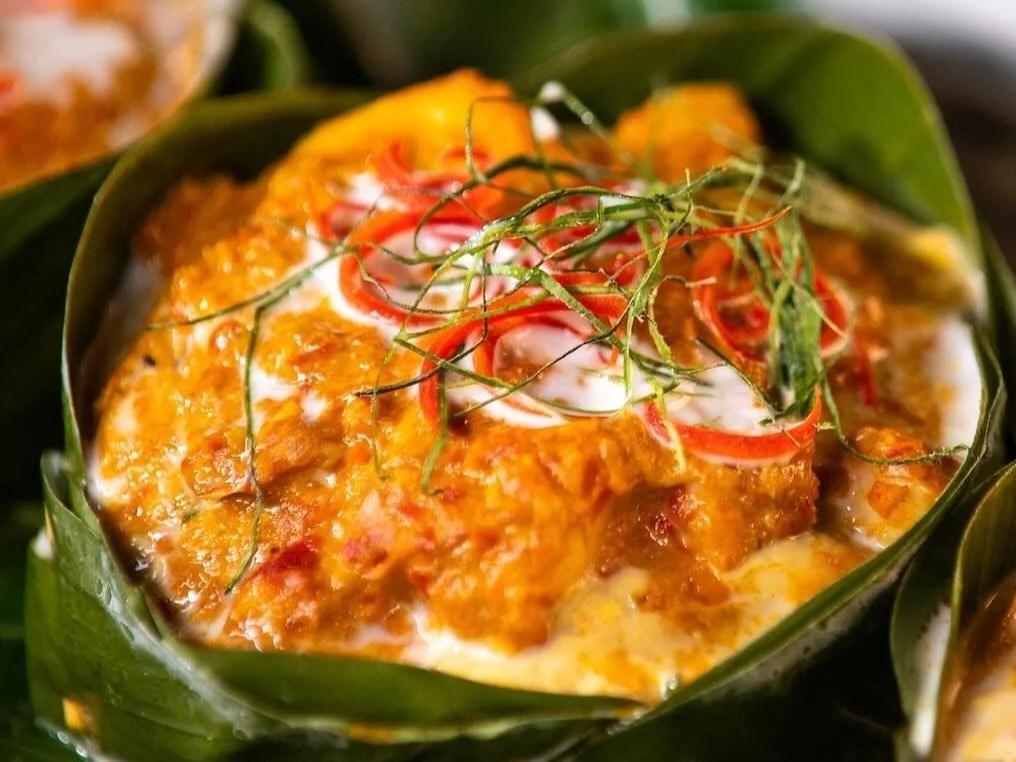
A spoonful of fish amok carries several pleasures together: fish, fragrant coconut, and the soft resistance of a savory custard. In Chef Nak's published preparation, red pepper and finely shredded lime leaves finish the surface; folded banana leaves make a small green cup around it.[1] The presentation is compact, but there is plenty to discover beneath the garnish.
Calling amok a fish curry leaves its texture to the imagination. In the steamed form, the coconut mixture has enough body to gather the fish into a soft, spoonable mouthful.[2]
Beneath the coconut
Nak describes kroeung, the aromatic paste in her amok, through lemongrass, galangal, turmeric and lime. Her recipe includes shrimp paste and palm sugar alongside the coconut cream.[1] Read those ingredients together and the richness acquires some edges: citrus fragrance, savory depth, a measured sweetness. Coconut supplies a generous background for the other flavors.
The fish matters within that background. Lara Dunston's Grantourismo account, based on cooking with an older Cambodian family in Siem Reap, records a preference for freshwater goby, snakehead or catfish. The accompanying recipe also allows alternatives such as snapper and cod, and uses fermented fish paste, prahok, with shrimp paste offered as a substitute.[2]
These are useful details for reading a restaurant menu. “Fish, coconut, herbs” can describe the plate without telling you very much about it. The species and fermented seasoning begin to reveal the cook's particular version. A mild fillet and a forceful condiment occupy the same little cup; their proportions deserve as much attention as the decoration.
A container with a job
Nak makes her cups from paired circles of banana leaf, folding corners and securing them with toothpicks. The mixture goes into them before steaming. Coconut cream and the sliced garnishes arrive near the end of cooking.[1]
The cup therefore gives the dish its shape while it cooks. By the time it reaches the table, preparation and presentation have become the same object. There is an appealing economy to that: the folds remain visible, and the diner can see the vessel that held the mixture as it set.
Other containers can preserve that relationship. Luke Nguyen's seafood amok, published by SBS, steams fish, prawns and squid in small coconut shells or heatproof moulds. Noni leaves, with spinach offered as an alternative, line the bottom.[3] His version makes the distinction between the outer vessel and the edible leaf underneath especially clear. Both have a place in the dish, and they perform different jobs.
The spoon tells you more than the color
The mixture inside can vary, too. Grantourismo's recipe distinguishes between lightly combining the ingredients to retain pieces of fish and stirring more vigorously for a smoother result. It also describes amok ranging from yellow-green to orange-brown, depending on the paste and chili.[2]
That makes color a poor verdict on its own. A bright surface may draw the eye, but the first spoonful answers the more interesting question: how has the cook chosen to bring fish and custard together? Distinct pieces interrupt the softness; a smoother mixture makes the mouthful feel more continuous. Neither effect can be read reliably from the garnish.
Nguyen calls for the mixture to set with a light, soufflé-like texture. His method includes a second addition of reserved seafood liquid during steaming, then finishes with coconut cream and lime leaves.[3] The description offers a useful expectation of delicacy, without requiring every amok to have precisely the same consistency. The fascination lies in how much variation a small, apparently simple serving can contain.
One name, more than one route
There is a complication worth keeping at the table. Cambodia's embassy in London publishes an Eleven One Kitchen recipe associated with chef Soklim Srun that cooks the paste and fish in a pan, adds coconut milk, and transfers the finished mixture into a leaf container. A separate note describes an original steamed preparation involving egg.[4]
The page documents two routes rather than one universal procedure. It also stops an attractive banana-leaf serving from becoming proof that its contents were steamed there. A diner interested in the custard texture has a practical question to ask: how is this kitchen's amok cooked?
That question leaves room for preference without turning a meal into an authenticity examination. A pan-cooked preparation may offer its own pleasures. The point of describing the steamed form carefully is to make its particular pleasure legible: the seasoning becomes part of the soft structure surrounding the fish.
Leave room for rice
Nguyen serves his amok with jasmine rice, while Grantourismo suggests placing it among several shared dishes.[2][3] Both arrangements give the rich spoonful somewhere to go.
Try a little by itself, then with rice. Notice how much fish each spoon carries and how the coconut and aromatics linger around it. The leaf cup invites attention, but the most rewarding detail is inside: a carefully seasoned mouthful that holds together just long enough to reach you.
Sources
- Chef Nak, “Cambodian Fish Amok,” from NHUM: Recipes from a Cambodian Home Kitchen — ingredients, leaf cups, steaming, garnish, and the article photograph.
- Lara Dunston, with recipe by Terence Carter, “Cambodian Fish Amok Recipe for an Authentic Steamed Fish Curry in the Old Style,” Grantourismo — firsthand recipe research, fish choices, texture, color, and shared service.
- Luke Nguyen, “Royal seafood amok,” SBS Food, June 25, 2015 — a seafood variation, coconut shells or moulds, leaf lining, staged steaming, and rice.
- Royal Embassy of Cambodia in London, “Fish Amok Recipe,” February 11, 2022 — Eleven One Kitchen's pan-cooked preparation and its separate note on the steamed form.