Before feteer meshaltet turns golden, it becomes almost transparent. In Amira Ibrahim's method, the dough is stretched until the worktop shows through it. The cook brushes, folds and wraps that broad sheet into something small enough for a baking dish.[2] Much of the pastry's appeal lies in this change of scale: a generous expanse of dough, gathered into a round whose layers will come apart at the table.
Feteer has a social generosity to match. UNIDO's 2020 inventory of Egyptian terroir foods describes it as a hospitable offering, associated with weddings and religious occasions but eaten throughout the year.[1] Its richness belongs as comfortably to a shared table as to the pastry itself.
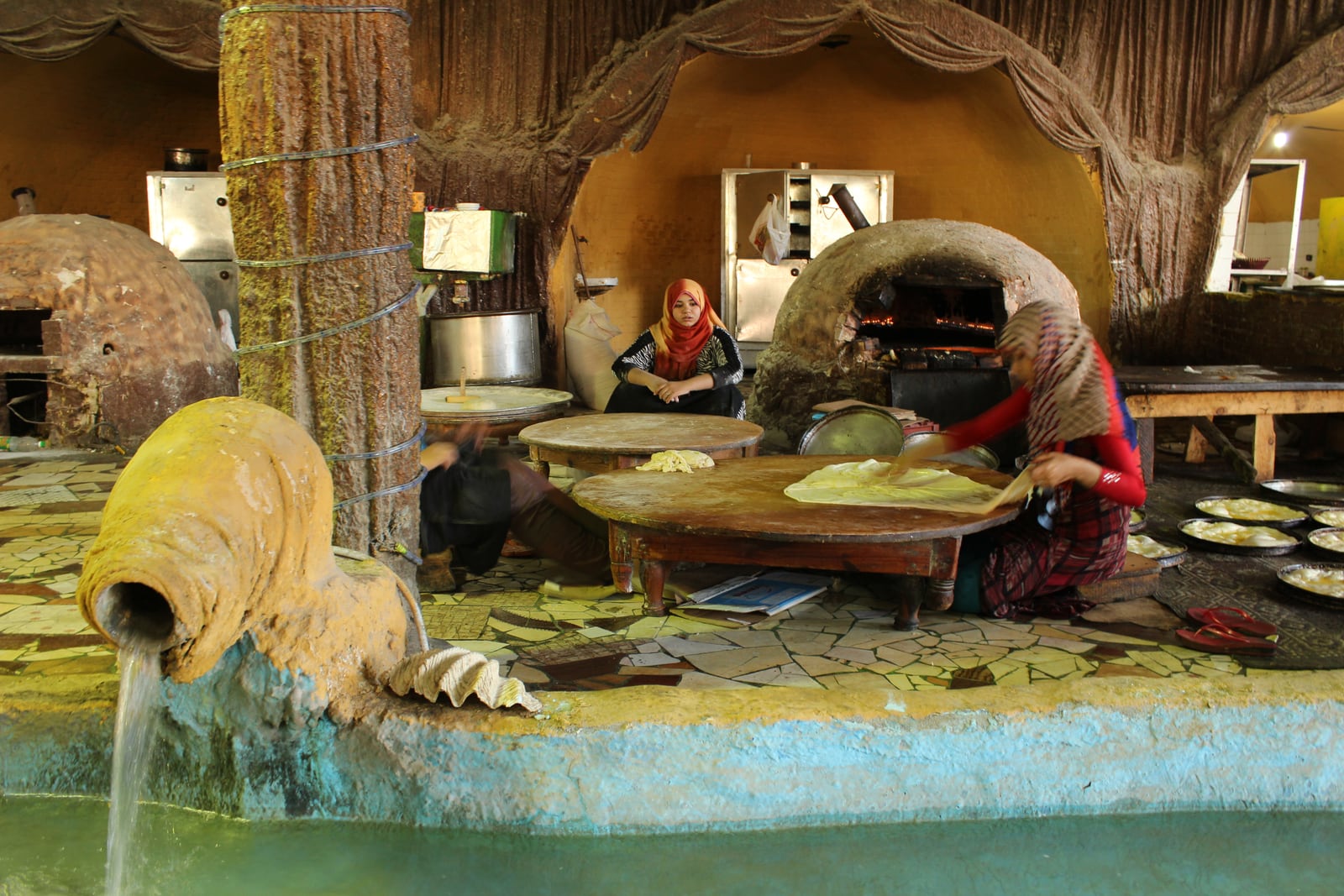
The knowledge in the hands
The UNIDO inventory locates generations of production in Minya and Menoufia. It describes small household and enterprise producers, with sales reaching customers through farmgates, markets, hotels and personal networks. Knowledge passes between generations.[1] That is a useful setting for understanding the craft: a repeated domestic gesture can also be a livelihood and a welcome.
Sawsan Abu Farha, writing at Chef in Disguise, remembers being captivated by a feteer maker's dexterity during her honeymoon in Cairo. Her own account translates that spectacle into manageable kitchen work, using a family recipe shared through a cooking challenge.[3] The interest is in what skilled hands are accomplishing. Every stretch makes more surface available; every fold brings that surface back into the pastry.
Give the sheet room
Ibrahim begins with flour, water and salt, kneading toward an elastic dough and resting the portions in fat before stretching. Her visual test is wonderfully direct: the counter should be visible through the sheet.[2] It gives a cook something to judge without pretending that a timer alone can describe the dough.
Abu Farha emphasizes a wet, sticky dough and gives her divided portions an hour's rest under melted ghee. She spreads each portion gently on a greased surface.[3] Read together, the methods put the dramatic moment in perspective. The broad, thin sheet depends on the preparation that precedes it. The baker's performance has a quiet first act.
For a diner, this is an appealing way to read the finished pastry. A plain round carries evidence of work that has become difficult to see. Its surface offers only a hint; opening it reveals what the cook spent time assembling.
Two ways to gather the layers
Ibrahim folds the first sheet into a parcel, then puts it inside another stretched sheet and wraps again, brushing fat between folds. Successive sheets build one larger package. Abu Farha folds in thirds in two directions to make a square; for her plain version, each square can become its own pastry after another rest and gentle flattening.[2][3]
The distinction matters. One method nests already folded dough inside new sheets; the other develops a pastry from a single folded sheet. Both make the broad surface do several jobs by bringing it back over itself. Simply counting the original dough balls would tell a reader little about how either pastry was constructed.
Lamination is the useful pastry term here: building distinct layers of dough and fat. King Arthur Baking's account of classic puff pastry illustrates another route, enclosing a cool, pliable butter block and rolling and folding the package.[4] Feteer's brushed sheets offer a different sequence. The comparison helps explain the shared ambition—layers that retain their identity—while keeping the handling methods clear.
Read the oven with the recipe
Even the oven settings resist a single universal rule. Ibrahim specifies 550°F, while Abu Farha gives 190°C, approximately 375°F.[2][3] Those instructions belong to their respective preparations. Combining the folding sequence from one with the temperature from the other would create an untested third recipe.
King Arthur's puff-pastry explanation describes steam lifting the layers during baking.[4] That is a helpful lens for watching a layered pastry expand: the oven makes the separation visible. Browning supplies another pleasure, setting a golden exterior against the folded interior. A photograph of the top can suggest richness; the way a piece opens tells more of the story.
Leave the last choice to the table
Abu Farha serves her plain feteer with honey, jam, feta and green olives.[3] The assortment makes the pastry a meeting place for salt and sweetness. A piece can pick up a little honey; the next can accompany cheese. The cook has done the intricate work of stretching and gathering. The guest gets the easy, pleasurable task of deciding what belongs on the next bite.
Sources
- UNIDO, Inventorying of Egyptian Terroir Food Products (2020), page 41 — regional production, hospitality, knowledge transmission and routes to market.
- Amira Ibrahim, “Egyptian Feteer meshaltet,” Amira's Pantry, updated 24 June 2020 — dough preparation, nested sheets and baking method.
- Sawsan Abu Farha, “Feteer meshaltet ‘Egyptian layered pastry’,” Chef in Disguise, 3 February 2015 — first-hand account, folded-square method and serving accompaniments.
- Amber Eisler, “How we make puff pastry at the King Arthur bakery,” King Arthur Baking, 2 August 2013 — comparison with butter-block lamination and steam lifting the layers.
- Mohamed Ouda, “Egyptian-food-47.jpg,” Wikimedia Commons, photographed 22 November 2014 — original photograph and CC BY-SA 4.0 attribution details.