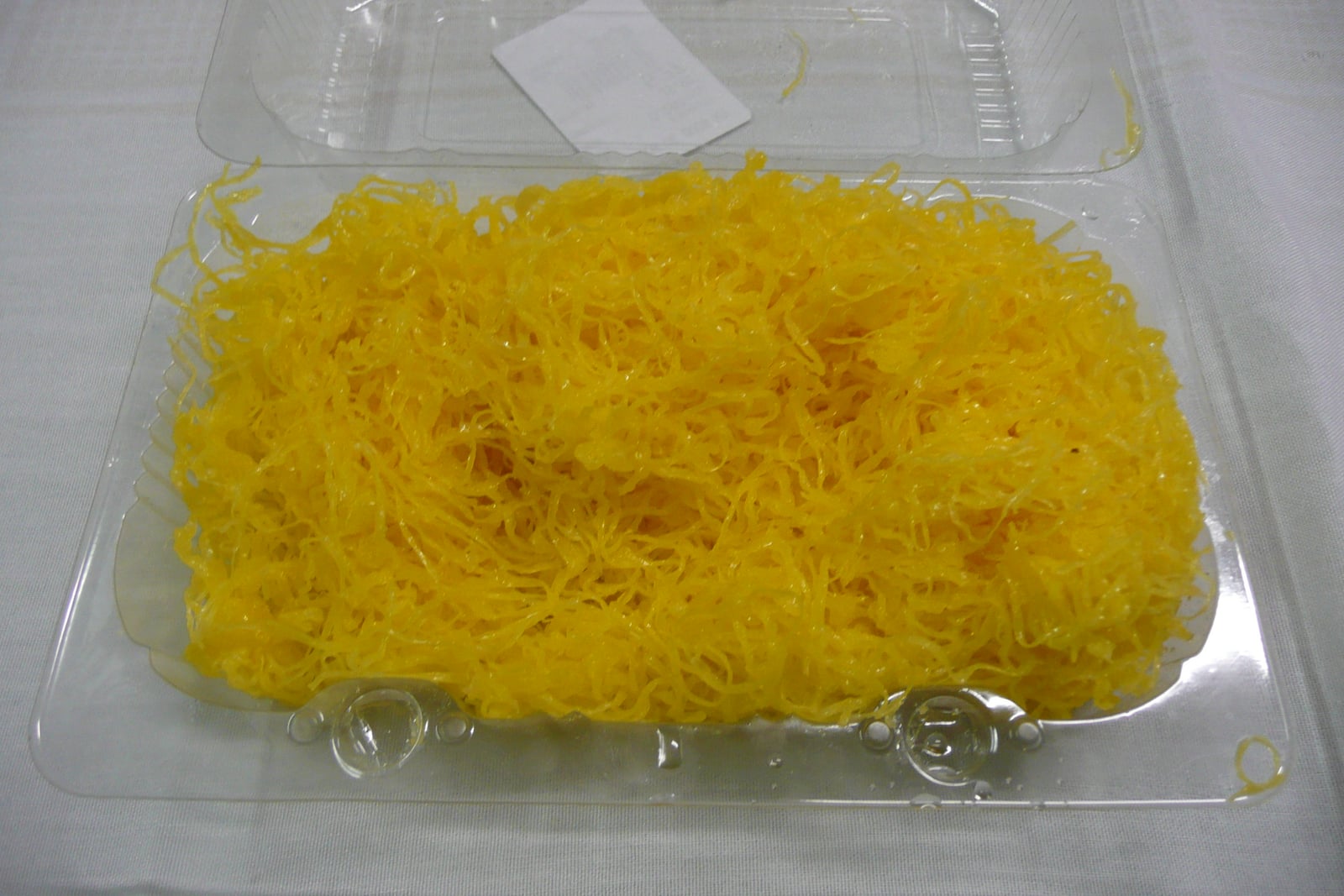
A fine stream of yolk falls into bubbling sugar syrup. The hand holding the funnel travels in circles; behind it, the liquid becomes a golden strand. Chef Carole Crema describes this transformation in her account of fios de ovos: the egg coagulates as it enters the syrup, and a wide pan gives the cook room to make long threads.[1] The finished tangle carries a record of that movement.
There is a particular extravagance to making something so fine from ingredients so familiar. Egg and sugar can fill a bowl with curls, loops and glistening ends. Understanding the craft means following the yolk through several changes of condition: smooth enough to pour, firm enough to lift, then loose enough for the strands to remain distinct. Published Portuguese recipes make those transitions unusually visible.
The thread begins above the pan
Straining comes before the flourish. In its method for homemade fios de ovos, Teleculinária describes gently opening the yolks with a fork in a sieve, allowing them to pass through while their pale membrane stays behind.[3] It is quiet preparation, easily overlooked beside the more theatrical pouring. Yet a funnel with narrow openings rewards a smooth liquid.
The egg mixture itself varies. Vaqueiro's recipe combines ten yolks with two whole eggs and passes the mixture through a strainer three times. Cátia Goarmon's version for 24Kitchen uses twelve yolks and one white.[2][4] These differences matter when reading recipes: “egg threads” names a preparation, rather than prescribing one universal ratio of yolk to white.
Crema describes a specialized funnel with five spouts. Filled with strained yolks and moved in circles over a broad pan, it makes several streams at once.[1] The utensil multiplies the hand's work, while the cook supplies the path. Imagine the difference between tracing a circle and pouring repeatedly onto one spot. The circular instruction gives each arriving stream somewhere to go.
This is a useful way to look at the confection on a plate. Its delicacy begins in the relationship between flow and movement. The cook is shaping the egg during its passage into the heat.
The syrup needs attention between batches
A recipe's starting quantities describe only the beginning of the syrup's life. Continued boiling removes water. That becomes important when the cook is standing over the same pan, making one small batch after another.
Teleculinária's method for the threads used in pingos de tocha explicitly calls for a few drops of cold water before adding more yolks, to prevent the syrup becoming too thick.[3] The instruction reveals a task hidden behind the finished sweet: keeping the cooking medium usable while the work proceeds.
Vaqueiro likewise tells the cook to replenish the syrup with small additions of water to maintain its density and to skim away foam. Its specified syrup stage is ponto de pérola, or pearl stage; Goarmon's recipe calls for ponto de fio, or thread stage.[2][4] The published methods share a recognizable technique while differing in their formulas and cues. Combining one recipe's egg mixture with another's syrup instructions would create a new method, whose results those sources have not established.
For someone learning the craft, the sensible approach is to follow one complete recipe and attend to its signs. For someone watching a pastry cook, the revealing moment may be the pause between pours. A glance into the pan, a small correction, the next measured portion: the repeatability of the threads depends on work that barely appears in the final presentation.
Lifting is only part of finishing
The threads still need handling after they set. Vaqueiro transfers them to a strainer, briefly dips and agitates it in cold water, then drains the strands and separates them with a fork.[2] Goarmon moves hers into iced water and then onto absorbent paper to remove excess moisture.[4]
Teleculinária's pingos de tocha method instead lifts the strands into a drainer and leaves them to cool.[3] Cooling and draining are therefore worth reading as part of each recipe's particular sequence. They are preparation for the next use, as consequential to the finished sweet as the more photogenic act of pouring.
The fork has a modest but important role here. It lets the cook tease the cooked strands apart. A loose curl can catch the light along its length; a compressed clump presents a different surface. What looks effortless in a finished serving may have required attention after the pan was already off the cook's mind.
A pastry ingredient with more than one job
Once made, fios de ovos can become part of a larger sweet. In Goarmon's Dom Rodrigo, they join yolk cream, ground almonds, cinnamon and a little syrup. The mixture goes into paper-lined foil parcels, or into small bowls for eating with a spoon.[4] The threads give a visible structure to a confection whose other components gather around them.
Teleculinária's trouxas-de-ovos offers another relationship. The recipe makes thin, crêpe-like sheets of egg in syrup, puts fios de ovos inside and rolls them into bundles. It then browns the bundles under a grill and serves them cooled with reserved syrup; its note also permits leaving them unbrowned.[5]
Here the same small family of ingredients supplies a wrapper and a filling. The sheets enclose; the threads occupy the centre in a tangle. The difference begins with how the egg meets the pan: a spoonful allowed to spread, or a moving stream drawn into lines. That is the pleasure of looking closely at fios de ovos. A tiny change in the cook's gesture becomes something the diner can see on the fork.
Sources
- Carole Crema, “Fios de ovos é prato típico portugues feito com dois ingredientes; aprenda,” BandNews FM, October 25, 2023 — coagulation, the five-spout funnel and the wide pan.
- Vaqueiro, “Fios de Ovos” — egg mixture, repeated straining, pearl-stage syrup, replenishment and cold-water finishing.
- Teleculinária, “Receita de pingos de tocha” — homemade egg threads, yolk membranes, syrup adjustment and draining.
- Cátia Goarmon, “Dom Rodrigo,” 24Kitchen — thread-stage syrup, iced-water finishing and assembly with yolk cream and almonds.
- Teleculinária, “Trouxas-de-ovos com fios de ovos” — egg sheets wrapped around threads, optional browning and syrup service.
- LipeFontoura, “Fios de ovos,” Wikimedia Commons, 2009 — photograph of egg threads bought in Curitiba, Brazil; released into the public domain.