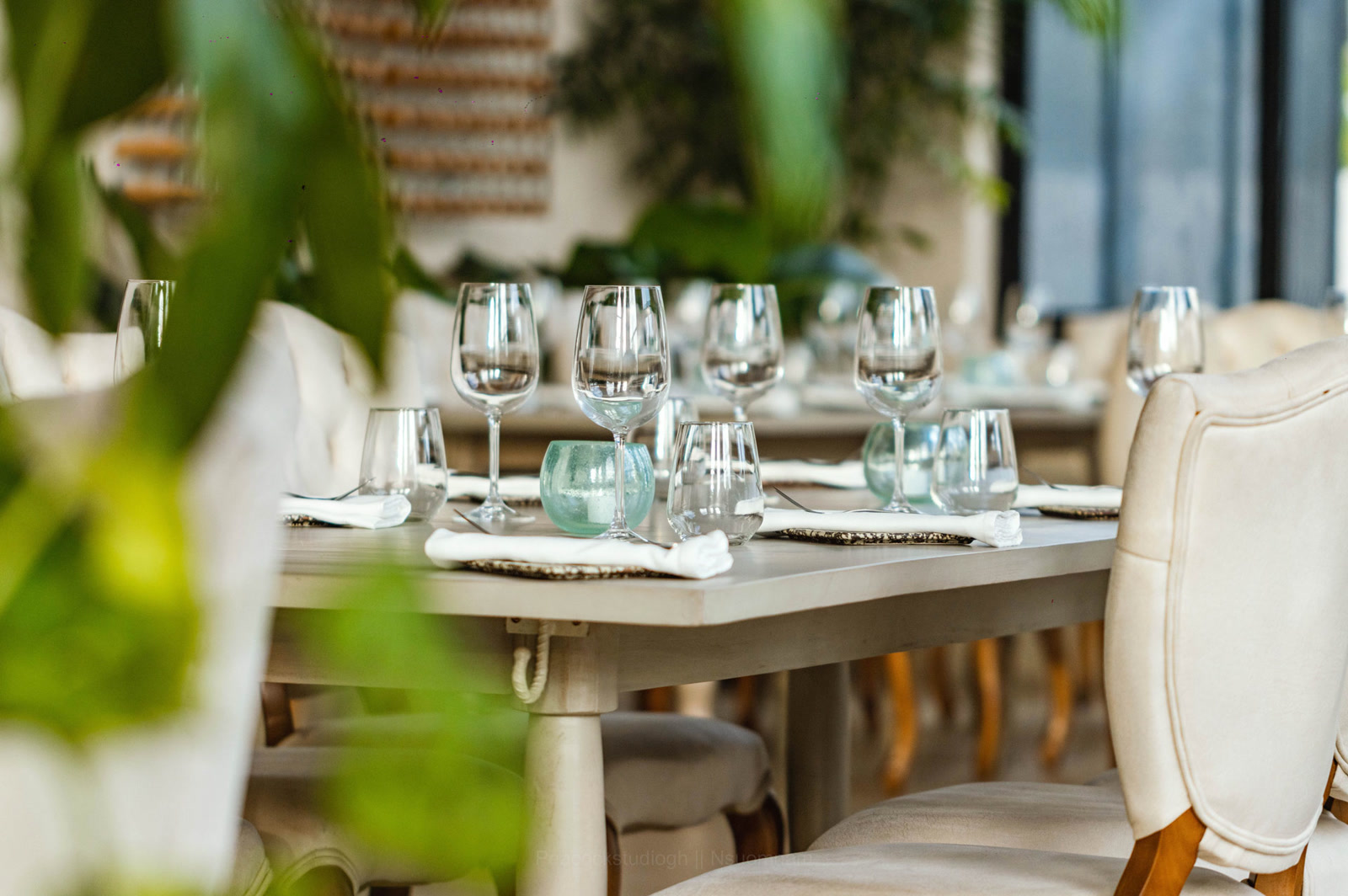
An empty table at NsuomNam already looks busy. Clear stems rise in little ranks; white napkins sit tightly rolled; pale chairs and a pale tabletop are softened by a large green leaf drifting across the camera's foreground. The official photograph is bright rather than clubby, formal without sealing Accra's tropical light outside.[8] A local report from the restaurant's first year found the same idea in the room's Ghana-made furniture, art and craft: place was meant to enter through the materials before dinner began.[5]
Then the menu arrives, and scale threatens to overwhelm place. There are mussels, clams, snails, shrimp, calamari, tilapia and several kinds of seasonal fish; there are burgers, pasta, oxtail and a GHS 1,050 sizzling seafood platter. Ordering the most expensive accumulation would be easy. It would also be the least revealing way to meet this kitchen.
The better first order follows a map rather than a price ladder: begin with fisherman's pepper soup, move inland through wagashi or northern fonio, let garri-crusted tilapia carry the main course, choose a cassava side that behaves like a dish, and finish with fura and nunu. That route makes room for five different transformations—broth, fresh cheese, grain, fermented cassava and cultured milk—instead of asking one heap of seafood to perform the whole restaurant.
This is a documentary ordering guide, not a disguised first-person review. As checked on 7 September 2026, NsuomNam's live menu page still links to a food-menu PDF stored under an October 2024 path. The restaurant also calls its cooking “ever-evolving.”[1][2] The dish names and prices below therefore describe the menu currently linked by the restaurant, not a promise about what will be on the pass when you arrive. Confirm availability and prices when booking; the online form handles tables of up to ten and directs larger parties to the booking team.[3]
Use one rule: choose the dish that names its work
NsuomNam describes itself as a pan-African seafood restaurant and says it mainly buys from local fishers, farmers and artisans, while growing herbs in a kitchen garden.[2] Its published record also shows that “pan-African” here has never meant untouched tradition. In a 2024 interview, then-head-chef Mick Élysée described applying classical technique to African staples, using sorghum flour in pastry and pasta, featuring millet and fonio elsewhere, and retaining methods such as banana-leaf cookery.[4] The current site credits chef Akwuebue Ikenna Bobmanuel with introducing a conscious, pan-African menu.[2]
Teams and dishes can change. The durable ordering clue is more modest: select plates whose descriptions tell you what the kitchen is doing to a particular ingredient. “Garri crust,” “iru palm-oil rice,” “wagashi emulsion” and “fura crumble” each give the diner something to notice. “Seasonal seafood mix with lime, garlic and herbs” mostly promises quantity. On a first visit, specificity is the more interesting luxury.
Start with steam, not crunch
Open with the mussels and clams pepper soup, GHS 85. On paper, it is the sharpest-value introduction on the menu: shellfish in a spicy fisherman's broth with scent leaf.[1] The point is not that frying is beneath fine dining. It is that the same starter page offers black Atlantic mussels with lemon-butter sauce and breadcrumbs for GHS 190, popcorn shrimp for GHS 185, and fried calamari for GHS 150.[1] Those familiar formats delay the question NsuomNam is best placed to answer: what does an ambitious seafood restaurant in Accra make legible that a competent seafood restaurant anywhere else might not?
Pepper soup answers with aroma and heat rather than armor. It should arrive as an appetite-opener, not a wall of batter. Shellfish sweetness has broth around it; scent leaf gets room to rise; the table starts with spoons and steam. That sensory forecast comes from the menu description, not a tasting claim. Execution still belongs to the kitchen, and anyone with a shellfish allergy should treat the menu's category labels as a prompt to speak with staff, not as a safety guarantee.
For a shellfish-free opening, choose the wagashi tomato salad, GHS 120. It also provides the best second course for a two-person table because it changes register completely.
Let wagashi interrupt the seafood
The current salad sets wagashi emulsion against macerated tomatoes, brassica greens, caramelized-onion tuile and coriander oil.[1] The words promise several scales of texture: milk made smooth, tomato made juicy, onion made brittle. More importantly, the plate stops a seafood restaurant from becoming monotonously marine.
Wagashi is not hidden under the generic label “cheese.” NsuomNam keeps its name in the dish title, just as earlier leadership spoke publicly about making African grains and traditional methods visible rather than using refinement to erase them.[1][4] That history is not evidence that today's salad tastes a certain way. It does identify a continuing restaurant instinct: take an ingredient with its own life outside fine dining, change its texture, and keep its name visible.
At a table of three or four, add the fonio shrimp salad, GHS 165. NsuomNam identifies its fonio as coming from northern Ghana and pairs it with shrimp, lettuce, roasted-cashew dressing and orange pearls.[1] Ghana's National Commission on Culture describes the country's food as a set of regional cultures rather than one uniform recipe book, associating northern foodways especially with grains such as millet and sorghum and Greater Accra with culinary convergence.[6] That context matters because the plate is not a miniature national costume. Cajun seasoning and orange pearls make the restaurant's outward-looking grammar plain. Order it as a conversation between a specifically located grain and a roaming kitchen, not as a claim that one salad represents “authentic Ghana.”
Make the garri tilapia the anchor
For the first main, choose the crispy garri tilapia, GHS 280. The menu describes tilapia under a garri crust with tomato-ginger and tartar sauces.[1] Every part of that line has a job: fish provides softness, cassava granules promise a rough shell, tomato and ginger pull toward warmth and brightness, and tartar sauce supplies a cooler counterweight. Whether those contrasts land is review territory. But the composition gives a diner a clear question to taste.
Add gari foto, GHS 50, rather than French fries or steamed rice. NsuomNam describes the side as fermented cassava and sweet-potato crumbs cooked in aromatic tomato stew.[1] Garri outside and gari within is not pointless repetition: one use is dry coating, the other absorbs liquid and fat. Put them beside each other and cassava changes from crust to body. That is a more revealing comparison than doubling down on crispness with fries.
If two diners need a second main, the fish moqueca, GHS 350, takes the meal outward without becoming generic. Its seasonal fish sits in an Afro-Brazilian sweet-pepper and dendê sauce and comes with a side.[1] For a larger table, consider the native seafood rice pot, GHS 650: prawns, octopus, calamari and clams in iru palm-oil rice.[1] The menu does not state a serving count for that pot, so ask before treating it as a communal centerpiece.
Those additions reveal NsuomNam's two directions. Tilapia, garri and gari foto make a Ghana-focused argument through one staple in two textures. Moqueca and the rice pot show ingredients and techniques moving around the Atlantic and the continent. A good order does not force the restaurant to choose between roots and routes; it prevents either story from swallowing the other.
Skip the platter—unless the kitchen can make it specific
On a first visit, skip the GHS 1,050 sizzling seafood platter. This is not a verdict on a dish I have not eaten. It is a verdict on information. The linked menu promises a fresh seasonal mix finished with lime, garlic and herbs on a hot plate, but does not name the species, landing place, individual preparations or intended party size.[1] At more than three times the price of the garri tilapia, spectacle is doing much of the descriptive work.
For a group that wants the theater, turn the platter into a conversation before ordering: What came in today? How many people is it designed to feed? Are the components cooked separately? Which fishery or farm supplied the shellfish? That last question is not performative virtue. NsuomNam's local-sourcing and sustainability language is a restaurant claim, not item-level traceability.[2] An FAO survey of Ghana's marine and inland small-scale fisheries organizations documents both their importance and persistent limits in assets, organization and collective sales.[7] “Local” can locate a relationship; by itself, it does not certify its environmental or economic quality.
The same first-visit logic puts the seafood pasta, burgers, French fries and brownie behind more distinctive choices. They may be exactly right for a mixed group or a repeat visit. They simply spend appetite on forms whose purpose is already familiar. Skipping them once is not snobbery. It is editing.
Finish where grain meets cultured milk
Order the fura cheesecake, GHS 150, and share it. The menu builds it from nunu cheesecake mousse, fura crumble and mango curd.[1] After a dinner that has repeatedly made soft things crisp and crisp things soft, the construction feels like a proper final rhyme: cultured dairy becomes mousse, grain becomes crumble, fruit cuts across both.
The alternative desserts reveal why choice matters. A brownie with tropical almond chocolate and sesame praline may be pleasant; warm pineapple with coconut ice cream may close the meal cleanly; an éclair filled with tigernut mousse at least gives the familiar pastry a locally resonant filling.[1] But fura and nunu return the order from seafood to grain and cultured milk. Dessert stops being a sugar curtain and becomes another transformation.
For two people, the compact route is pepper soup (GHS 85), wagashi salad (GHS 120), garri tilapia (GHS 280), gari foto (GHS 50) and fura cheesecake (GHS 150): GHS 685 at the linked prices, before drinks or any unlisted charge.[1] Treat that as a tasting route, not a portion guarantee. Ask the server whether appetite calls for the moqueca, bringing the food subtotal to GHS 1,035. For three or four, add fonio salad and discuss whether the seafood rice pot should replace—not merely join—the second main.
That final edit is the whole guide. NsuomNam can give a table more seafood, more courses and more sizzle. Its more unusual promise is to make distance collapse without making ingredients anonymous: a northern grain on an Accra table, a cassava staple in two states, fresh cheese refined without losing its name, Atlantic travel folded into pepper and palm oil.
The room supplies the polish. Order the map.
Sources
- NsuomNam, New Food Menu — the food-menu PDF currently linked from the restaurant's site, consulted for dish descriptions and listed GHS prices.
- NsuomNam, “Our Menu” — the restaurant's current account of its pan-African approach, evolving menu, kitchen garden, sourcing aims and credited chef.
- NsuomNam, “Bookings” — current address, contact details and the stated limit of ten guests for ordinary online reservations.
- Leila Darabi, “Chef Aims to Create Most Sustainable Restaurant in Africa,” Linewaiters' Gazette, 16 January 2024 — a dated interview with NsuomNam's then-head-chef on African grains, classical training, local producers and traditional cooking methods.
- Ameyaw Debrah, “NsuomNam: More than just a Seafood & Fish Restaurant,” 11 July 2023 — an early local visit describing the room's Ghana-made furniture and art, Lake Volta Bar and the restaurant's seafood positioning.
- Ghana National Commission on Culture, “Regional Representation and Diversity” — official context for Ghana's regional food cultures, northern grain traditions and Greater Accra's role as a culinary meeting point.
- Marta Improta, Luca Moncada, Ana Paula de la O Campos and Katia A. Covarrubias, Monitoring the challenges of marine and inland small-scale fisherfolks in Ghana. FAO, 2023 — organization-level evidence on livelihoods, market structures and constraints behind Ghanaian small-scale fisheries.
- NsuomNam, official homepage — source page for the real dining-room photograph used as the article image.