Plenty of fire-driven restaurants want you to notice the smoke first. Etxebarri is more exacting than that. The smoke is there, but it is not the real subject. The real subject is distance: how far a prawn sits from the heat, how aggressively a piece of meat should meet the embers, how much wood aroma should register before a product starts tasting more of the grill than of itself.[2][3][4]
That is why the restaurant still feels so singular. The 50 Best Discovery profile describes Bittor Arguinzoniz as a master of simple Spanish barbecue cooked on adjustable-heat grills that he built himself, while Foods and Wines from Spain stresses the custom utensils and ingredient-specific woods that let him move beyond steaks into seafood, vegetables, and even dessert.[2][3] Put together, those details point to the same conclusion. Etxebarri is not a temple of rustic intensity. It is a restaurant where fire behaves like a precision instrument.
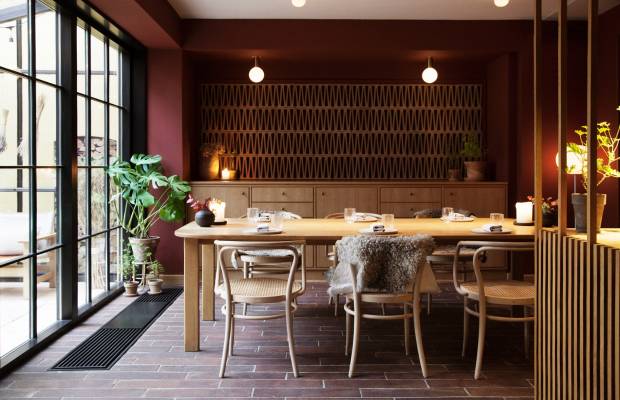
Image context: the lead image uses the exterior photograph shown on 50 Best Discovery rather than a close-up of one charred dish. That choice fits the article because Etxebarri's power comes from whole-house discipline, not from one dramatic plate photographed in isolation.[2]
1. The grill matters because it can move
The most important fact about Etxebarri is not that everything touches flame. Many restaurants can say that. The important fact is that the heat can be repositioned with unusual finesse. EL PAÍS's English feature on Basque cuisine describes Arguinzoniz's specially designed grills hanging at different levels on pulleys, while Foods and Wines from Spain notes that he devised movable grills and other custom tools so products could be pushed over or away from the fire as needed.[3][4]
That detail changes everything. Once the grill stops being fixed, fire stops reading as one blunt method and starts behaving like a scale. A cook can decide whether a product needs only a brief lick of warmth, a longer drying concentration, or a more assertive roast. The point is not to prove bravery with flame. The point is to meter contact.
This is why the usual vocabulary of "smoky" or "charred" feels too crude for Etxebarri. Those are outcomes. The craft sits one stage earlier, in the ability to decide exactly how much fire a product should be allowed to remember.[2][3][4]
2. Wood choice is treated as seasoning, not fuel alone
The second clue is the wood itself. Foods and Wines from Spain says Arguinzoniz refused coal because of its aroma and developed his own system: olive tree for vegetables, vinewood for meat, and holm-oak especially for fish and shellfish.[3] EL PAÍS adds another practical layer, describing separate fires started each morning with different woods before the embers are distributed under the grills.[4]
That system explains why Etxebarri's cooking is so hard to copy badly. Most restaurants that borrow the aesthetic of live fire stop at the visual grammar: open flames, blackened grates, dark wood, heroic language about embers. Etxebarri's grammar is stricter. Different products are not simply "grilled"; they are matched with different aromatic conditions.[3][4]
That distinction is what keeps the food from collapsing into one-note smokiness. Fire here is not a blanket signature pasted over everything on the menu. It is a way of preserving difference. The wood for a shellfish course should not tell the same story as the wood for beef, and the heat that flatters fresh mozzarella should not bully it into tasting like a steakhouse accident.[2][3]
3. The restaurant's range proves that the method is restraint, not macho force
The Discovery profile is especially useful because it lists products that do not fit the stereotype of a grill house at all: homemade chorizo, baby eels, sea cucumber with green beans, Palamós prawns, fresh mozzarella, and the milk ice cream with beetroot that closes the meal.[2] Foods and Wines from Spain makes the same point from another angle, noting that Arguinzoniz kept expanding from fish and meat into anchovies, rice, mushrooms, shrimps, and other products once he started inventing tools for them.[3]
That spread matters because it reveals the restaurant's deepest discipline. Etxebarri is not trying to make every ingredient taste more masculine. It is trying to discover how little interference each ingredient can tolerate while still becoming more itself. A prawn does not need the same intensity as a chop. Mozzarella and milk ice cream are even stricter tests because dairy exposes clumsy smoke immediately.[2]
This is where the restaurant's global reputation starts to make sense. If a grill can handle only meat, the achievement is narrow. If it can handle eels, shellfish, cheese, vegetables, and dessert without turning them monotonous, then fire has been elevated from theme to language.[2][3]
4. The lunch-only format is part of the craft
As of April 5, 2026, Etxebarri's official site says the restaurant runs on a request-only booking system, charges 300€ before drinks, serves only lunch starting at 13:30, and requires the whole table to take either the tasting menu or a la carte service together.[1] Those details look administrative, but they help explain the food.
Lunch-only service keeps the day on one arc. The restaurant is not stretching the same fire logic across a full lunch-and-dinner relay with multiple resets meant to maximize volume. The structure is narrower, and that narrowness fits the cooking. A kitchen obsessed with millimetric grill height and ingredient-specific woods benefits from less noise, fewer turns, and one concentrated service window.[1][4]
The "full table" rule also makes sense in that frame. Etxebarri is not organized like a room built to absorb endless individual customization. It is organized around sequence, rhythm, and the cook's control over how the fire will read across a meal. Even the reservations process feels consistent with the cuisine: request, review, confirmation, prepayment, then one tightly defined lunch slot.[1]
Why Etxebarri still feels modern
Restaurants built on old methods often age in one of two ways. They either become heritage theater, admired for authenticity but no longer sharp, or they turn their founding gesture into a logo and let imitators flatten it. Etxebarri avoids both traps because its real invention was never "cooking over fire" in the generic sense. Its invention was to make fire adjustable enough, ingredient-specific enough, and restrained enough that product identity survives contact.[2][3][4]
That is why the restaurant still reads as contemporary even though the method looks ancient. The tools are custom. The wood choices are selective. The range of ingredients is improbably broad. The room remains unpretentious on purpose, because too much performance would only obscure the actual feat.[2] What Arguinzoniz built in Atxondo was not a nostalgia machine. He built a system for making heat behave with manners.
Once you see that, the meal becomes easier to read. Smoke is present, but it is no longer the headline. The headline is judgment: when to lift, when to lower, when to change wood, when to stop. At Etxebarri, fire is impressive only because it is so rarely allowed to become loud.[1][2][3][4]
Sources
- Asador Etxebarri, "Home" - official page covering the current request-only reservation system, 300€ menu price, prepayment, lunch-only 13:30 start, and full-table service rule.
- 50 Best Discovery, "Asador Etxebarri" - current profile covering the chef-built adjustable-heat grills, representative dishes from prawns to milk ice cream, the unpretentious dining room, Atxondo valley setting, lunch schedule, and the exterior photo used here.
- Foods and Wines from Spain, "Bittor Arginzoniz" - profile describing the chef's movable grills, custom perforated pans, refusal to use coal, and ingredient-specific wood choices.
- EL PAÍS English, "The power of Basque cuisine" - feature describing Arguinzoniz's pulley-based grills, different woods, Atxondo village context, and fire-centered working method.