Plenty of New Nordic restaurants talk about place. Kadeau Copenhagen feels more exact than that. The restaurant does not use Bornholm as a scenic backstory attached to a capital-city tasting menu. It uses the island as an operating system: the official menu description says the Copenhagen menu is shaped by the seasons and the terroir of Bornholm, with colder months built around preservation techniques and spring and summer shifting toward fresh produce from the garden.[1] The World's 50 Best profile adds a second, equally important detail. At Kadeau, even the room changes with the menu, moving visually from growing season to preservation season rather than staying decoratively neutral all year.[2]
That is the restaurant's real distinction in 2026. Luxury here does not come from abundance alone. It comes from storage, sequencing, and memory. The menu keeps asking how a coast, a garden, and a habit of preserving can survive the trip from Bornholm to Copenhagen without becoming a museum piece.[1][2][4]
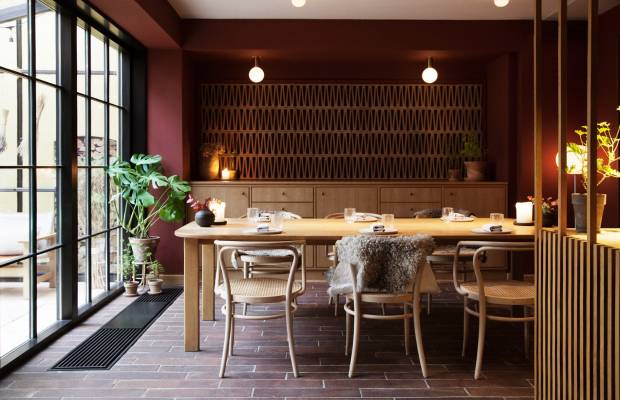
Image context: the lead image uses an official 50 Best interior photograph because Kadeau works through atmosphere as much as product. The article is about a restaurant that makes season visible in the room, so a space image is more useful than a single plated close-up.[2]
1. Bornholm is the grammar, not a marketing origin story
The Copenhagen restaurant makes more sense once the Bornholm origin stops reading like a branding anecdote and starts reading like the grammar of the whole project. 50 Best Discovery describes the city outpost as rooted in the Baltic island where the original Kadeau still stands, complete with its own farm, while Falstaff's 2024 profile traces the restaurant back to 2007, when childhood friends Nicolai Norregaard, Rasmus Kofoed, and Magnus Klein Kofoed opened the first Kadeau on Bornholm.[3][4] The move to Copenhagen in 2011 did not erase that geography. It intensified the question of how much island specificity could survive in a more urban room.[2][4]
Falstaff is especially useful because it makes Bornholm feel concrete rather than poetic.[4] The profile begins in the garden a few kilometers from the island restaurant: greenhouse, beehives, onions, cabbage, pumpkin, zucchini, berries, and more. Some of that produce is served in season; some is pickled or fermented; a significant portion travels onward to Kadeau Copenhagen.[4] That detail explains why the restaurant's language of place feels sturdier than the usual Nordic-romantic script. Bornholm is not only a mood board of shoreline and herbs. It is a supply line, a preservation problem, and a discipline of deciding what should arrive fresh and what should arrive transformed.
This is why Kadeau rarely reads like generic destination dining. The island is present in the food, but also in the method that decides what the food is allowed to become.[1][3][4]
2. Preservation season is the point where memory becomes cuisine
The official menu page gives away the deepest part of the restaurant's logic in one sentence: colder months focus on preservation techniques, paired with the best Nordic meat and seafood, while spring and summer turn toward fresh produce from the garden.[1] That statement does more than describe ingredients. It describes time. Kadeau is not trying to pretend that every product can be equally vivid in every month. It works by accepting the season's limits and then deciding what should be carried forward through pickling, fermenting, curing, smoking, and other forms of storage.[1][4]
The Falstaff profile makes that storage logic feel familial as well as technical.[4] Norregaard recalls a grandfather who fished, salted, fermented, and preserved marrow, pumpkin, berries, and cucumbers. That memory matters because it keeps preservation from sounding like a laboratory reflex imported for modern prestige. At Kadeau, preservation has social depth. It belongs to island habits, winter management, and an older respect for ingredients that could not simply be made permanent by refrigeration and global logistics.[4]
The World's 50 Best profile then shows what happens when that habit is pushed into fine-dining precision.[2] It describes a menu full of elegantly balanced acidity produced through fermentation and preservation, and pairs that with dishes that carry both landscape and storage inside them. The result is not a room chasing shock through aggressive funk or novelty. It is a restaurant trying to make delayed flavor feel exact. A preserved plum, cultured cream, smoked whey, or fruit leather is never just garnish in that system. Each one tells you something about what the restaurant believed was worth saving from another part of the year.[2]
That is why Kadeau's version of luxury feels unusually durable. It does not depend on a nonstop parade of just-harvested perfection. It depends on judgment about what a season should leave behind for the next one.[1][2][4]
3. The room keeps pace with the pantry
Many restaurants talk about seasonality while keeping the dining room frozen in one aspirational register. Kadeau's room appears to resist that split. The World's 50 Best profile says the interior, designed by OEO Studio, combines Scandinavian craft and Japanese minimalism in oak and brass around an open kitchen, and it notes that the space evolves visually with each menu and time of year.[2] 50 Best Discovery adds another tactile layer: wrought iron, Scandi wood, and pickling jars in an intimate room.[3]
Those details matter because the restaurant's food would lose force if the room behaved like a generic luxury container. Kadeau's cuisine depends on readers catching the difference between growing season and preservation season, between fresh green energy and the darker, sharper concentration of stored ingredients.[1][2] A room that changes with the year helps keep those shifts legible before the first plate lands.
The material choices reinforce that idea. Oak, brass, handmade ceramics from Bornholm artisan Torben Lov, and an open kitchen all keep the restaurant close to labor and surface instead of turning it into a polished black box.[2] Even when the plates are highly refined, the surrounding signals keep pulling the meal back toward craft, storage vessels, smoke, coast, and handwork. The point is not rustic theater. The point is coherence.
4. Why Kadeau still feels necessary
New Nordic cuisine is old enough now to risk becoming its own heritage district. A lot of restaurants can borrow the vocabulary of forage, acid, seaweed, smoke, and local ceramics. Fewer can make those elements feel structurally necessary. Kadeau still can because it keeps one hard question in play: how should a specific place survive translation?[2][3][4]
The 50 Best pages are helpful here because they do not reduce the answer to one iconic plate.[2][3] On one side there are detailed examples such as six-day house-smoked salmon, squid with smoked buttermilk whey and brown butter, or king crab with yeasted barley and Havgus cheese.[2][3] On the other side there is the broader claim that nearly every plant-based ingredient comes from the Bornholm garden and that the Copenhagen menu remains loyal to the original island philosophy.[2][4] Put together, those details show a restaurant whose real achievement is continuity without stiffness.
That continuity is what makes Kadeau readable now. The restaurant is not selling wilderness fantasy to city diners. It is building a careful chain between island memory and metropolitan service. Winter gets translated into preservation. Summer gets translated into garden brightness. The room shifts so those translations feel physical rather than rhetorical. The menu keeps enough acidity and smoke to remind the diner that storage can sharpen pleasure instead of flattening it.[1][2]
Kadeau's real luxury, then, is not extravagance at full volume. It is the ability to hold onto weather. A coastline, a greenhouse, a smokehouse inheritance, and a preserving habit all arrive in Copenhagen still carrying their original pressure. That is a harder achievement than simply serving beautiful products, and it is why the restaurant remains one of the clearest statements in European fine dining.[1][2][3][4]
Sources
- Kadeau, "Menu" - official description of the Copenhagen menu's seasonal structure, Bornholm terroir, winter preservation, and summer garden produce.
- The World's 50 Best Restaurants 2025, "Kadeau" - ranking profile covering the Bornholm-to-Copenhagen line, dining-room design, seasonal visual shifts, ceramics, and representative dishes.
- 50 Best Discovery, "Kadeau" - venue profile covering the original Bornholm restaurant, the island-rooted concept, the intimate room, and example dishes.
- Falstaff, "Nicolai Norregaard: Bringing Global Culinary Attention to Bornholm" - profile covering Kadeau's 2007 founding, the garden and beehives, preservation practice, and the Copenhagen outpost.