The fastest way to flatten Nouri is to call it a fusion restaurant.
That description misses the real mechanism. Ivan Brehm's house is not trying to prove that distant flavors can coexist on one plate. It starts from a harder premise: cuisines have already been crossing one another for centuries, and fine dining can either hide that history behind polish or make it legible.[1][3][4] Nouri calls that method crossroads cooking, and the current dish that explains it most cleanly is Manio'ka.[1][2]
As of April 16, 2026, Nouri's public Chef's Tasting Menu is priced at 328 with a Discovery Pairing at 160, an epicurean pairing at 238, and a sake pairing at 145.[1] Manio'ka sits inside that main tasting sequence rather than on the cheaper weekly lunch track, which matters because the restaurant is telling you the dish is not a side thought or one clever course among strangers. It is part of the restaurant's main argument.[1]
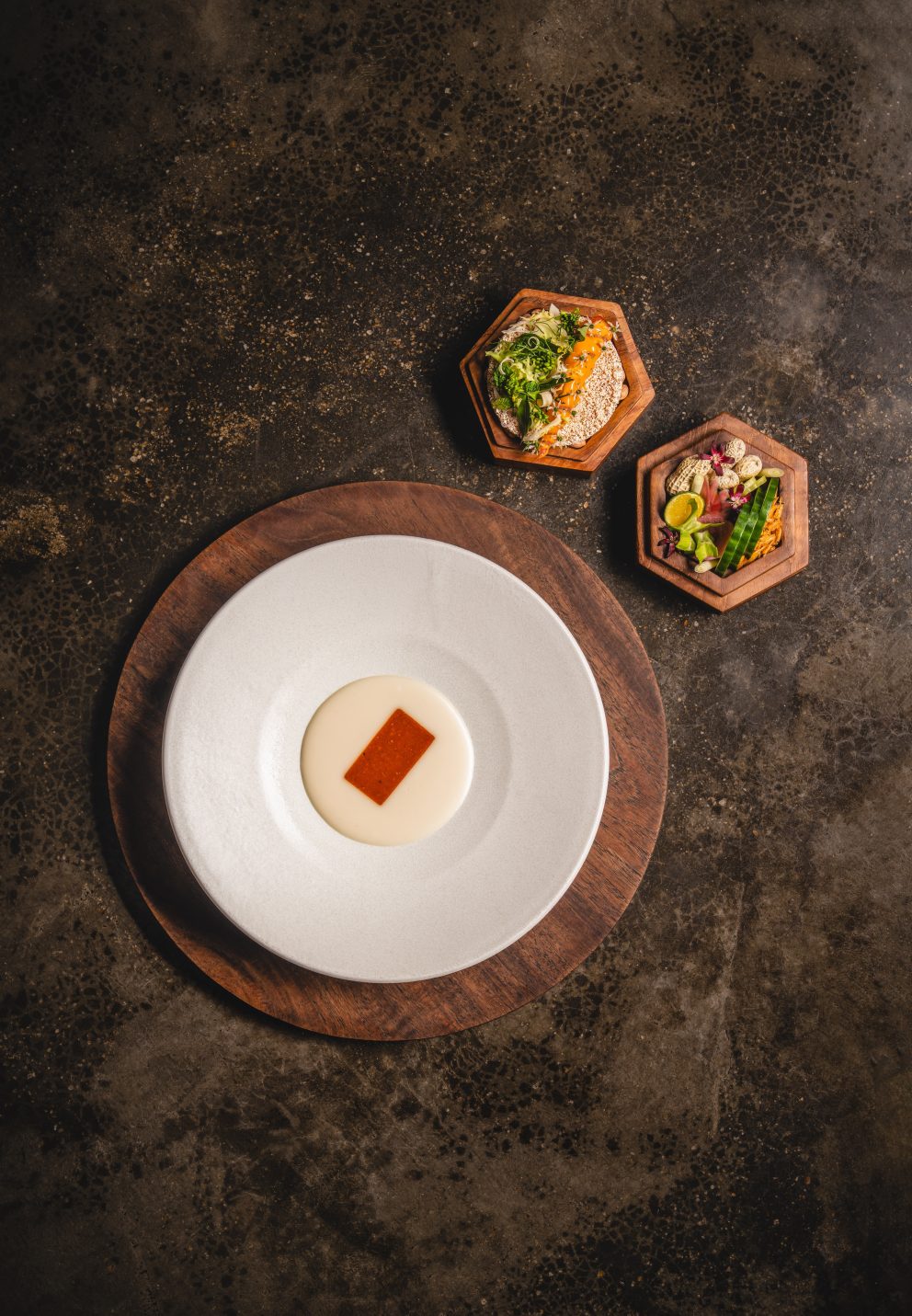
Image context: the lead image uses Nouri's official Manio'ka dish photograph. That is the right visual anchor because this article is not about atmosphere alone or chef portraiture. It is about how one plate compresses a long route of starch, fermentation, labor, and migration into something that still looks calm once it reaches the table.[1]
Manio'ka begins in the Amazon, but it does not stay there
Nouri's own dish note is unusually explicit about the historical burden it wants the course to carry. The restaurant describes tapioca as a drought-resistant tuber first domesticated in the southern Amazon roughly 10,000 years ago, then follows its travel through South America, Africa, and Southeast Asia.[2] That scale matters because many tasting-menu dishes borrow from global ingredients while treating movement as aesthetic garnish. Manio'ka does the opposite. The movement is the dish.
The kitchen builds that history through technique rather than through lecture. Nouri points to the Tupi methods used in Brazil to detoxify cassava by grating, pressing, fermenting, and drying it into forms such as beiju, tucupi, farinha, and puba.[2] It then links that Brazilian starch grammar to the wild fermentation cultures of tapai in Malaysia and Indonesia.[2] The plate is therefore not framed as Brazil on one side and Southeast Asia on the other. It is framed as one ingredient learning different survival logics in different climates.
That is why the components matter so much. The creamy angu base recalls cassava as hearth food. The fermented sambal in the center gives the dish a hotter, more acid archipelagic pulse. The Mazara red prawn beiju on top takes the old cassava flatbread format and pushes it into fine-dining delicacy without removing the labor history that made the format possible.[2] The plate tastes polished, but its structure is built from preservation technologies and colonial-era plant movement rather than from luxury shorthand.
The dish works because the whole restaurant is built to think this way
Manio'ka would feel academic in a lesser room. At Nouri, it lands because the whole restaurant keeps preparing the diner to read food genealogically.
On the official site, Brehm's biography is presented almost as a culinary map: Per Se in New York, Hibiscus in London, Mugaritz in the Basque Country, then Heston Blumenthal's experimental kitchen at The Fat Duck.[1] The same page also foregrounds his mixed family background across Italian, German, Russian, Spanish, Lebanese, Syrian, and Brazilian lineages.[1] Those facts alone do not guarantee a coherent restaurant. What gives them shape is the conceptual frame Brehm later named in Singapore.
The Singapore Global Network profile is the clearest outside explanation of that frame. It describes Crossroads Thinking as a refusal to treat any dish as culturally sealed, and places its development directly inside Singapore's own history as a trading port, migration hub, and everyday food crossroads.[3] Brehm says he became less interested in ownership claims and more interested in tracing how dishes interacted with other peoples and absorbed non-native ingredients over time.[3] That is precisely the difference between generic fusion and the kind of cooking Nouri is after. Fusion says two things can be mixed. Crossroads cooking asks how they were already entangled before the chef arrived.
The same SGN profile makes another useful point: Nouri's upstairs concept Appetite functions as a research arm that studies food and cultural history through that crossroads lens, then feeds the findings back into the tasting menu downstairs.[3] Manio'ka benefits from that wider apparatus. It does not read like a chef improvising around cassava, sambal, and prawn because the combination sounds worldly. It reads like a researched thesis that has been compressed until it can move with the pace of service.
Why the plate does not collapse into "global" vagueness
The hardest technical problem in this kind of restaurant is not sourcing. It is restraint.
Cross-cultural menus fail when they panic and start naming too much. A chef wants the diner to notice Brazil, Indonesia, Malaysia, fermentation, migration, memory, seafood, and tropical herbs all at once, so the dish becomes an annotated bibliography on porcelain. Manio'ka avoids that trap because the line of travel is tight.[2][3]
Everything turns around starch. Cassava is the constant. The Brazilian forms explain how the ingredient became edible and portable; the Southeast Asian fermentation logic explains how it acquired a second life; the prawn and herbs keep the plate from becoming root-heavy or purely nostalgic.[2] In other words, Nouri does not use history to thicken the menu note after the fact. It uses history to decide what the center of gravity on the plate should be.
This is also where Singapore matters as more than location. The SGN interview describes Brehm's fascination with Singapore as a place where food crosses class and culture in public, from hawker centers to more formal dining rooms.[3] The restaurant's own site echoes that social ambition more abstractly, calling Nouri a place that nourishes the bond between "you" and "I."[1] Then 50 Best Discovery gives that idea physical form, describing a sleek communal marble table designed to encourage interaction and connection, while also noting that the restaurant name grows from the Latin root for nourishment.[4] Manio'ka belongs in exactly that kind of room. It is a dish about transmission, so it makes sense in a restaurant that treats the table itself as shared infrastructure.
How to order Nouri if this dish is the reason you are going
If Manio'ka is the main reason for booking, the answer is simple: take the full Chef's Tasting Menu.[1] The weekly lunch set at 82 for two courses or 168 for four is clearly designed for speed and seasonality, but the public sample menu shows it as a lighter, rotating collaborative track rather than the restaurant's full narrative lane.[1] Manio'ka appears on the main tasting sequence, where its role is to connect the restaurant's philosophy to the body of the meal.[1][2]
The most interesting pairing choice is the cheapest serious one, not the most expensive. The Discovery Pairing at 160 looks like the cleanest fit because Manio'ka is a dish about bridges rather than sheer weight.[1] The epicurean and sake options may well be excellent, but the article's logic points somewhere else: this is a plate built on transition, fermentation, acid, and remembered labor, so you want a pairing lane that keeps movement visible rather than overpowering the cassava line.
That is why Manio'ka matters beyond one beautiful course. It shows what Nouri is actually trying to do in Singapore. The restaurant does not use migration as moral decoration or "global" cuisine as a badge of openness. It turns one starch into an archive and then serves that archive at fine-dining speed.[1][2][3][4]
Sources
- Nouri official homepage, including the restaurant's crossroads-cooking philosophy, Ivan Brehm biography, current public menu and pairing pricing, weekly lunch pricing, operating hours, and the official Manio'ka dish image used here.
- Nouri, "Crossroads Menu - Manio'ka," the restaurant's current note on the dish's cassava history, Brazilian processing methods, tapai link, and plate composition.
- Singapore Global Network, "How Singapore's crossroads of cultures inspires this Michelin-starred chef" (July 1, 2024), on Ivan Brehm's Crossroads Thinking, Singapore's influence on Nouri, and the research role of Appetite.
- 50 Best Discovery, "Nouri - Singapore," on the restaurant's crossroads-cuisine framing, communal marble table, Asia's 50 Best context, and the name's nourishment logic.