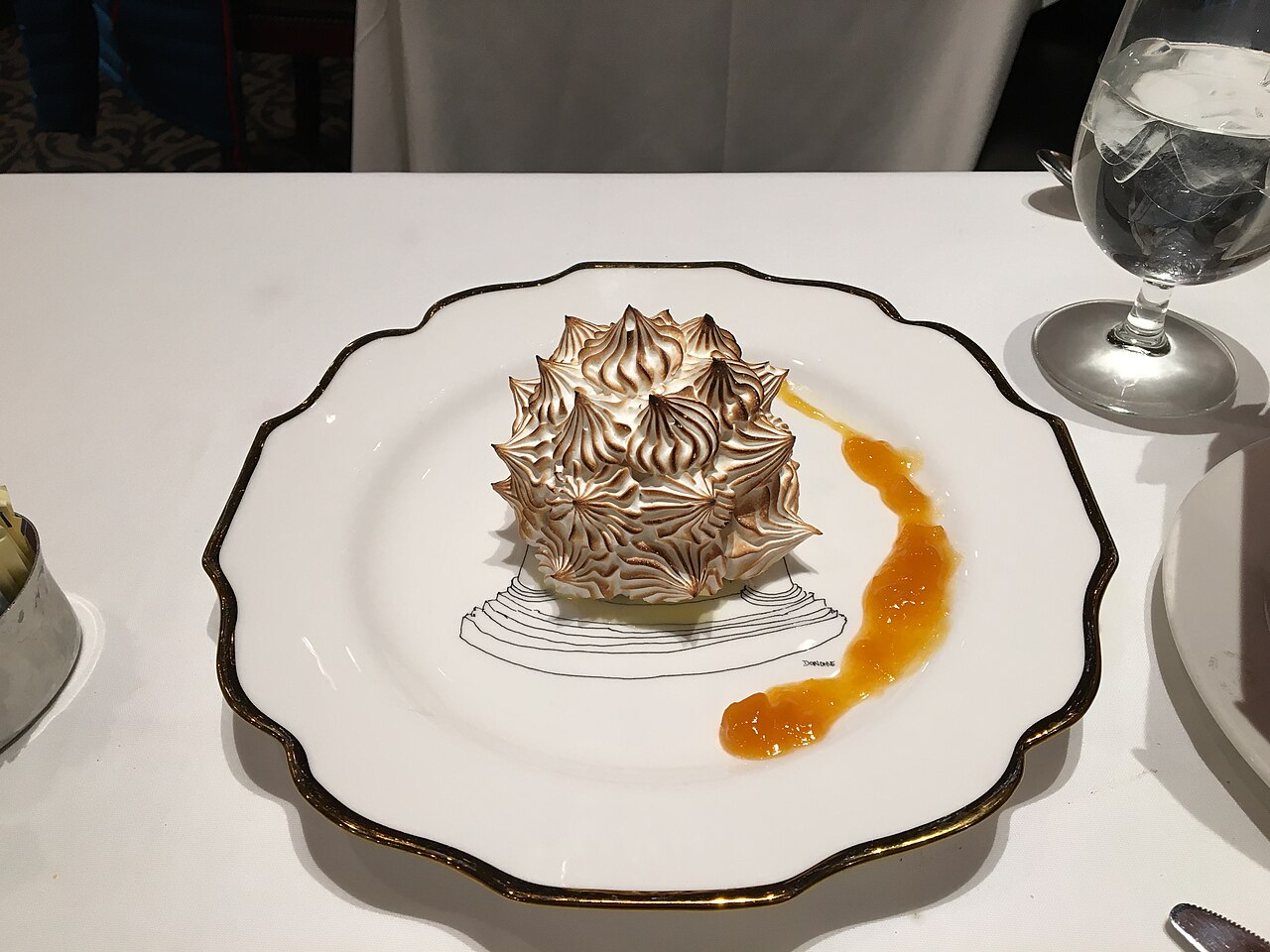
Baked Alaska looks like a magic trick, but its best versions are more disciplined than magical. The dessert asks a kitchen to do something apparently unreasonable: place ice cream under heat, brown the outside, preserve the cold center, and then deliver the result before the contrast collapses. That is why it belongs in fine dining. It is not just a retro showpiece. It is a lesson in insulation, timing, and service confidence.
The basic construction is simple enough to sound almost childish: ice cream, sponge cake, and meringue, baked quickly at high heat until the meringue browns.[1] The dining-room effect is not simple. A proper Baked Alaska should arrive with a surface that reads as hot, a core that remains frozen, and a spoonful that makes the diner feel both states at once. Luxury comes from holding that contradiction long enough for the table to experience it.
That is also why the origin story should be handled carefully. Britannica frames Baked Alaska as an American dessert of disputed authorship, broadly connected to the 1867 Alaska acquisition, with a better-supported claim attaching the hot-cold "Alaska, Florida" idea to Charles Ranhofer at Delmonico's.[1] Delmonico's own history page keeps Ranhofer at the center of the restaurant's mythology, naming Baked Alaska among the creations associated with his tenure after he became chef de cuisine in 1862.[2] But CooksInfo's Alaska Florida entry is more exact about the published form: Ranhofer's 1894 Epicurean recipe called for small cakes hollowed and masked with apricot marmalade, molded banana and vanilla ice creams, a piped meringue coating, and two minutes in a hot oven.[4]
Read that sequence as a technique, not a museum label. The dessert survives because each layer has a job.
The shell is an edible wall
The most important ingredient in Baked Alaska is air. Meringue is not merely a sweet white covering; it is a foam. Sponge cake is not merely a base; it is another porous structure. COMSOL's heat-transfer explanation is useful because it names the mechanism plainly: trapped air in the cellular structure of meringue and sponge helps insulate the ice cream from oven heat.[5] Scientific American's classroom version reaches the same practical observation: sponge and meringue contain many air bubbles, and that stationary air slows heat flow long enough to protect the cold center.[6]
This is why a thin, careless smear of meringue misses the point. The meringue must cover the ice cream completely, with no leaks where heat can rush in. It must be thick enough to buy time, but not so thick that the dessert becomes a sugar helmet. It must brown before the interior warms past the point of pleasure. In a restaurant, that turns pastry into logistics. The ice cream has to begin hard. The cake has to be sturdy enough to hold shape and absorb some temperature shock. The oven, broiler, salamander, or torch has to be hot enough to color the outside quickly. The server has to move before the architecture starts losing its argument.[1][5][6]
The surprising thing is that the method is less forgiving than it looks. A kitchen can hide a weak custard under fruit or rescue a dry cake with sauce. Baked Alaska exposes delay. If the ice cream is soft before baking, the final slice slumps. If the meringue has gaps, the core melts at the edges. If the heat is timid, the dessert warms without browning. If the browning is overextended, the table gets drama but loses contrast.
Ranhofer's version explains the dining-room logic
Ranhofer's "Alaska, Florida" name matters because it is a climate joke with service discipline behind it.[1][4] The dessert is not only cold plus hot. It is cold staged as hot. In CooksInfo's transcription of the Epicurean method, the assembled pieces wait cold until "a few moments before serving," then meringue is piped on, browned, and sent out at once.[4] That last phrase is the heart of the dish. Baked Alaska is finished against the clock.
Open Library's record for The Epicurean also helps place the dessert inside the larger Delmonico's system: the book was not a slim pastry pamphlet but a large culinary treatise with table service, wine service, practical studies, and Delmonico's bills of fare from 1862 to 1894.[3] In other words, "Alaska, Florida" belonged to a world where the kitchen and dining room were connected by choreography. The chef's idea had to become a repeatable service object.
That context keeps the dessert from becoming mere nostalgia. A modern tasting-menu kitchen still faces the same problem whenever it sends out an unstable temperature contrast: frozen and warm, crisp and melting, torched and raw, hot sauce over cold cream. The old Delmonico's dessert is one of the cleanest examples because the engineering is visible. The guest sees the meringue shell and knows, before the first spoonful, that something has been protected.
Why the cake matters
It is tempting to treat the sponge as a platform, but the sponge is doing more than holding ice cream above the plate. It contributes insulation, structure, and eating sequence.[5][6] Without cake, the dessert can become a mound of sweet foam around ice cream. With cake, the spoon has somewhere to land. The browned meringue gives the first aroma; the cake gives chew and warmth; the ice cream gives shock; the whole bite becomes a controlled alternation.
This is also where Baked Alaska differs from ordinary ice cream cake. Ice cream cake normally celebrates cold continuity. Baked Alaska celebrates contradiction. It has to pretend, briefly and convincingly, that baked and frozen can occupy the same plate without one defeating the other. The cake is the hinge between those states.
The best versions therefore avoid excess garnish. Fruit, compote, or flambed liqueur can work when they sharpen the contrast, but the dessert does not need decoration to explain itself.[1] It already has a narrative: the outside was exposed to fire or fierce heat, and the inside survived. Add too much and the clean pleasure of that survival gets blurred.
The performance should serve the physics
Because Baked Alaska photographs well, restaurants can overplay it. A giant flame, a dramatic tableside torch, or a cruise-ship parade can make the dessert feel like edible nostalgia rather than fine dining. The better standard is stricter: the performance must improve the eating. Browning should deepen aroma. Heat should set the meringue surface. Service should focus attention on the hot-cold contrast. If the show does not protect or sharpen the dessert, it is only noise.
That is why the dish is still useful in 2026. Contemporary fine dining often wants a visible finishing gesture: sauce poured at the table, broth released into a bowl, smoke lifted from a lid, citrus grated over the final bite. Baked Alaska shows the older rule for those gestures. The visible action has to solve a technical problem. Here the problem is heat management. The theater works because the physics are real.
The dessert's disputed history even improves the lesson. Whether one emphasizes Delmonico's, earlier baked-ice traditions, or later cookbook standardization, the durable object is not the anecdote. It is the method: freeze hard, cover completely, brown fast, serve immediately, and let the diner taste the temporary truce between heat and cold.[1][4][5][6]
Baked Alaska survives because it turns a practical kitchen fact into pleasure. Air is a poor conductor. Meringue is a foam. Sponge holds shape. Ice cream melts if time wins. Fine dining takes those facts and makes them feel festive. For a few minutes, insulation becomes hospitality.
Sources
- Encyclopaedia Britannica, "Baked Alaska" - reference overview of the dessert's ingredients, hot-cold construction, disputed origins, Alaska Purchase naming context, and Ranhofer/Delmonico's attribution.
- Delmonico's, "Our History" - official restaurant history covering the 1837 opening, private dining rooms, wine cellar, Charles Ranhofer's 1862 chef de cuisine role, and house dish claims including Baked Alaska.
- Open Library, Charles Ranhofer, The Epicurean - edition record for the large Delmonico's culinary treatise, including table service, wine service, practical cookery, and bills of fare from 1862 to 1894.
- CooksInfo, "Alaska Florida" - food-history entry summarizing and excerpting Ranhofer's 1894 Epicurean method for the meringue-covered ice-cream dessert.
- COMSOL Blog, "Why Doesn't the Ice Cream in a Baked Alaska Melt?" - heat-transfer explanation of meringue, sponge cake, trapped air, oven timing, and insulating layers.
- Scientific American, "Can You Bake Your Ice Cream?" - practical food-science activity explaining how sponge cake and meringue air bubbles slow heat transfer and protect ice cream for a short time.
- Wikimedia Commons, "File:Baked Alaska.jpg" - real 2020 photograph by Zheng Zhou of Baked Alaska at Delmonico's, used as this article's image.