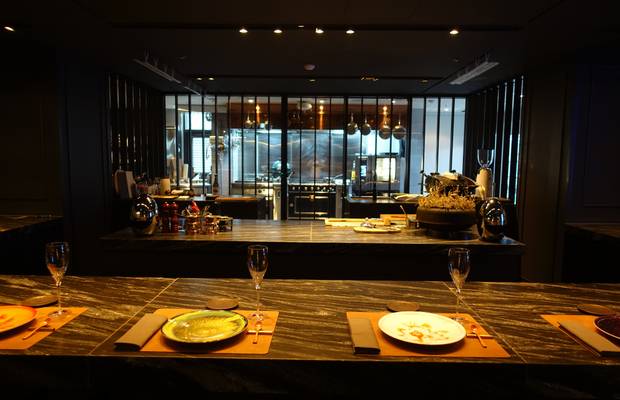
The easiest way to misread 7th Door is to treat fermentation as one more luxury flourish: a clever sauce here, a pickled detail there, a little Korean depth layered under contemporary plating. The restaurant's own language points somewhere stricter. On its homepage, 7th Door presents itself as Chef Kim Dae-chun's route to "gastronomic heaven," built through Korean methods of fermentation and aging and framed by a long corridor symbolizing six doors before the diner reaches the seventh.[1] The official about page then makes the concept harder and more precise. The first five doors correspond to the five fundamental tastes. The sixth is fermentation and aging. The seventh is the chef's invitation to turn all of that stored knowledge into a live meal.[2]
That distinction matters because it changes the role fermentation is allowed to play. At 7th Door, it is not garnish. It is architecture.
As of April 29, 2026, the public evidence lines up unusually well. The official homepage still foregrounds 7th Door's Michelin recognition and its core slogan, "Inspired by DNA of Korean Cuisine - Fermentation and Aging."[1] Asia's 50 Best Restaurants 2026 currently places the restaurant at No. 49, while the companion 50 Best Discovery profile keeps returning to the same operational facts: a corridor lined with ferments aged three to 10 years, a concept built around the seven tastes, and a service of 10 inventive courses for only 14 diners per sitting around the chef's counter.[3][4] Read together, those sources suggest that 7th Door's real technique is not one isolated preservation trick. It is the conversion of time into room design, service flow, and flavor sequencing.
1. The sixth taste is a method before it becomes a flavor
The official about page says Chef Kim's "vast repertoire of different culinary practices" is based on the Korean art of fermentation and aging, and adds the key phrase that makes the restaurant legible: at 7th Door, diners are asked not only to discover new tastes, but to rediscover old tastes.[2] That sentence is easy to glide past. It is also the most important one on the page.
Many modern fine-dining restaurants use fermentation as a marker of seriousness. It signals craft, patience, and pantry depth. 7th Door appears to ask for something broader. Fermentation here is treated as an old Korean storage intelligence that can still organize a contemporary menu. The point is not merely that aged ingredients taste deeper. The point is that they carry memory, compression, and delay. They let the kitchen bring the past forward without pretending the past should remain untouched.
The Asia's 50 Best 2026 profile sharpens the logic further. It describes the restaurant's DNA as being built on the fundamentals of traditional Korean cuisine, especially ageing and fermentation, and says Kim wants diners to experience the seven tastes through ingredients drawn from Korea's larder.[4] That is a bigger claim than "chef likes ferments." It means fermentation is being treated as a category of culinary perception, a way of noticing how sweetness, salinity, bitterness, acidity, and savoriness can be thickened by time.
2. The corridor does technical work before the first bite arrives
The most revealing part of 7th Door may be the walk to the table. The official site keeps returning to that hallway because it is not decorative set dressing.[1][2] On the about page, diners are told they will be guided through a corridor symbolizing six doors; on the right sits a glass cabinet filled with ingredients and pots in the process of fermentation and aging, some of them prepared by Chef Kim himself and some in collaboration with Korean master artisans.[2] The 50 Best Discovery profile supplies the tactile detail: the corridor is lined with jars of ferments aged from three to 10 years.[3]
That sequence turns technique into atmosphere before technique becomes taste. Plenty of restaurants hide their hardest labor in the back. 7th Door does the opposite. It lets the diner see jars, waiting, and stored transformation before the meal has fully begun. In practical terms, that means the restaurant is teaching the guest how to read the food. You are not entering a neutral dining room and then being informed that fermentation matters. You are walking through fermentation first.
This is what makes the concept stronger than a branding slogan. The corridor acts like a palate primer. It reminds you that the kitchen's most important raw material is not only fish, meat, vegetables, or grain. It is elapsed time.
3. The 14-seat bar keeps fermentation under stage lighting
The second architectural move is just as important as the first. According to the official about page, once diners reach the seventh door they are shown to one of 14 seats at a three-sided bar, with the open kitchen on the fourth side.[2] The 50 Best profiles repeat the same scale and emphasize the counter format.[3][4] This is not a large dining room built to absorb abstraction. It is an intimate chamber where process remains close to the eye.
That layout matters because fermentation can easily become mystical language. A 14-seat counter pushes in the opposite direction. It asks the kitchen to make its decisions look accountable. You can watch the handwork. You can feel the pacing. You can register whether an aged element is being used to dominate the course or simply to tune it. The room makes the menu's theory harder to fake.
The Discovery page suggests that each sitting unfolds over 10 courses for a very small number of guests.[3] That size is not only a luxury signal. It is a control system. A restaurant working with deeply aged sauces, pastes, extracts, or preserved ingredients has to balance pressure carefully. Too much and the meal becomes didactic or heavy. Too little and the concept collapses into a hidden backstory. The counter format gives 7th Door a way to meter those decisions with theatrical precision.
4. Old Korean time meets modern play
If all of this sounded solemn, the 50 Best 2026 ranking page provides the necessary correction. It describes 7th Door as a playful guided tour through the seven tastes of Korea and notes dishes that refuse museum stiffness, such as classic Korean tteokbokki paired with black truffle sauce or aged fish served with pickled jalapeno ssamjang.[4] That is useful evidence because it shows the restaurant does not confuse reverence with seriousness.
The craft question, then, is not whether 7th Door preserves tradition intact. It is how it uses ancient preservation logic to give modern dishes more tensile structure. Fermentation and aging create pressure, but Kim's menu appears designed to release that pressure through humor, contrast, and contemporary plating.[4] That is a more interesting move than simple orthodoxy. It lets Korean pantry knowledge behave dynamically instead of ceremonially.
Even the official homepage hints at this balance by framing the meal as both a deep reading of Korean food culture and an "ultimate journey" rather than a lesson.[1] The restaurant's strongest technical achievement may be that it treats fermentation as both scholarship and pleasure. The jars are real, the years are real, the corridor is real, but the final obligation is still deliciousness.
What 7th Door is really making
7th Door is not merely making fermented food. It is making a dining format in which fermentation becomes visible, legible, and sequential. The corridor teaches the premise. The jars prove the pantry depth. The 14-seat bar keeps the kitchen exposed. The courses then translate that slow material into flavors that can move from old Korean memory to something more playful and contemporary without losing seriousness.[1][2][3][4]
That is why the restaurant matters beyond its ranking lines. Plenty of ambitious dining rooms can buy rare products and plate them beautifully. Fewer can build an entire meal around a disciplined idea of time. 7th Door's real technique is not one preserved ingredient or one signature dish. It is the decision to make waiting itself part of the cuisine.
Sources
- 7th Door official homepage - restaurant concept, homepage description, six-door corridor framing, Michelin badge, and "Inspired by DNA of Korean Cuisine - Fermentation and Aging" language.
- 7th Door, "About" - official explanation of the seven-door concept, Chef Kim Dae-chun's fermentation-and-aging focus, three-to-ten-year jars, and the 14-seat three-sided bar facing the open kitchen.
- 50 Best Discovery, "7th Door - Seoul - Restaurant" - current profile covering the neon-lit corridor, jars of ferments aged three to 10 years, 10-course format, 14 diners per sitting, location, and current Asia's 50 Best ranking context.
- Asia's 50 Best Restaurants 2026, "7th Door" - ranking profile describing Kim Dae-chun's culinary philosophy, the seven tastes framework, the six-door corridor, the 14-seat room, the three-hour tasting menu, and example dishes.
- MICHELIN Guide, "7th Door - Seoul - a MICHELIN Guide Restaurant" - current restaurant entry describing 7th Door as an entrance to the seven tastes of food, with fermentation and aging as the sixth and the chef's culinary sensibility as the seventh.