Most tasting-menu restaurants try to explain themselves with a speech.
Eatanic Garden does something smarter. According to 50 Best Discovery, diners receive an illustrated set of cards outlining the key ingredients of every course.[3] That sounds like a small service flourish, but it changes the whole rhythm of the meal. Instead of asking you to treat fine dining as a sequence of surprises whose meaning arrives only after the plate lands, the restaurant teaches you how to look before you eat. At a room that Michelin describes as a beautiful urban garden with commanding views from the 36th floor, that choice matters.[2]
The restaurant's public profile is unusually coherent across sources. Michelin's current Seoul listing places Eatanic Garden in the 2026 MICHELIN Guide South Korea as a One Star restaurant serving contemporary Korean cuisine at 36F, Josun Palace Hotel, 231 Teheran-ro, Gangnam-gu.[2] LetSeoul introduces it as a one-star dining room with Han River views, where chef Son Jong-won blends Korean tradition with modern technique.[1] The official Josun Palace page is spare by comparison, but it confirms the core frame directly: this is a hotel destination built around a Korean lunch and dinner experience, not a casual annex.[4]
That combination explains why Eatanic Garden is more interesting than a standard "good view, careful food" room. The view is not decoration added on top of the cuisine. It is part of the method. The meal keeps asking how Korean ingredients, Korean memory, and metropolitan Seoul can occupy the same frame without cancelling one another out.
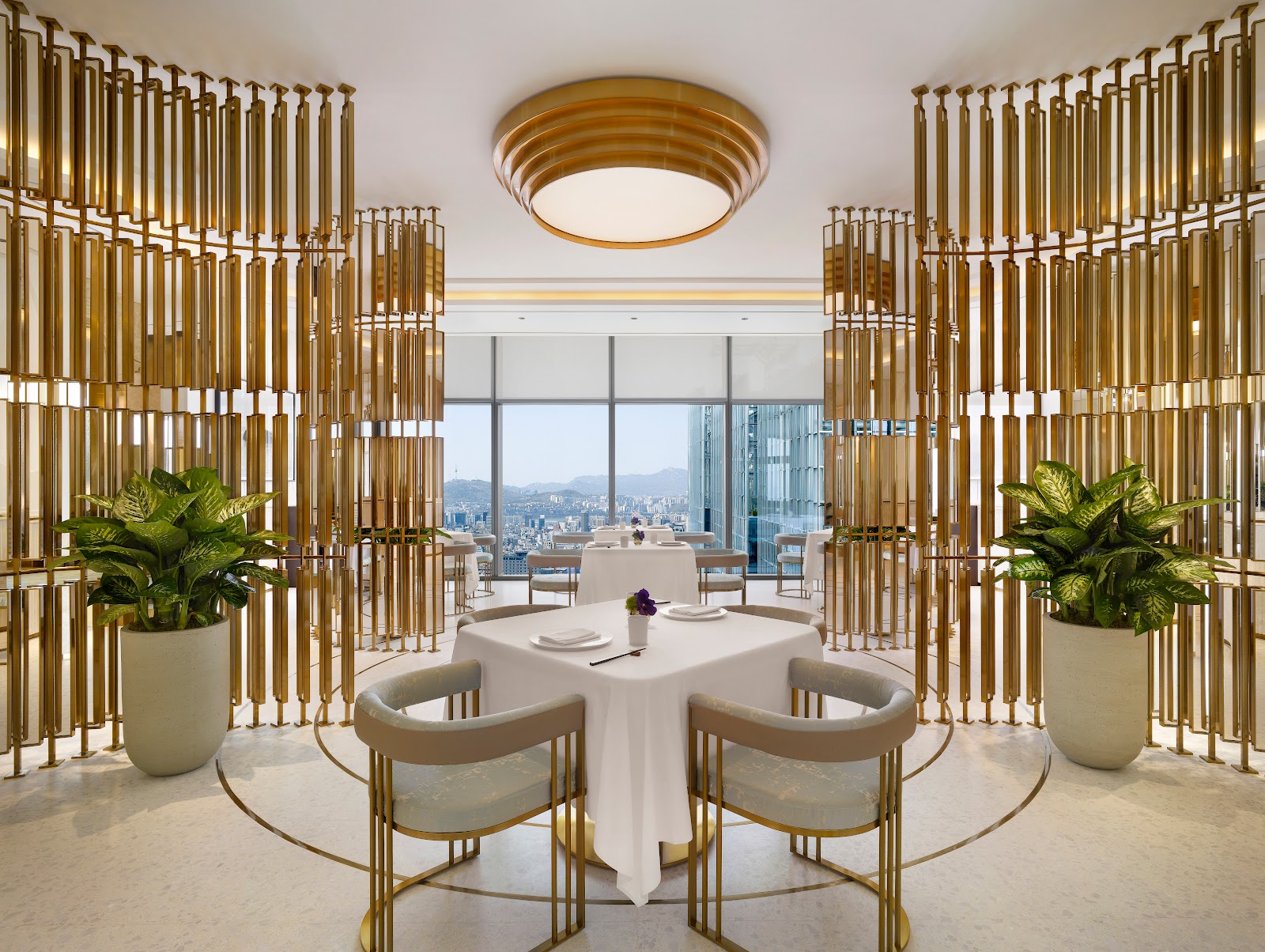
Image context: the cover uses a real interior photograph from the venue listing on LetSeoul because this article is about staging as much as flavor. The room's gold screens, pale table settings, and window line show the restaurant's central argument at a glance: nature is being reassembled inside the city rather than separated from it.[1]
The cards are the first course
The most revealing thing about Eatanic Garden may be that the meal starts on paper.
50 Best Discovery notes that the restaurant hands out ingredient cards for every course.[3] In a weaker restaurant, that would be branding. Here it reads as discipline. Contemporary Korean fine dining often risks either over-explaining itself through heritage language or under-explaining itself through abstraction. The card system avoids both problems. It tells you which ingredients matter, but it does not flatten the course into a museum label. It creates a compact between kitchen and diner: pay attention to the structure, not just to luxury signals.
That matters because Eatanic Garden's identity is built less on shock than on arrangement. The name itself is a pun on "botanic garden," as 50 Best points out, and the restaurant turns that pun into a service grammar.[3] You are not meant to read the meal as a parade of expensive ingredients entering a neutral white room. You are meant to read it as a guided walk through selected materials, one card and one plate at a time.
The room keeps the city inside the meal
Many fine-dining rooms use gardens as fantasy. Eatanic Garden uses them as contrast.
Michelin's Seoul write-up says the space evokes a beautiful urban garden and specifically notes that the window seats are prized for their city views from the 36th floor.[2] LetSeoul sharpens the same point by stressing the Han River vista.[1] Those are not interchangeable travel-copy details. Together they explain what the restaurant is trying to do visually: keep diners aware that this is Korean seasonality under urban pressure, not a retreat into pastoral purity.
That makes the skyline part of the tasting logic. If the room pretended to shut Seoul out, the "garden" concept would become generic wellness luxury. By keeping the city visible, Eatanic Garden turns the meal into a negotiation between cultivation and density. The setting says that nature here will be selected, framed, fermented, reduced, clarified, and replanted on the plate. The city remains present as the condition that makes all that refinement necessary.
The menu reads best when ingredients are treated as teaching tools
The restaurant's public sources do not publish a full narrative essay about the current menu, but they do reveal the house method.
50 Best Discovery gives the clearest example, describing hanwoo beef served three ways with fermented cauliflower and white winter vegetables shaped into snowflakes.[3] Whether that exact dish is on the menu the day you visit matters less than what it shows. Eatanic Garden is not merely plating premium Korean product cleanly. It is turning a course into an exercise in variation, fermentation, and seasonal image-making. The hanwoo is broken into formats rather than monumentalized; the cauliflower is fermented rather than left as garnish; the winter vegetables are shaped to make season legible rather than simply named.
That is contemporary Korean fine dining at its strongest. The cuisine does not become modern because the room is elevated or the plates are elegant. It becomes modern because ingredients are made to carry multiple kinds of information at once: taste, texture, season, memory, and design. The illustrated cards matter again here. They prime the diner to notice not just what is luxurious, but what is being transformed and why.[3]
Michelin's classification of the cuisine as contemporary Korean is therefore more precise than it first appears.[2] "Contemporary" in this case does not mean globally anonymous technique with Korean accents attached. It means Korean ingredients and references reorganized so that the diner can watch tradition being edited in real time.
What you should book Eatanic Garden for in 2026
If you book Eatanic Garden only for the view, you are booking it too cheaply.
50 Best Discovery currently lists the restaurant at No. 26 in Asia's 50 Best Restaurants 2026, notes that the tasting menu starts at $130, and says lunch and dinner are served Wednesday through Sunday.[3] Michelin gives the stronger endorsement by keeping the restaurant at one star for the 2026 guide.[2] The official Josun Palace page anchors that prestige in a very practical reality: this is a formal restaurant with dedicated lunch and dinner menus inside one of Seoul's flagship hotel properties.[4]
The real reason to go, though, is that Eatanic Garden appears to understand something many ambitious rooms forget. A tasting menu does not become memorable by maximizing novelty. It becomes memorable when the restaurant gives diners a stable way to read what is happening. At Eatanic Garden, the cards provide that reading method, the skyline provides the tension, and the food provides the proof.
That is why the place sounds worth booking now. It offers a version of luxury that is unusually legible. The city stays in view. The ingredients are named before they are decoded. The Korean-ness of the meal is not sealed inside nostalgia, but reworked into a sequence that can still teach you how to look course by course.[1][2][3][4]
Sources
- LetSeoul, "Eatanic Garden," on the restaurant's one-Michelin-star status, 36th-floor setting, Han River views, Chef Son Jong-won's contemporary Korean approach, and the venue photography used for the cover image.
- The MICHELIN Guide, "Eatanic Garden - Seoul - a MICHELIN Guide Restaurant," on the 2026 one-star award, contemporary Korean cuisine, 36th-floor location at Josun Palace, and the "urban garden" dining-room description.
- 50 Best Discovery, "Eatanic Garden at Josun Palace," on the restaurant's Asia's 50 Best rankings, illustrated ingredient cards, 36th-floor "urban oasis" framing, tasting-menu entry price, service days, and example dishes.
- Josun Palace official dining page, "Eatanic Garden," confirming the official restaurant page and linked lunch and dinner menu PDFs under the Korean Cuisine listing.