The easiest way to misread Hertog Jan at Botanic in 2026 is to treat it as a Belgian fine-dining comeback dressed in Japanese language. The official pages do say that chef Gert De Mangeleer draws strongly on Japan, and the restaurant group openly compares the experience to omakase.[1][6] But the more revealing story is operational. This restaurant has built scarcity directly into the guest journey: it opens only two weeks per month, runs a fixed-menu contract with limited dietary flexibility, uses the hotel site as an arrival buffer, and publishes different time-and-intensity ladders for lunch, standard omakase, and deluxe omakase.[1][2][3] The luxury is not surprise alone. It is surprise with traffic control.
As of April 28, 2026, the official operating frame is unusually explicit. Hertog Jan at Botanic says it has 26 seats on the grounds of Botanic Sanctuary Antwerp, serves lunch arrivals between 12:00 pm and 1:15 pm and dinner arrivals between 7:00 pm and 8:15 pm, and opens from Tuesday to Saturday during only two scheduled weeks each month.[1] The menu page then sharpens the throughput logic: the Signature Lunch is priced at EUR175 and can be served in 2 hours, the standard Omakase costs EUR285 and runs 3 hours, while Omakase Deluxe costs EUR385, lasts 4 hours, and includes an exclusive kitchen moment.[2] Michelin's listing supplies the missing front-of-house signal. Inspectors emphasize that the restaurant protects the element of surprise and explicitly notes a social-media restraint around the chef's table experience.[4] Read together, the restaurant stops looking like a generic tasting counter with Japanese references. It starts looking like a rigorously scheduled bandwidth-management system.
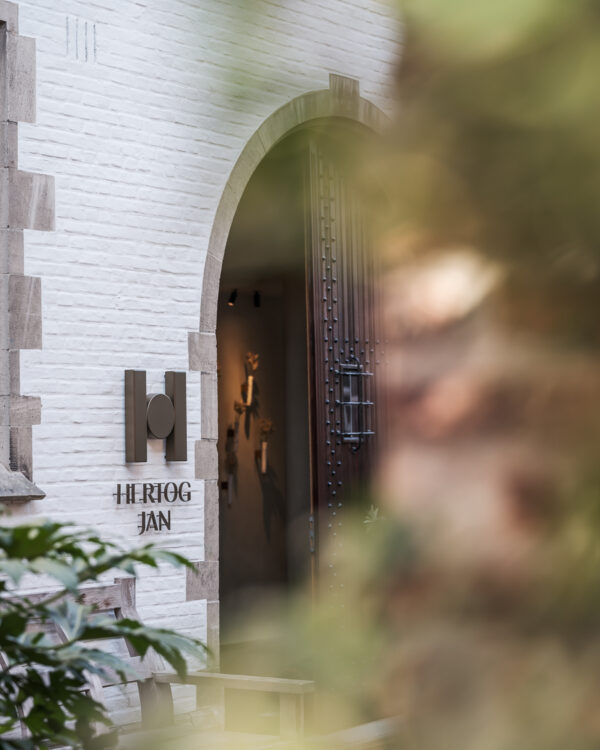
Image context: the cover uses Hertog Jan at Botanic's official entrance photograph rather than a plated course because this article is about threshold design. The sign, archway, and softened garden framing matter here: the house wants the guest to decelerate before the meal begins, and that controlled arrival is one of the main operational ideas.[1]
1. Scarcity is scheduled, not accidental
Many top restaurants are hard to book because demand outruns supply. Hertog Jan at Botanic goes further and turns scarcity into a published structure. The official site does not simply say the room is intimate; it states 26 seats and an opening rhythm of only two weeks per month.[1] The FAQ adds that reservation demand is heavy enough to justify a waiting list, and it encourages guests to register on multiple days because requests exceed immediate availability.[3]
That matters because published scarcity changes guest behavior before anyone sits down. A restaurant that is open every week can let demand fluctuate and still preserve some softness around the edges. A restaurant that announces a narrow calendar for March, April, May, June, July, September, October, November, and December 2026, with August closed, is effectively teaching guests to think in release windows rather than casual dinner plans.[1] The fixed operating calendar becomes part of the product.
The structure is also stricter than the "exclusive but flexible" model common in luxury dining. The FAQ says a reservation is only final after deposit payment, includes a reconfirmation email one week before the visit, and allows cancellation up to 7 days before arrival; after that, refunds depend on whether the table can be refilled, with EUR75 per person otherwise retained.[3] Those are not dramatic penalty terms by the standards of high-end tasting menus. What makes them distinctive is how neatly they fit the broader system. When a room is open only part of the month, every seat has to be protected from drift.
2. "Omakase" here is a service contract, not a cuisine label
The house uses Japanese vocabulary, but the most useful reading is procedural rather than geographic. On the menu page, the restaurant describes omakase as placing trust in Gert's hands, with Japanese inspiration adapted to the rhythm of the seasons.[2] The group page makes the comparison even more direct: the experience is "best compared to an omakase menu," literally a format in which the guest leaves decisions to the chef.[6] The FAQ then grounds that promise operationally. Hertog Jan serves one fixed menu, adapted to seasonality and product availability, with Japanese influences and regional products; full vegan and fully lactose-free menus are not available because of the nature of the experience.[3]
That is a different proposition from merely saying the food borrows from Japan. The restaurant is telling guests that information itself will be managed. Michelin's inspector note reinforces this by stressing the importance of surprise and by referring to the chef's table in a way that deliberately avoids over-describing what happens there.[4] The official menu page supports the same logic by presenting three menu lanes without item-level transparency: Signature Lunch, Omakase, and Omakase Deluxe give you duration, pairing prices, and level of experience, but not the comfort of planning every plate in advance.[2]
This is why the format feels closer to a front-of-house discipline than to a branding flourish. 50 Best Discovery describes the menu as transient and secretive, while still pointing to recurring signatures such as the caviar opening and cod course.[5] In practice, that means the service team is not just carrying plates. It is managing uncertainty so that the guest experiences surprise as confidence rather than as ambiguity. That takes a specific kind of room script.
3. The hotel site absorbs noise the restaurant does not want
Hertog Jan at Botanic is not a standalone street-door bistro. It sits inside the grounds of Botanic Sanctuary Antwerp, and the official site treats that fact as part of the experience rather than a location footnote.[1] The entrance is given separately, valet service is offered at EUR55 per car, nearby self-parking sits 150m away, and tram stops imply a 5-to-10-minute walk; Antwerp Central is framed as a 15-to-20-minute walk.[1] Guests staying at the hotel can charge the bill to their room.[1][3]
These details might look administrative until you compare them with another line in the FAQ: there is no bar in the restaurant itself before the meal, and guests who want a pre-dinner drink are directed to Henry's Bar in the hotel.[3] That is a revealing choice. Plenty of luxury restaurants want the prestige of a hotel address while still building their own lounge or champagne holding pen. Hertog Jan does the opposite. It uses the hotel for buffering functions and keeps the restaurant room cleaner, smaller, and more singular.
Operationally, this is smart. The hotel can absorb early arrivals, parking friction, overnight extension, and part of the social preamble. The restaurant can preserve focus for the meal proper. Even the maximum table size of 8 guests in the FAQ reads differently in that context.[3] The site does not want to become a banquet room just because it lives inside a luxury property. The hotel handles breadth; the restaurant protects intensity.
4. The menu ladder is really a pacing ladder
The menu page is one of the clearest public documents in high-end dining right now because it spells out what many restaurants leave vague. The Signature Lunch is the compressed entry point: EUR175, wine pairing EUR95, deluxe wine pairing EUR170, non-alcoholic pairing EUR65, and a service window that can run in 2 hours if flagged on arrival.[2] The standard Omakase raises both price and duration to EUR285 and 3 hours, with a note that it is unavailable on Friday evening and Saturday evening.[2] The deluxe version moves to EUR385, pairings up to EUR355, and a full 4-hour arc with an exclusive kitchen moment.[2]
That is not just pricing architecture. It is an operations diagram. The restaurant is using menu tiers to sort guests by time appetite, sensory appetite, and willingness to surrender the evening. The lunch format offers a controlled first pass. The standard omakase gives the core proposition without the heaviest service load on the highest-pressure nights. The deluxe menu reserves maximum dwell time for guests who actively want the full immersion.[2]
This helps explain why the restaurant's scarcity does not read as arbitrary theater. The house is not only selling fewer seats. It is matching seat time to experience depth. That is a more serious kind of luxury because it acknowledges that the main scarce resource in fine dining is not truffle or caviar. It is uninterrupted attention, from both guest and staff.
Why the system feels coherent
The strongest reading of Hertog Jan at Botanic is that De Mangeleer and Joachim Boudens have built a restaurant where the room, the calendar, and the menu all do the same job.[1][4][6] The Japanese influence matters, but it matters less as an aesthetic label than as a permission structure for trust, opacity, and chef-led sequencing.[2][3][6] The hotel location matters, but not because hotel glamour automatically upgrades the meal. It matters because it lets the restaurant offload arrival noise while keeping the dining room itself spare.[1][3] The published calendar, deposits, waiting list, menu durations, and pairing ladders all reinforce one point: the guest is being asked to enter a controlled service clock.
That is why Hertog Jan at Botanic feels more interesting than a simple "comeback two-star" narrative. Plenty of restaurants can cook at a very high level. Fewer are willing to expose their time logic this clearly. In Antwerp, the result is a form of luxury that behaves less like abundance and more like edited concentration.[1][2][3][4][5][6]
Sources
- Hertog Jan at Botanic Antwerp official home page - current presentation of the experience, 26-seat setting, two-weeks-per-month opening rhythm, 2026 operating calendar, arrival windows, valet pricing, transport cues, and official entrance image used here.
- Hertog Jan at Botanic Antwerp official menu page - current pricing and timing structure for Signature Lunch, Omakase, and Omakase Deluxe, plus pairing ladders and dietary boundary note.
- Hertog Jan at Botanic Antwerp FAQ - reservation waitlist logic, fixed-menu framing, Japanese influences with regional products, deposit and cancellation terms, no in-restaurant pre-dinner bar, maximum table size, and guest-communication flow.
- MICHELIN Guide, "Hertog Jan at Botanic - Antwerpen" - current listing covering the Botanic Sanctuary setting, the intimate room, chef's-table visibility, Asia-leaning signature, and the restaurant's effort to preserve surprise.
- 50 Best Discovery, "Hertog Jan at Botanic Sanctuary" - profile covering the 2018 closure of the original Hertog Jan, the return in central Antwerp, the garden-and-greenhouse context, tasting-menu framing, and current public price marker.
- Hertog Jan Restaurant Group, "What we do" - group overview describing Hertog Jan at Botanic as a rebirth in Antwerp and comparing the experience explicitly to an omakase format.