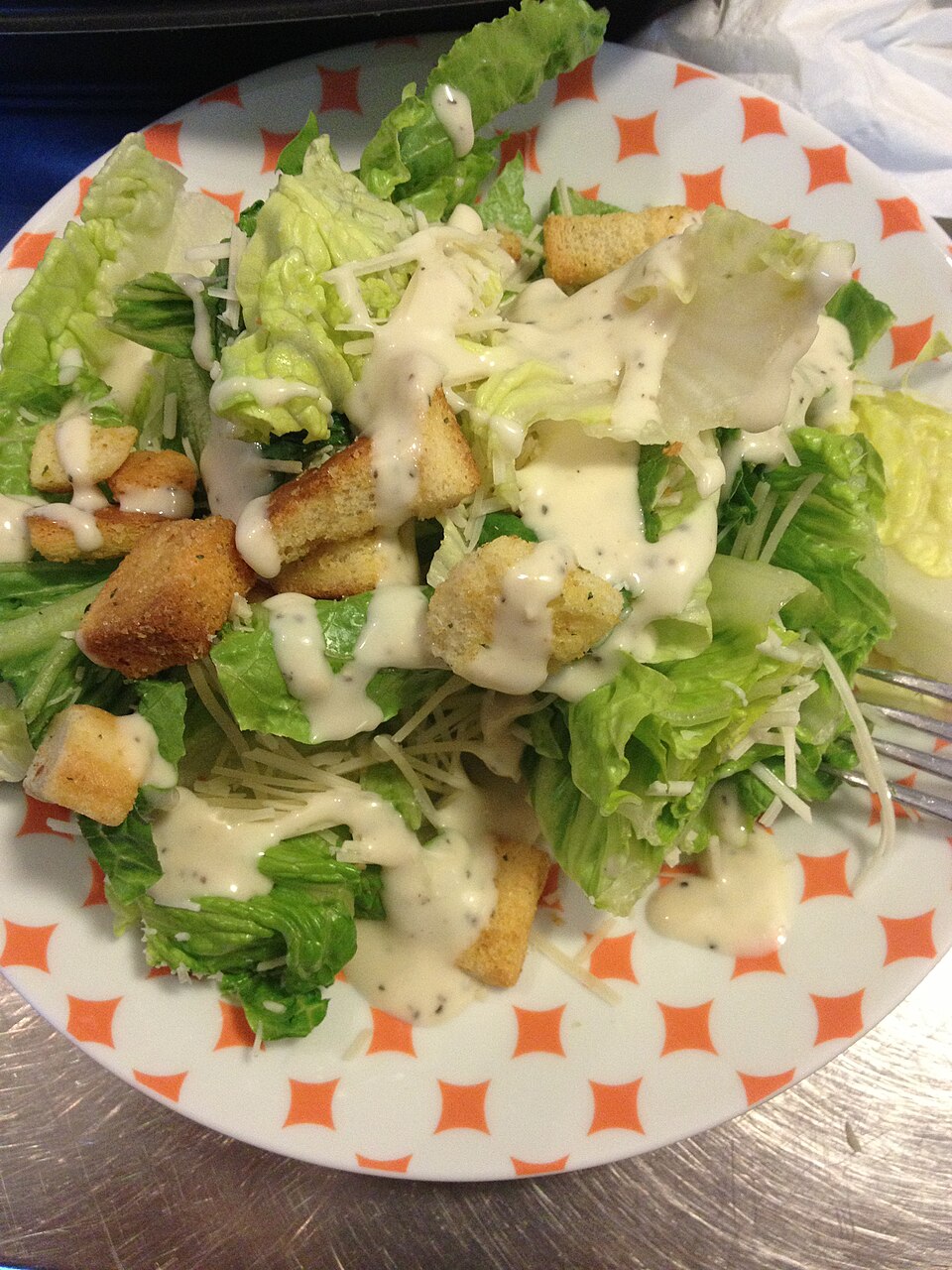
The Caesar salad is easy to underestimate because it arrives wearing the costume of simplicity: romaine, croutons, Parmesan, dressing. In weak hands it becomes a hotel side salad with too much bottled cream and too little tension. In strong hands, it is closer to a tiny dining-room performance. The important object is not only the lettuce. It is the bowl.
That is why the dish belongs in a fine-dining lineage rather than only in a recipe file. Britannica's concise definition gets the clue exactly right: the Caesar is "made elegant" in classic form by tableside preparation.[1] The glamour is not built from rare product. It comes from a server making an emulsion in public, seasoning in front of the guest, coating whole leaves just enough, and turning scarcity into confidence. The dish asks the dining room to behave like part of the kitchen.
The standard origin story begins in Tijuana in 1924, where Italian-born Caesar Cardini ran a restaurant during Prohibition's cross-border boom.[1][2] Americans could not legally drink at home, so Tijuana became a release valve for appetite, alcohol, night life, and border theater. The legend says the restaurant ran short on a busy holiday weekend, Cardini assembled what he could find, and the salad was tossed at the table with enough showmanship to make improvisation feel intentional.[1][4] Whether every detail is perfectly recoverable is less important than the durable shape of the story: shortage entered the room and was converted into style.
Image context: the cover uses a real Wikimedia Commons photograph of a Caesar salad rather than a diagram or generated image. It is not pretending to document Cardini's original room; it gives the reader the recognizable plate before the article pulls attention back to the service act that made the plate famous.[6]
The Border Room Made The Dish Possible
The Caesar salad's birthplace matters because Tijuana in the 1920s was not a neutral backdrop. It was a city shaped by American Prohibition, border traffic, and entertainment demand. Britannica frames Cardini's move from San Diego to Tijuana around the ability to serve alcohol without U.S. legal limits, and it describes Caesar's as a restaurant popular with both Americans and Mexicans near the border.[1] National Geographic's 2025 anniversary account makes the tourism energy more vivid: Restaurante Caesar's drew U.S. visitors looking for escape from Prohibition laws, and the salad story begins during a packed Fourth of July service.[4]
That environment explains why a salad could become theatrical. A captive, hungry, lubricated holiday crowd does not want a lecture about ingredients. It wants something to happen. Tableside preparation solved two problems at once. It bought time in a strained kitchen, and it gave the room a visible act. Garlic, oil, egg, Worcestershire sauce, citrus, cheese, pepper, and romaine became more convincing because guests watched the sequence.
This is the first fine-dining lesson. Luxury does not always begin with abundance. Sometimes it begins with control under pressure. If a restaurant can make a shortage look like hospitality, it has done something more difficult than buying expensive ingredients.
The Recipe Is A Service Script
The classic ingredients are not exotic: romaine leaves, garlic croutons, Parmesan, lemon or lime, egg, olive oil, Worcestershire sauce, pepper, and salt.[1][4] That plainness is part of the dish's strength. Each ingredient has to be activated by timing and contact. The garlic must perfume without bullying. The oil has to be incorporated slowly enough to coat. The egg gives body. The acid keeps the dressing awake. Worcestershire sauce brings the anchovy-like depth that later versions often make explicit with anchovies.[1][4]
National Geographic's description of the traditional tableside method is useful because it reads like choreography: the salad maker builds the dressing in a wooden bowl, incorporates olive oil while whisking, adds whole romaine leaves, tosses, plates the lettuce, then finishes with croutons and more Parmesan.[4] The current Caesar's menu in Tijuana still lists "Ensalada Caesar's" as "preparada en su mesa," prepared at your table.[5] That continuity matters. The dish's real recipe includes a room, a cart or bowl, a person with practiced hands, and a guest close enough to see the emulsion form.
This is also why the whole romaine leaf matters. KPBS's 2024 centennial report notes the old habit of eating the salad by hand.[3] That detail sounds charming until you notice how much it changes the dish. A chopped Caesar can be good, but it becomes anonymous quickly: forkfuls, creamy coating, crunchy garnish, repeat. Whole leaves keep the salad closer to an hors d'oeuvre, almost a passed object. The diner lifts the rib, feels the dressing, and eats a dressed leaf like a deliberate bite rather than a tossed mass.
The great trick is that the salad feels casual while the service is exact. That combination is hard to copy. Too much solemnity and the dish becomes parody; too little care and it becomes cafeteria lettuce. The best Caesars stay in the middle: crisp, sharp, a little salty, faintly theatrical, and gone before the show overstays.
Disputed Authorship Helps Explain Its Spread
Food history often becomes murky at exactly the point where a dish starts traveling. The Caesar is no exception. Smithsonian's account notes the generally accepted Cardini version while also naming competing claims from Cardini's brother and a business partner, including an "Aviator salad" version with anchovies.[2] National Geographic similarly records that Alex Cardini and Livio Santini appear in alternate lines of credit, while historians still agree on the Tijuana creation frame.[4]
That ambiguity is not just a footnote. It helps explain why the Caesar became so portable. The dish had a strong identity but a flexible edge. Was the original anchovy explicit, or present only through Worcestershire sauce? Was the acid lime, lemon, or translation drift? Should the leaves remain whole, or can they be cut? Each debate keeps the dish alive because the central grammar survives variation: crisp romaine, savory emulsion, cheese, crunch, acid, and a service memory that points back to the bowl.
The Caesar's later commercial life sharpened that portability. Britannica notes that Cardini moved to Los Angeles after Prohibition, marketed a trademarked dressing, and that by the 1940s the salad had become a fixture at fine restaurants around the world.[1] Once a dressing can be bottled, the dish can travel without the room. Yet the bottled version also creates the problem that fine restaurants keep trying to correct: how to restore immediacy to a salad that industrial success made familiar.
That is why tableside Caesars still carry disproportionate appeal. They rescue the dish from its own fame. The server does not need to invent a new salad; the server needs to make an old one feel newly made.
The Centennial Proved The Ritual Still Has Force
The salad's 100th anniversary in 2024 was not treated as a dusty birthday. KPBS reported that Tijuana planned a festival, book launch, and gala dinners around the centennial, with chefs from the region joining the celebration.[3] Javier Plascencia, whose family runs Caesar's, said the restaurant makes about 2,500 salads a week, each prepared tableside.[3] That number is more than trivia. It shows that the ritual is not a museum demonstration staged once a day for tourists. It is a working service rhythm.
The current restaurant materials support the same point. Caesar's official menu still foregrounds the tableside Caesar, listing it as prepared at the guest's table.[5] The phrase may be promotional, but the operational claim is concrete. A restaurant cannot claim tableside Caesar as a living specialty unless it trains people to repeat the motion hundreds of times a week.
This is where the dish feels most modern. Fine dining now spends enormous energy trying to create memorable gestures: a sauce poured at the table, a broth finished in front of the guest, a cart, a tableside cut, a handoff, a story attached to a single bite. The Caesar salad got there early with ordinary ingredients. It understood that a guest remembers not only flavor, but transfer: bowl to leaf, server to guest, room to memory.
Why The Bowl Still Wins
The Caesar salad's weakness is the same as its strength: everyone knows it. Familiarity makes it vulnerable to laziness, but it also gives good restaurants a shared language to reactivate. A carefully made Caesar does not need novelty to feel current. It needs temperature, texture, acid, salt, and a person willing to treat a salad as service rather than filler.
That is the lineage worth preserving. Cardini's Tijuana story is not powerful because it proves one unbroken recipe from 1924 to now. It is powerful because it shows how a restaurant can create value from presence. The guest sees the dressing made. The leaves are coated just before eating. The bowl holds a little suspense. The dish remains humble enough to travel and structured enough to be restored.
In that sense, the Caesar salad is one of fine dining's cleanest lessons in theatrical restraint. It does not need smoke, tweezers, rare truffles, or a long speech. It needs a wooden bowl, disciplined hands, crisp leaves, and the confidence to make the room part of the recipe. The salad became famous because it tasted good. It became durable because the bowl stayed in the room.
Sources
- Gregory Lewis McNamee, "Caesar salad," Encyclopaedia Britannica - origin account, Cardini biography, Prohibition context, tableside preparation, ingredient structure, dressing commercialization, and global fine-restaurant spread.
- Lisa Bramen, "Hail Caesar--The Birthplace of the Famous Salad Closes," Smithsonian Magazine, September 30, 2009 - disputed origin claims, Cardini version, anchovy debate, Julia Child/Rosa Cardini reference, and Tijuana restaurant afterlife.
- Katie Anastas, "Caesar salad centennial celebration planned in its birthplace, Tijuana," KPBS Public Media, June 5, 2024 - centennial context, Javier Plascencia quotes, current tableside volume, festival/book/gala plans, and hand-eating detail.
- Daniela Toporek, "The story behind Caesar salad," National Geographic Traveller, last updated July 4, 2025 - Tijuana origin, Prohibition tourism frame, Fourth of July improvisation story, competing authorship claims, preparation choreography, and modern variations.
- Caesar's Restaurant Tijuana, "Menu" - current official menu listing "Ensalada Caesar's" as prepared at the table and giving restaurant address and service hours.
- Wikimedia Commons, "File:Caesar salad.jpg" - real 2013 photograph by Lenarc used as the article image.