Before carob syrup can fall in a dark ribbon from a spoon, water has to coax the sweetness out of a hard pod. A production account from Anogyra, in Cyprus's Limassol district, follows washed, milled carobs through a long soak and into baskets set over a sloping board. The liquid drains away; a cauldron and hours of stirring turn it into syrup.[1]
It is an unexpectedly watery beginning for something so dense. Called haroupomelo or teratsomelo, and often translated as carob honey, the finished ingredient belongs beside bread, sesame paste and fresh cheese as comfortably as it does in pastry.[1][4][6] Its interest for a kitchen lies in that journey: fruit becomes an extract, and the maker decides how far to concentrate it.
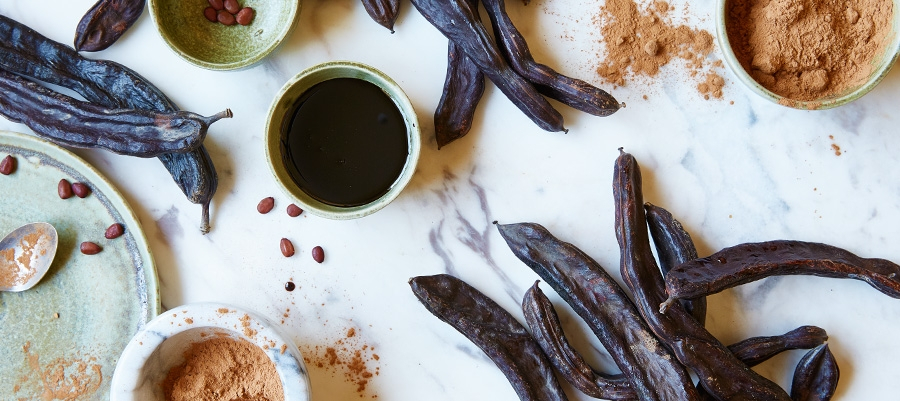
The season before the bottle
The raw material has its own calendar. Terra Carob, a processor in Famagusta, describes an August–September harvest followed by storage and drying before processing. Its account also distinguishes the separation and crushing of the pod's outer material and kernels.[2] There is work between the tree and the familiar packet or jar, even when the product eventually looks effortless to use.
That interval matters to how we think about seasonality. A bottle opened in winter can still carry a late-summer crop. Drying and storage allow an ingredient to travel beyond the moment of picking; the harvest date and the bottling date describe different stages. For a buyer interested in origin, asking where the pods came from and when they were harvested is more revealing than treating the date on the finished bottle as the whole story.
Carob's value to Cyprus long preceded the restaurant pantry. The Cyprus National Commission for UNESCO's heritage page records a 2018 inscription, describes the crop as a source of rural income and links its familiar nickname, “black gold,” to export earnings. The applicants included the Anogyra Community Council, the University of Cyprus and the Cyprus Food and Nutrition Museum.[3] The attention spans the field, the village and the archive: the syrup is one expression of a larger agricultural livelihood.
First the water, then the fire
The Anogyra method recorded in the government's gastronomical map, reproduced by the Cyprus Food Museum, gives roughly 20 hours for soaking the milled pods. The drained extract then takes about seven hours of boiling and continuous stirring to thicken. Further cooking and repeated hand pulling produce pasteli, the village's carob toffee.[1] Syrup is a deliberate stopping point along that route.
Accounts preserved by the museum vary. In Kythrea, a resident described stone-broken pods soaked for three or four days; in Anogyra, ground carobs in a basket were repeatedly moistened for 20–24 hours.[4]
The common sequence explains the transformation. Water carries sweetness out of the broken pods; heating removes water from the collected liquid. The maker needs both operations. Simply admiring the long boil misses the extraction that supplies the pot in the first place.
An interwar Kazafani account distinguishes thicker syrup from a thinner everyday version, which yielded more finished syrup from the same quantity of carobs.[4] Concentration changes both quantity and behavior; a more fluid version can have a purpose of its own.
Those timings belong to the recorded local methods. Contemporary suppliers have their own processes to describe. The question to carry from the archive to a purchasing conversation is how this particular maker extracts and concentrates the fruit.
A specification beside the story
Modern processing can make some of those choices easier to discuss. Stavros Parpis Foodstuffs, founded in 1992, describes a business using machinery for primary carob processing. Its published syrup analysis lists a concentration figure of 68 Brix at 20°C, and its product page offers four- and twenty-litre containers alongside its consumer presentation.[5]
The specification describes this producer's syrup and opens a useful conversation about consistency between deliveries. The larger containers also place carob firmly in a working pantry: an ingredient to measure into dressings or pastry batches as well as a bottle to bring home from a holiday.
A sensible trial would compare samples at the same serving temperature, first from a spoon and then in the intended dish. Does the syrup spread across the cheese or sit in a heavy streak? How much is needed before the sweetness obscures the other ingredients? These suggested kitchen checks help turn an evocative origin story into a usable choice.
Let the dark ribbon remain visible
There is plenty of culinary precedent for keeping that trial simple. The museum records carob syrup with tahini on bread, in pasta preparations and, on permitted fasting days, over bulgur pilaf.[4] The official tourism portal suggests it over yoghurt or anari cheese, and in dressings, marinades and sauces.[6]
For a small cheese course, that suggests a restrained starting point: anari with a little syrup, leaving enough pale cheese exposed to taste the two separately. Bread and tahini offer another way in, giving the syrup something substantial to cling to. These serving ideas follow the documented combinations; they leave the final balance to the bottle and the cook.
The pleasure is partly visual: a dark pour crossing a pale surface, its thickness briefly apparent before the first bite. Behind it are the harvested pods, the water that drew out their sweetness and the person who decided the pot was ready. A good serving gives those decisions room to be tasted.
Sources
- Cyprus Food Museum, “Haroupomelo & pasteli Anogyras, gastronomical map,” reproducing the Department of Agriculture's 2022 gastronomical map — soaking, draining, concentration, toffee production and culinary uses.
- Terra Carob Industry, “Carob Processing Process,” accessed November 10, 2026 — the Famagusta processor's account of harvest timing, storage, drying and separation.
- Cyprus National Commission for UNESCO, “Cypriot Carob: Traditional Cultivation, Harvesting and Processing Techniques” — records a 2018 inscription, rural income, export history and applicant organizations.
- Cyprus Food Museum, “Teratsomelon — carob syrup” — attributed accounts of Kythrea, Anogyra and interwar Kazafani production, differing concentrations and household uses.
- Stavros Parpis Foodstuffs, official company and product page, accessed November 10, 2026 — founding year, processing, published syrup analysis and container sizes; manufacturer claims.
- Cyprus Deputy Ministry of Tourism, “Carob Syrup” — yoghurt, anari and other culinary suggestions; source of the accompanying photograph.