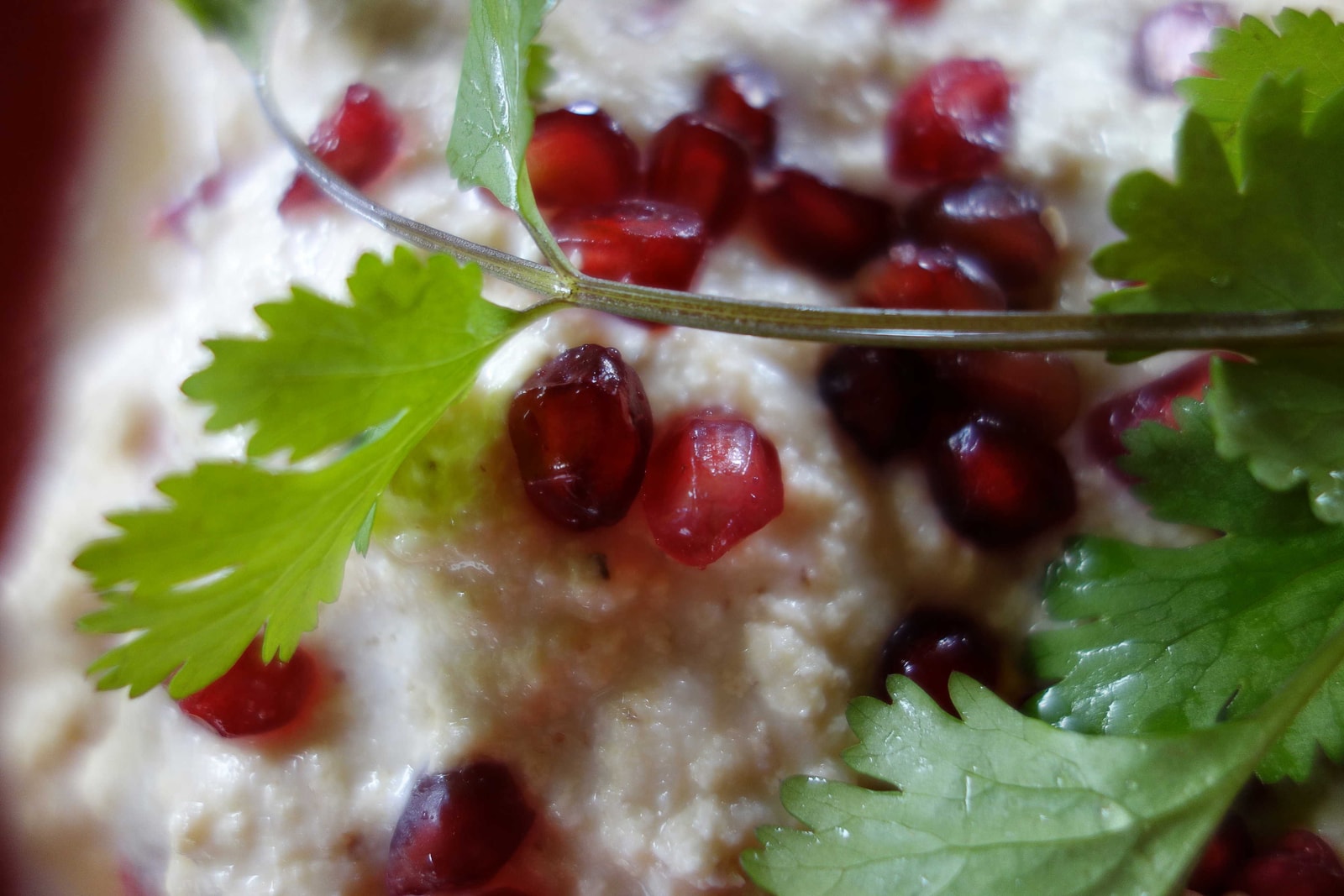
The walnut sauce hides most of the pepper. Pomegranate seeds and parsley announce the colours; a cut through the pale surface reveals something more crowded. Inside a chile en nogada, pork shares space with pear, apple, peach and plantain. The fruit belongs to the main course, tucked into the poblano alongside the meat.[1]
Puebla's Museo Casa del Mendrugo places the dish in the agricultural valleys below Popocatépetl and Iztaccíhuatl, where the rainy season brings the ingredients together. Its account names particular local fruits, including lechera pear and panochera apple.[1] That specificity changes how the plate reads. Under its elaborate dressing lies a gathering of things ready to eat at roughly the same time.
A filling with pieces worth finding
The recipe published by WWF México under Yuri de Gortari's name builds its picadillo with both pork and beef. Pear, apple, plantain, peach and raisins join the meat; almonds, herbs and spices follow, with roasted tomato and pine nuts added later.[3] Reading that sequence is enough to dispel the idea of a plain meat stuffing with a sweet garnish. Fruit runs through the centre of the dish.
The ingredients offer several kinds of resistance to the fork: tender flesh, softened fruit, small firm pieces of nut. Cinnamon and clove sit among savoury ingredients, so their familiar association with dessert becomes less useful. Here, a bite can move between meat and orchard without changing courses.
A version in México the Beautiful Cookbook, preserved online by the University of Texas at San Antonio Libraries, begins differently. Pork loin is simmered until tender and then chopped before joining the fruit mixture. The filling cooks until thickened, and the instructions caution against packing too much into each pepper.[4] This is a practical limit with a visible consequence: the poblano must still be able to contain dinner.
These methods need not produce identical bites. Starting with cooked, chopped pork and building a mixed-meat picadillo are distinct routes into the same recognisable dish. The recipes give a diner something more interesting to notice than an ingredient checklist: how much individuality survives inside the filling.
The white sauce begins with peeling
The quietest-looking part of the plate conceals particularly patient work. Rick Bayless describes the traditional freshly harvested walnut as still pliable, with a skin that can be removed relatively easily. Ordinary dried supermarket walnuts are firmer, and their skin clings more tightly. His adaptation boils and soaks them before scrubbing away as much skin as possible.[2]
Casa del Mendrugo also identifies peeling as essential to removing the skin's bitter taste.[1] The ivory colour, then, comes with a flavour decision and a considerable amount of handling. A smooth-looking sauce gives little indication of how many small surfaces someone has worked over.
The dairy changes between versions. De Gortari's recipe blends peeled walnuts soaked in milk with soaked almonds, then adds goat's cheese, sugar, salt and dry sherry.[3] The cookbook uses milk, thick cream and queso fresco, offering feta as a substitute.[4] Both surround the nuts with dairy, but they describe different preparations rather than a universal formula.
That distinction matters when reading a menu's brief promise of “walnut sauce.” The name leaves room for the cook's choices. The useful question at the table is whether the nut still has a presence through the surrounding richness. That is a judgement of balance, not something a white surface can settle in advance.
The layer you may not see
Between sauce and pepper there may be another preparation: capeado, an egg coating fried around the stuffed chile. De Gortari's version calls for flouring the filled peppers, covering them with beaten egg and frying them individually before adding the nogada.[3] The extra layer is easy to overlook once the sauce arrives.
The cookbook is especially helpful here. It specifies beaten egg whites, yolks folded in, and frying until lightly browned, but its variation note also permits leaving the peppers uncoated.[4] Bayless chooses an unbattered version in his updated recipe.[2] Comparing them makes the difference concrete: one plate contains a fried egg layer beneath the sauce; another brings sauce directly against the poblano.
Neither appearance alone nor the dish's name tells the whole story. The first cut does. It exposes the coating, if present, and lets the filling loosen into the sauce.
Bayless notes that room-temperature service is common, while expressing his own preference for a warm filling.[2] There is room here for another contrast within one plate. Pomegranate seeds interrupt the soft textures; parsley gives the pale sauce a fresh green edge. The decoration participates in the bite.
The satisfying way into chiles en nogada is through that cross-section: sauce, possible egg coating, pepper, then fruit and meat together. Its splendour survives the first cut. In fact, that is when the dish finally shows how much is inside.
Sources
- Museo Casa del Mendrugo, “Chile en Nogada,” Google Arts & Culture — Puebla's agricultural setting, local fruit varieties, filling and peeled fresh walnuts.
- Rick Bayless, “Chiles en Nogada” — fresh versus dried walnuts, peeling, an unbattered adaptation and serving temperature.
- WWF México, “Chile en Nogada,” recipe file attributed to Yuri de Gortari — mixed-meat and fruit filling, walnut-almond sauce and egg coating.
- Susanna Palazuelos, Marilyn Tausend and Laurie Gruenbeck, México the Beautiful Cookbook (1991), “Chile en Nogada”; excerpt hosted by UTSA Libraries — cooked and chopped pork, dairy sauce, frying and recipe variations.
- Julián Monge-Nájera, “2017 Chiles en Nogada Mexican food.jpg,” Wikimedia Commons — original photograph, author record and CC BY-SA 4.0 licence.