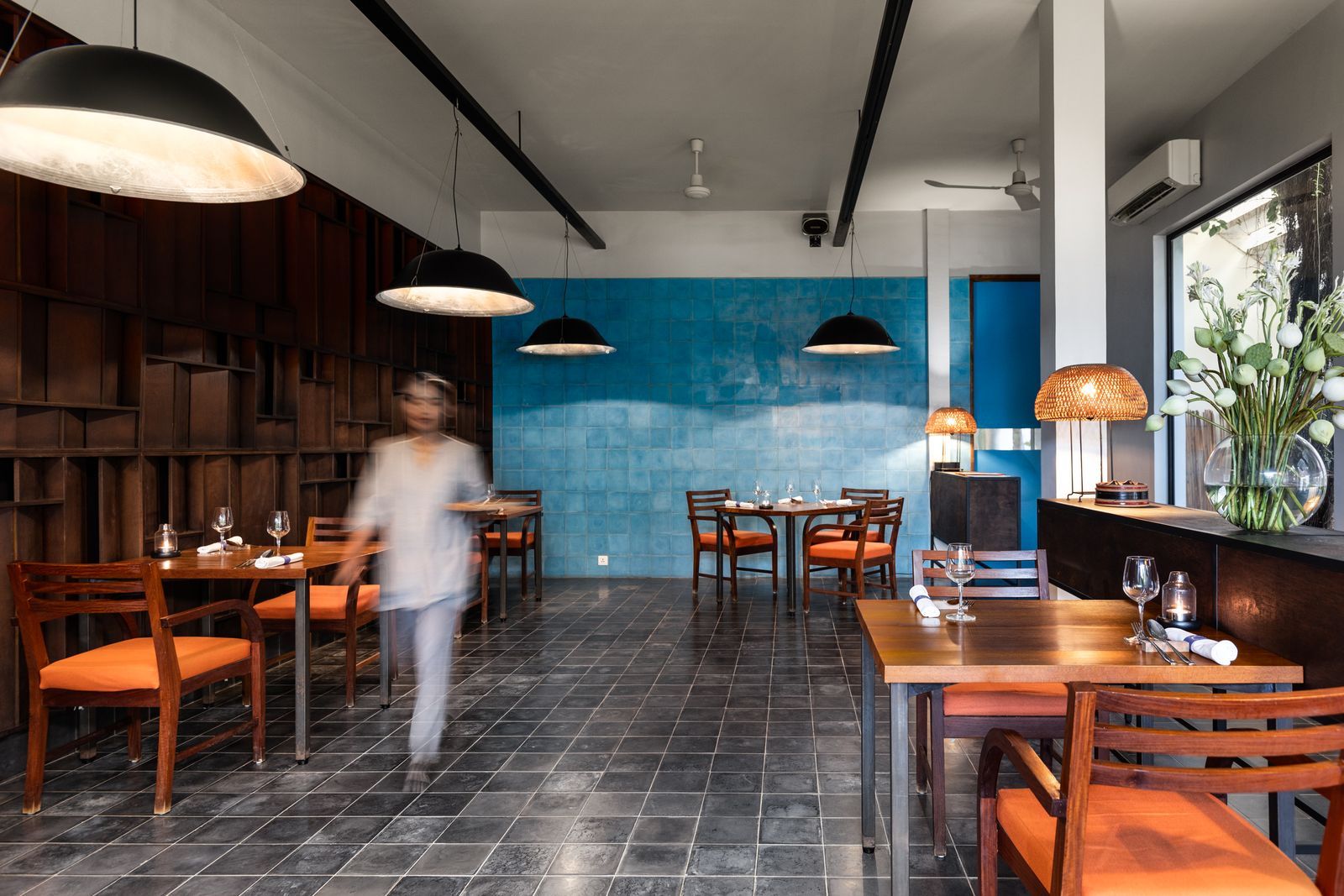
The blue wall is the loudest color in Cuisine Wat Damnak’s indoor dining room. It runs behind dark timber tables set with narrow white napkins, orange-cushioned chairs and black pendant lamps. In Regis Binard’s photograph, a server crosses the floor quickly enough to become translucent.[6] The room is polished, but it has not been embalmed by polish. Dinner is about to happen.
That is also the restaurant’s most persuasive culinary idea. French technique is present everywhere at this Siem Reap flagship—in confit, purée, sorbet, crème brûlée and the careful compression of a long meal into individual plates—but it is not supposed to become the main character. The subjects are Cambodian: freshwater fish, maam, green peppercorn, rice-paddy herb, moringa, luffa, jackfruit, pandan and whatever the market can supply this week.
“Fusion” is too easy a word for that arrangement. It implies two cuisines meeting as equals on a blank plate, as though neither arrived with a place, a history or an imbalance of prestige. Cuisine Wat Damnak is more interesting when read as a restaurant trying to make one tool kit answer to one pantry. Its best work asks French discipline to adjust texture and service while Cambodian ingredients and combinations decide what the food means.
Fifteen years after the restaurant opened, that distinction matters more than another award citation. Cuisine Wat Damnak is no longer simply the story of a French chef who learned to cook in Cambodia. It is a two-city business with Cambodian operational leadership, a collaborative kitchen team, and a Siem Reap menu that still makes availability—not imported luxury—the reason to revise a course.[1][2][5]
The origin story needs more than one hero
Joannès Rivière arrived in Cambodia in 2003 as a volunteer cooking teacher at Siem Reap’s Sala Bai Hotel School. He wrote the school’s Cambodian Cooking, spent five years as executive chef at Hotel de la Paix, and later created Cuisine Wat Damnak with his partner Carole Salmon.[2] In 2015, the restaurant appeared at No. 50 on Asia’s 50 Best Restaurants, whose contemporary caption described Rivière as showcasing Cambodia’s indigenous pantry.[8]
That chronology explains the chef’s training and the international attention. It does not fully explain the restaurant that exists now.
Cuisine Wat Damnak’s own biography names Nguon Vengchhay as co-owner and partner, leading operations across Siem Reap and Phnom Penh after becoming a full partner in 2019.[2] Reporting in The Phnom Penh Post makes the collaboration less abstract. In 2021, Vengchhay described a weekly process in which Rivière and an eight-person kitchen team proposed dishes together and combined their ideas into a balanced menu; Rivière then added a finishing technique or dessert idea.[5]
The distinction is important. A menu based on learned local knowledge can easily be narrated as one outsider’s act of discovery. A menu made through cooks, market vendors, producers and front-of-house leadership is a more complicated piece of authorship. Rivière’s fluency in Khmer and long residence help him ask better questions; they do not make the people answering those questions incidental.
The restaurant’s profile should therefore begin with the partnership, not add it as a courtesy near the end. Rivière supplies a recognizable culinary method. Vengchhay supplies hospitality and operational direction. The 2021 account shows the team testing whether a week’s ideas can become one meal. Cambodia is not colorful material waiting for a chef to organize it. It is the source of the ingredients, tastes and knowledge to which the organization must remain accountable.
The pantry is a map with a short clock
Cuisine Wat Damnak says its ingredients come almost entirely from farms and villages around Siem Reap and Phnom Penh, supplemented by produce from other Cambodian regions: seafood from Koh Kong, cool-climate vegetables from Mondulkiri, and freshwater fish from the Tonlé Sap and Mekong.[1] This is the restaurant’s own sourcing account, not an independent supply-chain audit. Even with that boundary, the geography tells us what kind of luxury the kitchen is pursuing.
It is not the frictionless luxury of identical caviar tins arriving in many capitals. It is a pantry shaped by water, altitude, transport and season. A Sanday fish is not interchangeable with a generic white fillet. A green peppercorn still on its stem behaves differently from dried black pepper. Coconut-tree heart, water mimosa and rice-paddy herb arrive with textures and perishability that put a clock on invention.
The official Siem Reap page states the operating consequence plainly: there is no à la carte menu, and both the standard and vegetarian tastings change with fresh market availability.[4] That format can look controlling from the dining room. In the kitchen, it is a form of permission. The restaurant does not have to keep an ingredient on the menu after the ingredient has stopped being good.
Earlier local reporting adds useful friction to the “all local” romance. Vengchhay identified milk, chocolate, garlic, dried mushrooms and some oils as imports while describing most Siem Reap produce as coming from the land around Angkor.[5] Naming the exceptions makes the claim more credible. Locality here is a strong organizing preference, not a magic circle.
The current online menu, checked on July 29, 2026, reads like an inventory that has already begun moving. Angkor-stout pulled beef shank comes with cabbage fresh, steamed and pickled. Pork belly and maam are served in a galangal leaf with green peppercorn, herbs, flowers and local crudités. Sanday fish sits in a clear curry of coconut-tree heart, luffa and moringa leaves with pig-trotter broth and toasted-rice purée.[4] The place names and preservation methods carry more information than any luxury-brand label could.
Technique changes the bite, not the address
Rivière gave the clearest account of his technical boundary in a 2019 Michelin Guide interview. The products and their combinations, he said, remain local; French influence enters through texture and presentation. His example was duck: rather than boil a tough bird and reheat it, the kitchen could confit it slowly, crisp it to order, and build the broth from local vegetables and spices.[3]
That is not cultural neutrality. Confit comes with a French lineage, and plating a shared cuisine as a procession of individual courses changes how balance is experienced. Rivière also described Cambodian meals as finding equilibrium across the table—a sour soup beside a sweet stew and a spicy salad—rather than requiring each dish to contain every register.[3] A tasting menu takes that simultaneous conversation and turns it into sequence.
The restaurant succeeds when it acknowledges the conversion and protects the original relationships. The 2026 menu does this through repetition with difference. The beef course gives one cabbage three textures. The pork course puts fermented fish, fatty meat, raw vegetables and fresh pepper into the same aromatic leaf. The fish course joins a clear plant-led curry to pig-trotter broth and toasted-rice purée.[4] These are not French combinations decorated with Cambodian garnish. The combinations remain Cambodian in their appetite for herbs, fermentation, sourness, bitterness and the productive collision of fresh and preserved things; technique adjusts their edges.
Even the dessert line resists a simple East-meets-West caption. Jackfruit, tapioca and pandan become a crème brûlée; fresh and candied pomelo meet a crêpe, passion-fruit reduction, curd and sorbet.[4] The French forms are visible, perhaps more visible than in the savory courses. On paper, however, their aromatic center has moved: the named custard form must share attention with tropical fruit, a chewy starch and pandan rather than asking vanilla to carry the whole idea.
This is why “French-Cambodian fusion” undersells the restaurant. The phrase keeps our eyes on the border crossing. Cuisine Wat Damnak is better when the crossing has already happened and the diner can pay attention to what its sources and menu actually show: a tough bird becoming crisp and tender, a sour fruit listed at two concentrations, and a fermented seasoning named beside fresh herbs rather than translated away.
The house offers three temperatures of formality
The Siem Reap restaurant occupies a traditional Cambodian wooden house in Wat Damnak village. Its official description offers three choices: an air-conditioned modern room downstairs, a fan-cooled wooden room upstairs, and a softly lit tropical garden.[4] These are not merely seating zones. They change how the same tasting menu feels.
The indoor room in Binard’s photograph shows the cleanest version of the restaurant’s refinement: tiled floor, measured table spacing, blue plane, dark joinery, white flowers, a server in motion.[6] Upstairs, the wooden structure keeps more of the country-house atmosphere. Outside, the restaurant describes balmy evenings, tropical greenery and local herbs close to the table.[4] Fine dining usually tries to stabilize the environment so completely that weather disappears; Cuisine Wat Damnak lets a guest choose how much Cambodia’s evening air enters the meal.
The current prices are similarly legible. The regular tasting is listed at US$45 and the vegetarian menu at US$38, before a 5% service charge and 10% government tax.[4] Those figures may change, and the restaurant requests advance notice for dietary needs. Garlic and chile are treated as fundamental, while guests avoiding fish products are directed toward a pre-arranged vegetarian menu.[4] That is a more honest boundary than promising limitless customization and quietly hollowing out the cuisine.
The vegetarian progression is not framed as the lesser route. One current course combines pickled bamboo-shoot salad with chile and lime leaf, a yellow-bean and holy-basil falafel, and fermented-chile sauce; another brings black-sticky-rice porridge together with Mondulkiri onion, caramelized ginger and crisp layered tofu.[4] The menu does not need meat to prove technical seriousness because its pantry already supplies fermentation, smoke, crunch, acid, starch and scent.
Refinement has to keep revealing its sources
Cuisine Wat Damnak’s achievement is real: it built an internationally legible fine-dining form around Cambodian flavors and became the first Cambodian restaurant to enter Asia’s 50 Best list.[2][8] Its current institutional profile still emphasizes Rivière and Vengchhay’s co-ownership, the wooden house, the garden, and parallel regular and vegetarian tastings.[7] Durability matters for a restaurant whose turnover and Siem Reap hours were badly exposed by the collapse of travel during the pandemic.[5]
But longevity should sharpen the questions, not retire them. Which farms and fishers can the menu name? Which team member originated a course? How does the restaurant preserve the table-wide logic Rivière admires when it plates one guest at a time? When a French form and a Cambodian flavor meet, which one does the server explain first?
The public sources used for this profile cannot answer all of those questions. They document a geographic sourcing claim, a collaborative menu process, current dishes and a shared ownership structure. They do not disclose purchasing volumes, producer contracts or authorship for each plate. That limit is worth keeping visible. “Local” becomes thin marketing when no relationship can be seen behind it.
At its strongest, Cuisine Wat Damnak makes the relationship legible on the menu anyway. Maam keeps its name rather than being translated into anonymous umami. Green peppercorn appears as produce, not only as a provenance speech. Freshwater fish keeps its identity rather than impersonating a European luxury species. French technique does useful work—confit, purée, crisping, pacing—then steps out of the light.
The blurred server in the dining-room photograph offers the right final image. The architecture is composed, the tables are ready, and the person doing the work refuses to become furniture.[6] Refinement is not the still room. It is the movement that carries a particular market, team and place to the table without pretending the journey began in the dining room.
Sources
- Cuisine Wat Damnak, official welcome page — the restaurant’s account of its Cambodian ingredient geography and seasonal menu philosophy.
- Cuisine Wat Damnak, “About Us” — biographies of Joannès Rivière and co-owner Nguon Vengchhay, including Rivière’s 2003 arrival and Vengchhay’s operational partnership.
- Rachel Tan, “5 Questions with Joannès Rivière on New Cambodian Cuisine,” Michelin Guide (April 23, 2019) — interview on Cambodian meal balance, freshwater fish, local combinations, and the restaurant’s use of French technique for texture and presentation.
- Cuisine Wat Damnak, official Siem Reap page — current room descriptions, tasting-menu format, dishes, prices, dietary boundaries, taxes, and reservation details; checked July 29, 2026.
- Pann Rethea, “Khmer dishes served in a refined way,” The Phnom Penh Post (February 25, 2021) — local reporting on Nguon Vengchhay, collaborative menu development, sourcing exceptions, seasonal market work, and the pandemic-era expansion.
- Chaitali Patel, “48 Hours in Siem Reap, Cambodia,” Condé Nast Traveler (July 29, 2024) — city context, the restaurant’s wooden-house setting and local sourcing, and Regis Binard’s documentary dining-room photograph published in the article.
- 50 Best Discovery, “Cuisine Wat Damnak” — current institutional profile of the Siem Reap flagship, its co-owners, changing tasting menus, rooms, and representative dishes.
- Asia’s 50 Best Restaurants, “Asia’s 50 Best Restaurants 2015: the list in pictures” — contemporaneous record of Cuisine Wat Damnak’s No. 50 placement and its Cambodian-pantry framing.