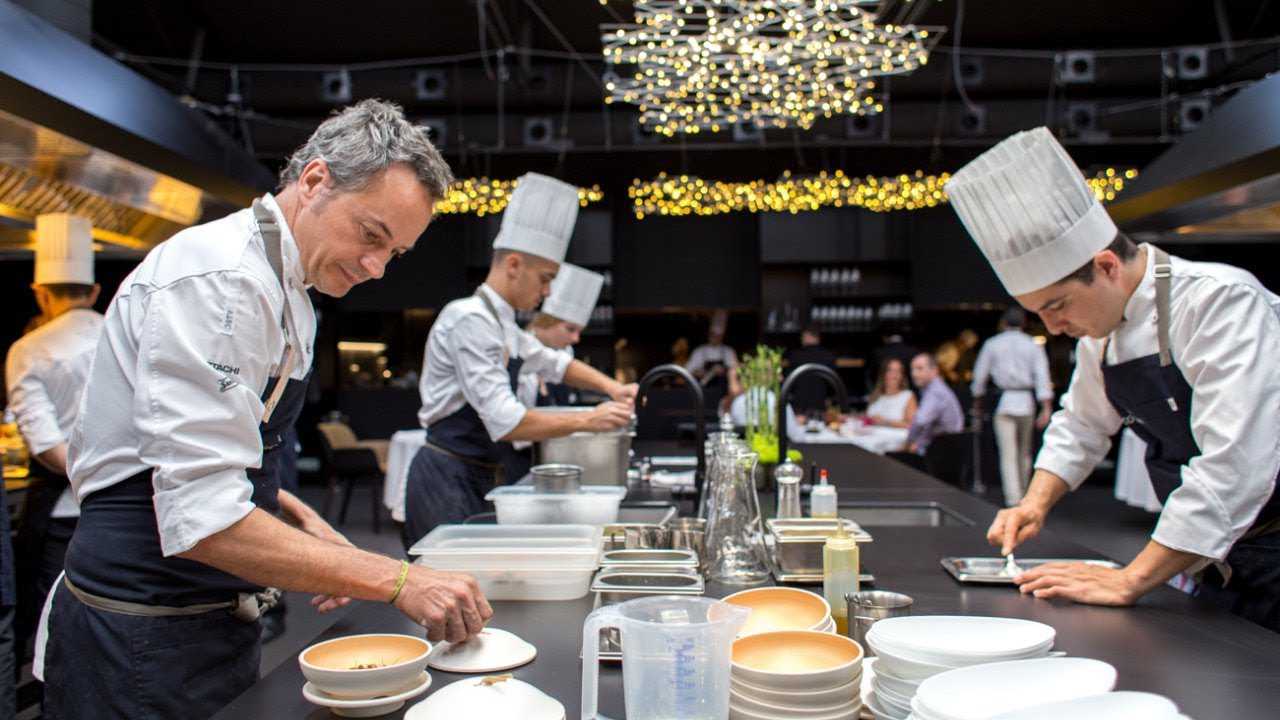
The lazy way to talk about Cocina Hermanos Torres is to call it an open-kitchen spectacle and stop there. That catches the first impression and misses the real idea. Sergio and Javier Torres did not simply move the stoves into view. They reorganized the room so that production, explanation, and dining happen inside the same field of attention.[1][3] At this restaurant, the room is not a backdrop for the recipe. It is one of the recipe's main ingredients.
As of April 30, 2026, the public evidence points in the same direction. The restaurant's own reservation page presents a single Revolucion tasting menu at EUR320, with a wine pairing at EUR195, and describes the kitchen's aim as getting "the most and best out of the product, with the least handling possible."[2] Michelin's current listing gives the broader architectural reading: the Torres twins placed their culinary microcosm in the heart of the dining room, with three cooking stations at the center and tables arranged around them under luminous "clouds" of light.[3] The 50 Best Discovery profile then adds the diner-level consequence: an industrial-scale open kitchen dominates the room, guests can look directly toward fish, meat, and pastry work, and there is effectively no bad seat because the whole dining room is organized around visibility.[4]
That combination is why the restaurant matters. Plenty of luxury rooms now perform openness. Cocina Hermanos Torres makes openness structural.
Image context: the lead photo comes from the restaurant's official discover page. It works here because this article is about spatial grammar. The tables do not merely face a kitchen; they orbit a central production field that the brothers designed as the heart of the experience.[1]
1. The three stoves are not theater props
The restaurant's own discover page states the idea with unusual clarity. The guest zone is described as the "centre and heart of the project," and the kitchen is framed as open, educational, and cultural, with the client treated as the protagonist of the experience.[1] That phrasing matters because it moves the design beyond generic luxury transparency. The point is not just that diners can watch chefs work. The point is that exchange itself is built into the format.
Michelin's reading supports that claim from the outside. Inspectors say the Torres brothers dreamed of putting their culinary microcosm into the center of the room so the experience could become a real spectacle, which is why the three cooking stations dominate the middle of the dining room.[3] Read alongside the official site, the word "spectacle" becomes more precise. These stations are not decorative islands built for a few finishing flourishes. They are the physical statement that the meal should be read as live assembly rather than as a sealed mystery emerging from a hidden brigade.
That difference is important in 2026 because open kitchens have become a prestige default. In many dining rooms, visibility is mostly atmospheric. At Cocina Hermanos Torres, visibility is the organizing principle.
2. The preparation chain stays legible from the table
The discover page becomes even more interesting once it breaks the room into working sections. Under the old industrial roof, the cooking area is divided into a cold room and vegetables section, a meat and poultry section, a fish and seafood section, and a preparatory kitchen for stocks and quartering.[1] The site explicitly calls these the functional areas that make up the preparation chain ending in the dish.[1]
That sentence is the key to the whole restaurant. The Torres brothers are telling diners that a plate is not a final object to admire from a distance. It is the last visible link in a chain of handling decisions. By keeping those sections in view, the room gives structure to ideas that often stay abstract in fine dining: product integrity, sequence, and restraint.
The 50 Best Discovery profile sharpens the same point with more tactile detail. It says diners get close to the cold room, the meat and poultry area, and the seafood and fish sections while the chefs work, and that they can also steal views into the glazed R&D room and the lively pastry kitchen.[4] That makes the restaurant feel less like a stage with one spotlight and more like a working ecosystem whose parts remain differentiated. You are not meant to see only the glamorous final brushstroke. You are meant to understand that vegetables, fish, meat, pastry, testing, and service all belong to one continuous syntax.
3. The support rooms keep the concept from collapsing into noise
Cocina Hermanos Torres would be far less convincing if every function were dumped into one giant hall. The space works because the side rooms control pace and pressure. The official site describes a bar and wine-cellar zone under the preserved industrial roofing where guests can gather before or after the meal; a glazed pastry bakery responsible for breads, chocolate work, and desserts; an education room for up to 20 seated visitors and live cooking demonstrations; and a private room for 12 guests with direct street access and a link to the R&D room.[1]
Those details might sound secondary. They are not. They explain how the restaurant avoids the trap that catches many open kitchens: too much visual democracy can flatten hierarchy and make a serious room feel restless. Here, the bar absorbs social looseness before and after dinner. The pastry room gives sweets their own identity instead of treating them as an afterthought. The education room formalizes the house's didactic impulse rather than letting it leak awkwardly into service. The private room allows discretion without severing the connection to the central kitchen field.[1]
That is why 50 Best's observation that there is "no such thing as a bad seat" lands so well.[4] The room is broad, yet it keeps redistributing focus.
4. The menu stays stricter than the room
The most disciplined part of the restaurant may be the menu architecture. The reservation page offers one public tasting line, Revolucion, and ties it directly to a product-first philosophy with minimum handling.[2] Michelin makes the same argument in more polished language, describing a gourmet journey through the best seasonal and local ingredients, treated to extract maximum flavor with minimal intervention, and even points to a signature example: cured squid with poultry consommé and caviar.[3]
That narrowness matters because the room could easily tempt the kitchen toward excess. Three central stations, visible sections, a pastry theater, an R&D window, and an educational identity would all make it easy to over-explain or over-perform. Instead, the menu logic pulls in the opposite direction. The public claim is restraint. The product must stay clear enough to survive all that architecture.
This is where the restaurant's profile becomes sharper than a generic "chef brothers with an impressive room" story. Cocina Hermanos Torres is not interesting because it proves that fine dining can be theatrical. It is interesting because it asks a harder question: how much theater can a restaurant build around a dish before the dish loses authority? The answer in Barcelona seems to be that theater works only when the kitchen keeps returning to product, sequence, and minimal intervention.[1][2][3][4]
Why the restaurant still stands out
Many luxury restaurants invite diners to admire what the kitchen has done. Cocina Hermanos Torres invites diners to inhabit the kitchen's logic. The three stoves at the center, the visible preparation chain, the glazed pastry and R&D rooms, the educational infrastructure, and the single Revolucion tasting menu all point toward the same ambition: make the guest feel the dish as the end of a legible process rather than as a magical object dropped from backstage.[1][2][3][4]
That is why the restaurant still reads as unusually complete. The room is bold, yet the food philosophy remains narrow. The architecture teaches, yet the menu keeps insisting on less handling, not more. In a period when open kitchens often function as a luxury shorthand, Cocina Hermanos Torres still feels like a fully argued house style.
Sources
- Cocina Hermanos Torres, "Discover" - official explanation of the central kitchen concept, visible preparation sections, bar, pastry room, education room, private room, R&D room, and the official interior image used for this article.
- Cocina Hermanos Torres, "Reserve" - official tasting-menu page covering the Revolucion menu, current EUR320 price, EUR195 wine pairing, booking contact flow, and arrival/parking notes.
- MICHELIN Guide, "Cocina Hermanos Torres - Barcelona" - current Michelin listing covering the three central cooking stations, three-star status, product-first Mediterranean cuisine, signature dish example, and overall room concept.
- 50 Best Discovery, "Cocina Hermanos Torres - Barcelona - Restaurant" - current profile covering the industrial-scale open kitchen, visible fish/meat/pastry sections, the glazed R&D view, the education room, and current tasting-menu positioning.