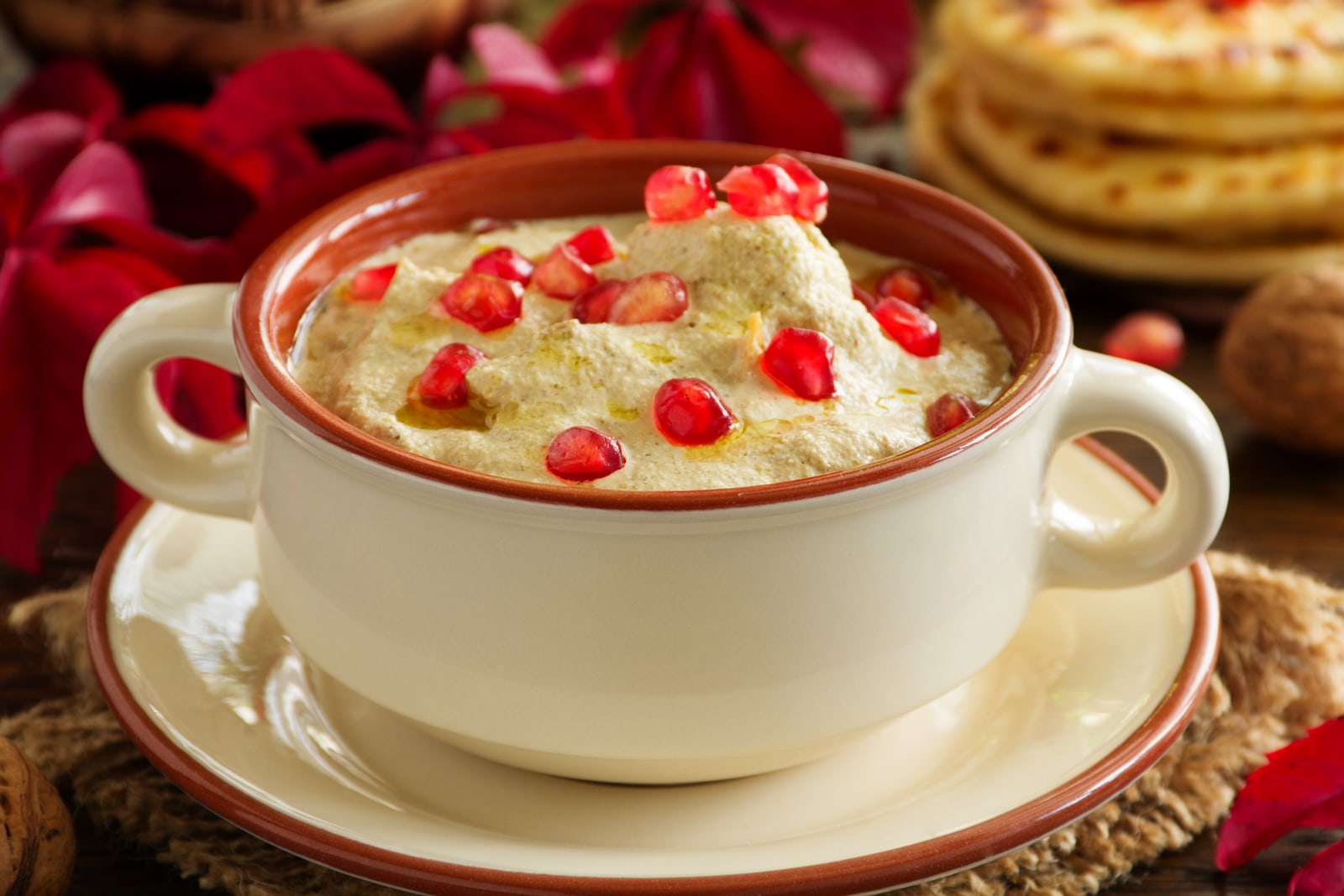
Poultry disappears beneath a pale walnut sauce, seasoned with garlic and spice. Cookbook author Irma Iantbelidze finishes her satsivi by refrigerating it and serving it cold.[1]
That arrival is part of its pleasure. Georgia's national tourism administration places satsivi at the New Year table and describes a dish made throughout the country, with turkey or chicken and considerable variation between households.[2] A feast can make room for this quieter sort of abundance: a bowl whose richness reveals itself when someone serves it.
The published recipes offer a useful way into satsivi. Follow what happens to the nuts, the cooking liquid, and the finished bird, and a deceptively uniform surface begins to show the decisions underneath.
The bird supplies more than meat
Iantbelidze's recipe uses a kilogram of walnuts for a medium turkey. The bird is boiled, and fat skimmed from its stock becomes the cooking fat for onions. Flour helps thicken the sauce; the stock is added gradually, followed by the seasoned nuts. The cooked turkey goes into that mixture before cooling.[1]
It is an economical sequence in a lavish dish. Turkey contributes flesh, liquid, and fat, while the walnuts give the liquid substance. Read this way, the sauce keeps the preparation connected: the meat returns to a concentrated version of its own cooking medium.
Georgia About's chicken recipe instead parboils and roasts the bird, reserving cooking liquid for the sauce and using the pot's surface fat for basting and onions.[3] The cold, covered dish conceals that earlier encounter with the oven.
The work beneath a smooth surface
In that preparation, walnuts go through a grinder twice. The cook saves their released oil and gradually loosens the seasoned nuts with cooking liquid. A sieve removes larger particles.[3]
Those small operations explain the polish. Grinding and sieving determine what remains perceptible on the tongue; liquid allows the nut mixture to surround the meat. The apparent simplicity of a pale sauce can contain considerable handwork.
The saved walnut oil may finish the dish.[3] Its gloss makes the walnut visible in a second form, alongside the dense sauce.
This is also where a tasting portion could earn its elegance. A clean bowl and a careful garnish offer little if the sauce underneath feels rough or lacks flavor. The most consequential refinement has already happened at the grinder and sieve.
Spice in small proportions
Iantbelidze seasons her turkey satsivi with blue fenugreek, dried marigold, coriander, garlic, chili, clove, and cinnamon. The quantities give a revealing sense of proportion: against that kilogram of walnuts, she specifies half a teaspoon of cinnamon and a fifth of a teaspoon of clove.[1]
Warm spice is present, but the recipe leaves the nuts plenty of room. The interest lies in how these aromatics sit within a savory preparation. Cinnamon need not imply sweetness; here, it shares a bowl with poultry stock and garlic.
Nor does every cook want the same balance. Georgia Travel records versions that omit cinnamon and clove, versions without vinegar, and versions thickened with flour. It also describes Barbare Jorjadze's older “Gurian satsivi” as using fewer walnuts and more vinegar than contemporary recipes.[2] That account is a useful check on the temptation to make maximum richness the sole measure of authenticity. A sharper sauce has a place in the dish's recorded history, too.
A neighboring sauce sharpens the picture
Bazhe, another Georgian walnut sauce, makes the role of liquid especially clear. Georgia Travel's preparation combines ground walnuts, garlic, and spices with water that has been boiled and cooled. More water adjusts the consistency; reserved walnut oil finishes the surface. Its suggested companions include chicken and vegetables.[4]
Compare that method with Iantbelidze's stock-based satsivi and a menu's short description—“chicken with walnut sauce”—begins to seem insufficient. In one recipe the sauce is built around the bird's broth and cooked onions; in the other, the nut mixture is loosened with cooled water. Those are different routes to the plate, even when several ingredients overlap.[1][4]
The names do not create an absolute technical border. Georgia About also publishes satsivi with eggs and onions: a walnut mixture loosened with cooled boiled water, served over fried onions with halved boiled eggs.[5] That example makes rigid definitions less useful than attention to the actual preparation. Ask what the cook has made, and the dish becomes more interesting.
The last spoonful
Cold service gives satsivi a distinctive place in the imagination of a feast. A roast usually invites attention to its browned exterior and carving. Here, the sauce asks for equal billing. The diner has to reach through it, then decide how much to carry with each piece.
The recipes suggest a good way to approach the bowl: taste the sauce on its own before taking meat with it. Notice the texture, then the garlic and spice, then how the poultry changes the mouthful. Satsivi rewards that small pause. Much of the cook's work is waiting in the part that looks most still.
Sources
- Irma Iantbelidze, “Satsivi,” Georgian Recipes — turkey, stock, onion, flour, spice quantities, refrigeration, and cold service.
- Georgian National Tourism Administration, “Satsivi,” Georgia Travel — New Year context, household variation, and its account of Barbare Jorjadze's Gurian recipe.
- Georgia About, “Satsivi,” Georgian Recipes, January 2, 2014 — chicken preparation, roasting, repeated grinding, sieving, and reserved walnut oil.
- Georgian National Tourism Administration, “Bazhe,” Georgia Travel — a neighboring walnut sauce prepared with cooled boiled water and served with poultry or vegetables.
- Georgia About, “Satsivi with Eggs and Onions,” Georgian Recipes, April 3, 2014 — an alternative preparation illustrating the breadth of the name.
- Lesya Dolyk, “Satsivi (2),” Wikimedia Commons — chicken satsivi photographed December 1, 2013; photograph provenance and CC BY-SA 2.0 license.