Bozar Restaurant is easy to misread from a distance. The name points first to the Brussels arts institution, then to Victor Horta's Palais des Beaux-Arts, then to medals: two Michelin stars, 17.5 out of 20 from Gault&Millau, and Karen Torosyan named Gault&Millau's Chef of the Year 2026.[3][4][5][6] That stack of signals can make the restaurant sound like a trophy room attached to a museum.
The more interesting reading is operational. Bozar works because the room turns craft into a service system. The architecture lowers the temperature. The menu makes the table choose together. The pastry-centered classics require advance discipline, limited production, and visible timing. The team is named publicly enough that the experience feels less like chef mythology and more like a coordinated house.
That is why the restaurant's calm is not decorative. It is a production tool.
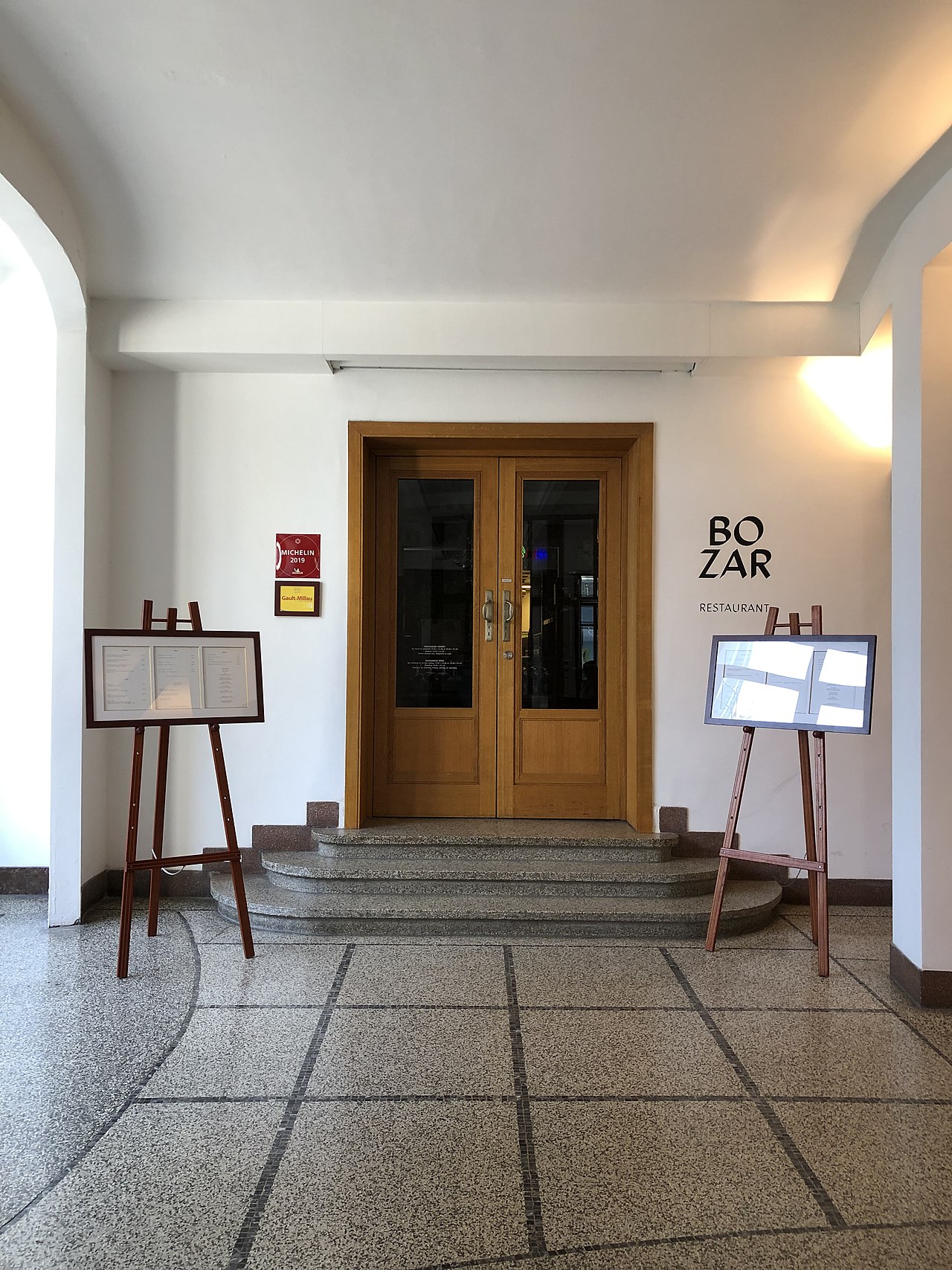
Image context: the lead image is a 2019 Wikimedia Commons photograph of Bozar Restaurant's entrance. It is not a plated-food glamour shot, and that is useful here. The double doors, menu stands, plaques, and institutional corridor show the first operational fact of the restaurant: the guest enters fine dining through an arts building, not through a freestanding luxury facade.[7]
The threshold does useful work
Bozar's own description starts with integration. The restaurant says it is "seamlessly integrated" into the Palais des Beaux-Arts, a Victor Horta building where art and cuisine are meant to sit in dialogue.[1] The cultural institution's page makes the same point in public-facing terms: Karen Torosyan's restaurant is inside Bozar at Rue Baron Horta 3, and its cooking is presented alongside the building's Art Deco interior.[3]
For service, that matters. A restaurant inside a major cultural venue inherits a peculiar kind of pressure. Guests may arrive after an exhibition, before a concert, or from the city center carrying the noise of Brussels with them. The room has to change their pace without turning stiff. Bozar's website describes clean lines, soft lighting, noble materials, and an atmosphere meant to be calm, elegant, and alive.[1] That is not just mood copy. It is a service requirement.
The best fine-dining rooms often solve anxiety before the first bite. Bozar's threshold does some of that work. The guest has already entered a palace of arts; the restaurant does not need to shout its importance. The building supplies gravity. The staff can then use restraint: fewer theatrical gestures, more control of rhythm, more attention to when a classic should be shown and when it should simply arrive.
This is a different form of luxury from the destination restaurant that must invent an entire universe from the driveway inward. Bozar borrows cultural mass from the house around it, then narrows that mass into dinner.
The table contract is stricter than it first looks
The current menu page is revealing because it is not a loose a la carte invitation. The main Bozar menu lists seven courses at EUR 275 with a EUR 125 wine selection, while Menu Horta lists five courses at EUR 195 with a EUR 95 wine selection and is excluded on Friday and Saturday evenings.[2] Lunch is a three-course EUR 115 lane with a EUR 55 wine selection.[2] The selected menu is served to all guests at the table.[2]
That last rule is doing a lot. It protects pacing. If one diner wants the full seven-course menu while another wants the shorter menu, the kitchen and dining room would have to run two clocks at one table. Bozar declines that friction. The table moves as a unit, which means the staff can choreograph courses, explanations, wine, clearing, and pastry timing around one shared sequence.
The same logic appears in the classics. Wellington is listed as limited production. Pithiviers and Granivore require reservation at least 48 hours before the meal. Each classic is built as a five-course format for two people, priced at EUR 325 per person with a EUR 175 prestige wine selection.[2] This is not scarcity as hype alone. It is scarcity as scheduling.
Puff pastry, farce, resting, carving, sauce, and table presentation do not behave like a quick supplement that can be bolted onto a tasting menu at the last minute. When Bozar says the Pithiviers and Granivore need 48 hours, it is making invisible labor legible. A guest who orders one of these dishes is not merely buying a famous preparation. They are buying the kitchen's right to plan.
Classics become living machinery
Michelin's current profile is unusually explicit about the craft. It frames Torosyan as a craftsman working with executive cheffe Cassandre Ercolini, elevating ancestral techniques and focusing on preparations such as pate en croute and pithiviers by reservation.[4] The guide also notes that puff pastry creations are presented before going into the oven, making the diner part of the sequence rather than only the recipient of a finished plate.[4]
That detail explains Bozar better than a list of awards. A pre-oven presentation changes the relationship between guest and kitchen. It says: here is the object before transformation; now trust time, heat, butter, structure, and restraint. The drama is not smoke, projection, or a surprise box. The drama is whether a classical form can still create suspense when everyone at the table knows the rules.
Gault&Millau's profile pushes the same craft argument from another angle. It gives Bozar 17.5 out of 20 and describes Torosyan's work as a meeting of present and past, craft and art, with a menu moving through Armenian tuiles, jambon persille and smoked eel, Brittany crab with sorrel and caviar, blue lobster, pigeon en croute, and a vanilla millefeuille baked a la minute.[5] The point is not that every ingredient is local to Brussels. Bozar's cuisine is not a narrow locavore manifesto. Its center is precision: Belgian and French classic memory filtered through a chef who treats timing as flavor.
That is why the pastry classics are so important to the house. Wellington, pithiviers, granivore pigeon, millefeuille: these are not minimalist plates that can hide behind tweezers. They are structural dishes. If the crust is dull, the sauce heavy, the meat mistimed, or the carving hesitant, the failure is public. Bozar's service has to carry that risk calmly.
The team is part of the architecture
Fine dining often overuses the singular chef story. Bozar has a strong protagonist, but the public information around the restaurant keeps widening the frame. Gault&Millau identifies Karen Torosyan as Chef of the Year 2026 and emphasizes rigor, perfection, and the way he refines classics with precision.[6] The restaurant's own palmares records the longer climb: Torosyan became executive chef in 2010, won the world championship of pate en croute in 2015, took over Bozar with his wife and business partner Nani-Lee Torosyan in 2018, earned a first Michelin star in 2017, and a second in 2023.[6]
The current Gault&Millau listing also names the working cast: Cassandre Ercolini as executive chef, Khalil Mezni as pastry chef, Stephanie Pierre as sommelier, and Vincent Sibourg as maitre.[5] Those names matter because Bozar's style depends on handoffs. The kitchen has to maintain exacting classical technique. The pastry section has to make last-minute baking feel generous rather than nerve-racking. The wine program has to support richness without making the meal heavier. The dining room has to keep the arts-palace setting serene rather than ceremonial.
Service awards and high scores are easy to flatten into prestige, but the operational reading is more useful: Bozar is a room where many small disciplines must line up. A limited-production Wellington is only impressive if procurement, prep, reservation notes, firing, carving, sauce work, and table pacing all agree. A 5-course Horta menu only feels graceful if the dining room can keep every guest at the table on the same clock without making the rule feel restrictive.
Why Bozar feels Belgian without becoming provincial
Bozar is not "Belgian" in the simplistic sense of using only Belgian products or quoting only Belgian dishes. The current menu names Brittany sea crab, Bresse poultry, blue lobster, turbot from Noirmoutier, Corrèze veal, Gariguette strawberry, Tahiti vanilla, Galicia beef, foie gras from Landes, and pigeon from Racan.[2] The geography is wide. The house identity comes from another place: Brussels as a diplomatic, multilingual, arts-heavy city where French classicism, Belgian institutional culture, Armenian biography, and international ingredients can sit at one table without needing a forced fusion label.
That is where Horta's building becomes more than backdrop. Bozar's official cultural page positions the restaurant as part of a larger visit to the Centre for Fine Arts: a meal during or after Bozar, in a setting shaped by the institution around it.[3] The restaurant's own language is similar, emphasizing art, cuisine, clean lines, and a curious cosmopolitan clientele.[1]
The result is not a rustic national table. It is a Brussels table: composed, cross-border, materially serious, and allergic to easy loudness. In another city, the same menu might feel like a grand French revival. Inside Bozar, it reads differently. The architecture tells the guest to look for craft, proportion, and sequence. The menu answers with pastry, sauce, product, and time.
The practical beauty of a controlled night
The most practical lesson in Bozar is that luxury can be built by removing operational ambiguity. The guest chooses a menu lane. The table moves together. Certain classics are limited or require advance notice. Opening hours cluster around lunch and dinner windows from Tuesday through Saturday, with Sunday and Monday closed.[4][5] The house does not pretend to be endlessly flexible.
That kind of control can sound severe. At Bozar, it reads as hospitality because the constraints are tied to pleasure. The same-table menu rule protects flow. The advance-reservation classics protect technique. The arts-palace setting protects mood. The team structure protects continuity. The point is not to make the guest feel managed; it is to make complicated cooking arrive as if it were inevitable.
This is why Bozar's current moment is interesting. Awards have lifted its visibility, including the 2025 World's 50 Best placement listed in the restaurant's own palmares and the 2026 Gault&Millau chef honor.[6] But the restaurant's deeper appeal is quieter than ranking momentum. It shows how a high-end room can make old forms feel alive by giving them a precise operating frame.
Bozar does not need to make craft look wild. It makes craft look architectural. The door closes behind the city, the table accepts one clock, the pastry goes into the oven, and the meal begins to feel like the building around it: calm because every load-bearing element knows its job.
Sources
- Bozar Restaurant, "Bozar Restaurant Brussels - Karen Torosyan" - official restaurant page on the Palais des Beaux-Arts setting, cuisine, atmosphere, and team philosophy.
- Bozar Restaurant, "Menu" - official current menu page for Menu Bozar, Menu Horta, lunch, Wellington, Pithiviers, Granivore, prices, wine selections, table-wide menu rule, and reservation notes.
- Bozar Brussels, "Bozar Restaurant" - institutional page on the restaurant's location, Michelin and Gault&Millau standing, Victor Horta interior, address, and cultural-venue context.
- MICHELIN Guide, "Bozar Restaurant - Brussels" - current guide profile covering the two-star rating, cuisine category, hours, craft framing, pithiviers and pate en croute emphasis, and restaurant address.
- Gault&Millau Belgium, "Bozar Restaurant" - current guide listing with score, menu examples, team roles, hours, awards, and menu prices.
- Bozar Restaurant, "Palmares" - official awards timeline for Torosyan's role, first and second Michelin stars, 2025 World's 50 Best placement, and 2026 Gault&Millau Chef of the Year.
- Wikimedia Commons, "File:Bozar (restaurant).jpg" - 2019 real photograph by GdML of Bozar Restaurant's entrance, used as the article image.