At Chef Tam's Seasons, seasonality is not a garnish added after the menu is written. It is the menu's scheduling logic. The official Wynn Palace page still frames the restaurant through chef Tam Kwok Fung's use of the 24 solar terms and calls the cooking "reimagined Cantonese cuisine that celebrates the best of each season."[1] Read together with the current Michelin and Forbes records, the stronger point becomes clear: the calendar here is doing technical work. One menu stays classic, one menu keeps turning, and the restaurant uses that moving rhythm to keep Cantonese cooking alive rather than merely luxurious.[1][2][3][4]
That is why the room is worth writing about in 2026. Wynn's March 26, 2026 press release says Chef Tam's Seasons has held two MICHELIN stars for a second consecutive year, risen to Two-Diamond status in the Black Pearl Restaurant Guide 2026, and ranked No. 7 on Asia's 50 Best Restaurants 2026 as the only Macao entry on the list.[5] Those accolades matter, but the real interest is mechanical. How does a high-end Cantonese restaurant keep a cuisine of soups, dim sum, roasted meats, and live seafood feeling seasonal at a micro level without dissolving into fashion?
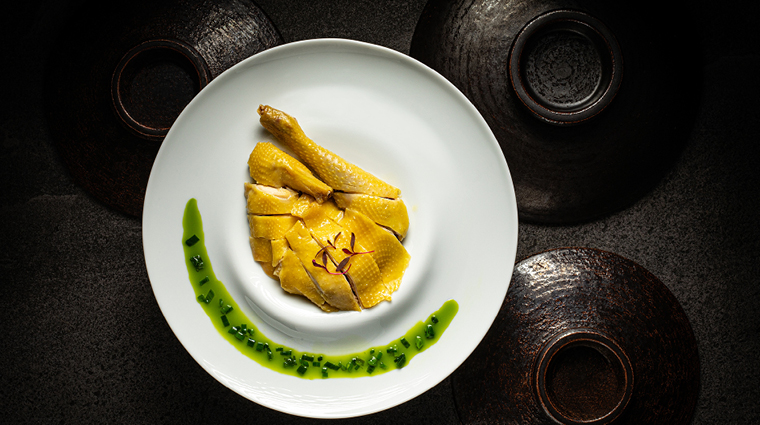
Image context: the lead image uses Forbes Travel Guide's photograph of Chef Tam's steamed free-range chicken with scallion oil because this article is about continuity under pressure. The dish is legible at first glance: a clear Cantonese form, a precise garnish hand, and no urge to disguise what the food is. That is exactly the kind of anchor a solar-term system needs if the surrounding menu is going to keep changing every fortnight.[2]
The solar terms are a production schedule, not a poetic theme
The restaurant's public record is unusually consistent on this point. Wynn says the menu is inspired by the 24 solar terms of traditional Chinese wisdom.[1] Forbes says the degustation menu changes about every two weeks according to those micro-seasons, and even gives an example: during Xiaoshu, the hot and humid early-summer term, the kitchen may move through razor clams with scallion oil, roasted pigeon with seasonal truffles, and wok dishes built around lotus root and French beans.[2] Michelin's February 2024 new-restaurants piece tightens the structure further, noting that the restaurant runs two set menus, one classic and one seasonal, with the seasonal path changing every fortnight in line with the Chinese calendar.[4]
That matters because it turns "seasonality" into an operating system. Plenty of fine-dining restaurants talk about the season while quietly keeping the same luxury architecture underneath: one shellfish opener, one clear soup, one premium fish, one expensive meat, one pretty dessert. Chef Tam's Seasons appears to start from a different question. If the year is divided into ever finer climatic signals, what should move with them, and what should stay stable enough for the cuisine to remain Cantonese?[1][2][4]
The answer is neither total flux nor museum rigidity. The seasonal menu rotates fast enough to make weather and produce consequential. The classic set, meanwhile, stops the restaurant from losing its accent. The calendar sets the pace, but it does not erase the grammar.[3][4]
Cantonese continuity comes from the dishes that hold their nerve
Michelin's current listing is especially useful because it shows how the restaurant keeps form recognizable while ingredients and emphases shift. The inspectors' writeup says Chef Tam's Seasons offers two sets, one classic and one seasonal, while new a la carte items appear every month to showcase seasonal ingredients.[3] The same note points to a few dishes that make the system legible: ge zha, or deep-fried egg custard, turned into a seasonal variation; and barbecued pork belly glazed with honey, kept smoky and aromatic rather than overwritten by concept.[3]
The earlier Michelin new-restaurants article says the seasonal set uses the 24 solar terms, while the classic set and a la carte menu keep older Cantonese pleasures in reach, including pairings with Chinese wine and tea.[4] Forbes adds other anchors: a nourishing seasonal soup that changes with each micro-season, a dim sum service from noon to 3 p.m., and enduring signatures such as crispy bean curd with bird's nest and steamed free-range chicken with scallion oil.[2]
This is where the craft gets interesting. Chef Tam's Seasons is not trying to invent a new cuisine every fifteen days. It is using a fast seasonal clock to alter pressure, temperature, aroma, and supporting ingredients around dishes that still read clearly as Cantonese. Soup remains important because Cantonese cuisine already treats broth as concentration rather than filler.[2] Dim sum remains relevant because small forms are excellent carriers for micro-seasonal adjustments.[2] Roasted and glazed meats remain persuasive because they give the menu a stable center of gravity when the seasonal set starts ranging more widely.[3][4]
In other words, the restaurant's technique is editorial. It edits what moves and what cannot move.
Tea, wine, and room design help the calendar land on the table
A system this restless would collapse if service could not translate it. Forbes shows how much front-of-house technique is built into the experience: almost 50 tea varieties, including aged Liubao and bamboo-aged pu'er; a custom-built baijiu trolley; more than 20 wines by the glass; and a dining room whose visual language runs through pale gold, fresh flowers, and a chandelier of over 700 Murano glass butterflies.[2] Wynn's own page is more concise, but it reinforces the same point by presenting the restaurant as a fully formed concept rather than a chef's menu hidden inside a hotel.[1]
This matters because the 24-solar-term idea is only impressive if diners can feel the transition rather than read about it in a paragraph. Tea pairings are especially important here. They allow the restaurant to register finer seasonal differences than wine alone often can, and they keep the experience culturally close to the cuisine's own habits of temperature, infusion, and aftertaste.[2][4] A fast-turning Cantonese tasting menu could easily start feeling overdesigned. Tea slows it back down.
Forbes also notes that the restaurant is unusually accommodating to dietary requirements, which is no small technical achievement for a kitchen working inside a tradition-driven Cantonese frame while changing its degustation menu every two weeks.[2] That flexibility suggests the solar-term concept is not being used as a rigid excuse. It is being used as a live framework.
Why the system matters now
Chef Tam's Seasons matters in 2026 because it offers a cleaner answer than most luxury Chinese restaurants to the seasonality question. One common answer is abundance: keep the seafood tanks full, the bird's nest visible, the dining room glittering, and let luxury stand in for movement. Another answer is trendiness: attach whatever is freshest to a contemporary tasting script and call it seasonal. Chef Tam's Seasons appears to have found a third path. It lets the calendar do real culinary work while preserving the identity markers that make the food unmistakably Cantonese.[1][2][3][4]
That is what the recent awards actually confirm. Two Michelin stars, a higher Black Pearl ranking, and Macau's only spot on Asia's 50 Best are the visible outputs.[5] The deeper reason the restaurant stands out is that its technique is not just in the wok, the soup pot, or the dim sum fold. It is in the act of deciding how much of the cuisine should change every fifteen days, and how much must stay steady so the season has something solid to lean against.[2][3][4][5]
Sources
- Wynn Palace, "Chef Tam's Seasons" official page, covering chef Tam Kwok Fung's 24-solar-terms concept, the restaurant's current positioning as reimagined Cantonese cuisine, contact details, and official booking page.
- Forbes Travel Guide, "Chef Tam's Seasons - Macau Restaurants - Macau, China," covering the 24 solar terms on the Chinese lunar calendar, roughly two-week degustation turns, tea and baijiu service, room design, seasonal soup, dim sum hours, and signature dishes including steamed free-range chicken with scallion oil.
- MICHELIN Guide, "Chef Tam's Seasons – Macau - a MICHELIN Guide Restaurant," covering the restaurant's current two-star status and the inspectors' note on one classic set, one seasonal set, monthly a la carte additions, ge zha, and honey-glazed barbecued pork belly.
- MICHELIN Guide Hong Kong & Macau, "February 2024: 13 New Restaurants are Added to the MICHELIN Guide Hong Kong & Macau," covering the two-set structure, the seasonal menu's 24-solar-terms logic, fortnightly changes, ge zha, roast spareribs in black bean honey sauce, and Chinese wine and tea pairing.
- Wynn Resorts Newsroom, "Wynn Receives Prestigious Accolades from the World's Leading Authorities in Culinary" (March 26, 2026), covering Chef Tam's Seasons retaining two MICHELIN stars in 2026, its rise to Two-Diamond Black Pearl status, and its No. 7 ranking on Asia's 50 Best Restaurants 2026 as Macau's only entry.