The easy Saint Peter story is celebrity technique. Josh Niland changed how a generation of cooks talks about fish, and that alone is enough to fill a feature. The more interesting 2026 story sits one level higher, in operations. At the Grand National Hotel in Paddington, Saint Peter no longer behaves like a cult restaurant squeezed into a narrow room. It behaves like a small hospitality system: a bar for walk-ins, a main dining room with two seating styles, a private dining room for larger groups, and hotel rooms above the restaurant that pull breakfast, late checkout, and dinner credit into the same controlled loop.[1][2][3][4]
That change matters because Niland's whole-fish philosophy was never only moral theater. The strongest 50 Best profile on him says the original push came from financial pressure: if most restaurants sell fillets and throw away the rest, they also throw away margin, menu range, and future revenue.[5] Saint Peter's new home turns that logic into architecture. The move is not "bigger room, same restaurant." It is a more complete machine for converting sourcing discipline into different kinds of guest time.[1][3][4][5]
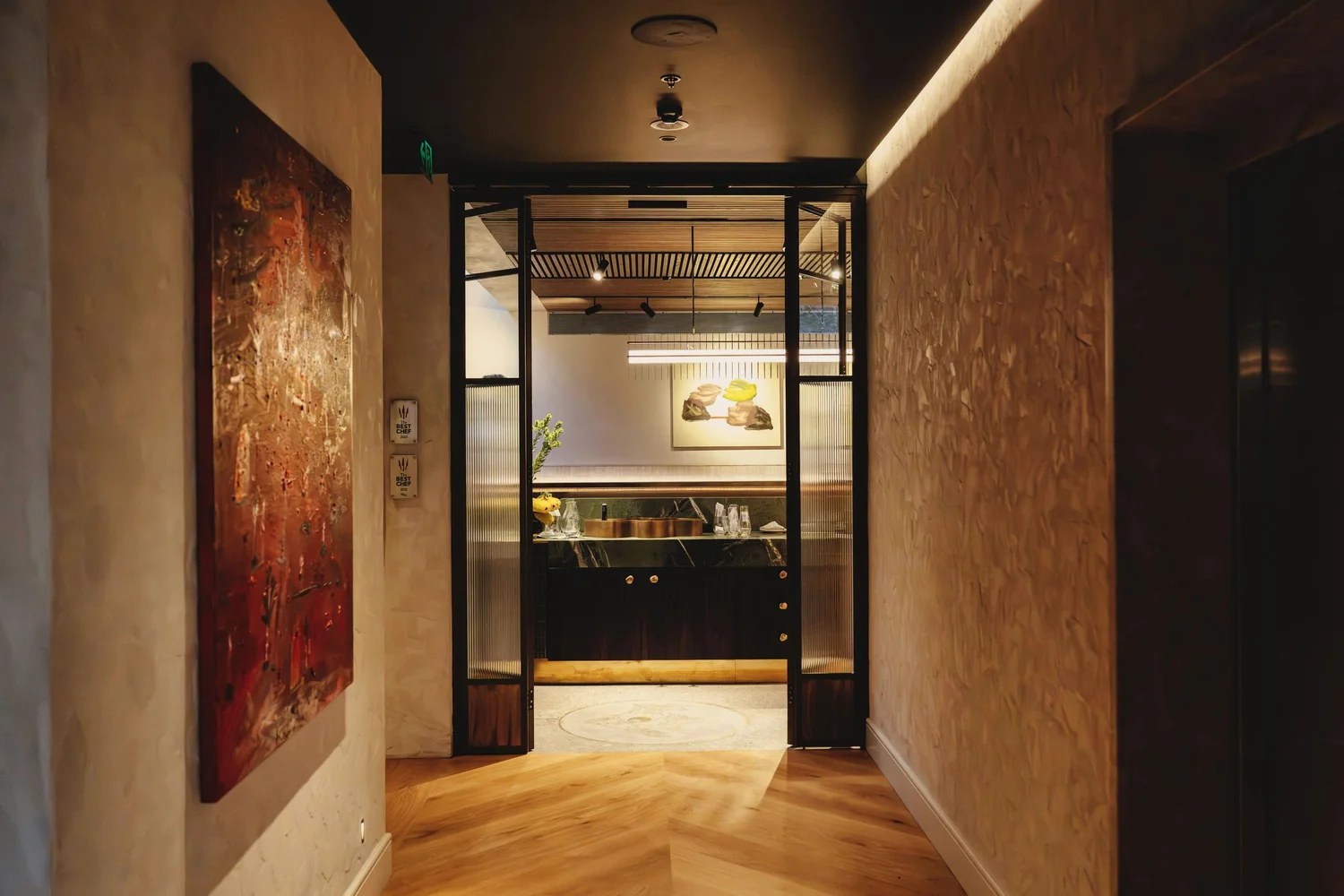
Image context: the lead image comes from Saint Peter's official reservations page. It is the right visual anchor because the article is about a restaurant whose new strength lies in passage and sequencing: the Grand National lets the Nilands turn arrival, bar time, dinner, and overnight stay into one continuous hospitality script rather than one heroic dining room service.[1]
1. Whole-fish thinking scales best when it stops living in one room
The original Saint Peter earned its reputation through precision and nerve, but the newer Grand National version makes a different argument. Broadsheet's opening report describes the old Oxford Street site as a place that sat just 35 guests, while the new address gives the Nilands a venue with capacity for more than 60 plus 14 hotel rooms.[4] That is a big operational jump, yet the point is not brute volume. It is the chance to distribute the brand's pressure more intelligently.
The 50 Best story helps explain why this is a coherent scale-up rather than a vanity move.[5] It frames Niland's cooking as a system where using the whole fish is tied directly to economics, margin capture, and the search for luxury in unconventional cuts. Once that is the core operating logic, the Grand National begins to make sense. A restaurant built around yield, careful handling, and differentiated uses for the same raw material benefits from having more than one service surface. One guest wants a long tasting-menu night. Another wants oysters and cocktails at the bar. Another wants lunch with a two-hour cap. Another wants to sleep upstairs and wake up inside the same food world.[1][2][3][5]
That is a stronger growth model than simply adding covers. The Nilands are multiplying contexts in which the same sourcing and kitchen intelligence can earn money without flattening the restaurant into a generic upscale venue.[1][2][3][4][5]
2. The reservation design shows two distinct luxury speeds
Saint Peter's official reservations page is unusually revealing because it is operationally specific.[1] Lunch runs as a three-course choice menu at AUD 185 per person, served Thursday to Sunday from noon, with a stated two-hour dining time. Dinner runs as a ten-course tasting menu at AUD 325 per person, offered seven days from 5:30 pm, with the restaurant recommending about three hours to enjoy the full experience.[1] Those numbers tell you the house is not trying to funnel every guest into one prestige format. It is building two tempos.
That split matters. A lot of ambitious restaurants talk about accessibility while quietly meaning "come for one expensive marathon." Saint Peter's structure is more exact. Lunch is shorter, more permeable, and easier to slot into city life; dinner remains the full authored statement.[1][5] The reservation page also says the main dining room itself contains two experiences: kitchen tables with direct views into the action, and core tables that lean more intimate and considered.[1] In other words, even after the guest chooses lunch or dinner, Saint Peter still offers a second layer of pacing and proximity.
This is where the Grand National move starts to look strategically smart rather than simply glamorous. The restaurant can sell immersion without demanding that every diner buy immersion in the same way. That keeps the house legible to more kinds of guests while preserving a premium ceiling.[1][4]
3. The bar solves the walk-in problem without cheapening the flagship
One of the classic fine-dining tensions is how to stay desirable without becoming socially inert. Saint Peter's bar is the cleanest answer the Nilands have built so far. The official bar page says walk-ins are always welcome, reservations are not required, cocktails are led by Sam Cocks, and the wine program is curated by head sommelier Houston Barakat.[2] It also keeps broader hours than the tasting room, running from 5 pm to late Monday through Wednesday and from noon to late Thursday through Sunday, with a service pause in the kitchen between 3 pm and 5:30 pm on those longer days.[2]
That is more than a waiting room for the serious meal. It is a second demand engine. Broadsheet describes an a la carte front bar with references to the Nilands' wider fish world, including items tied to Fish Butchery and Charcoal Fish, plus a drinks program aligned with sustainability.[4] Put beside the official bar page, the picture is clear: Saint Peter has finally built a proper entry lane for curiosity, spontaneity, and repeat local use.[2][4]
For operations, that matters enormously. Tasting-menu restaurants often suffer from low-frequency intimacy: guests may adore the experience but treat it as an annual event. A good bar changes that cadence. It lets the same house capture a Monday drinker, a Sunday oyster stop, or a guest who wants to enter the Saint Peter ecosystem without committing to the full ten-course runway.[2][4]
4. Rooms upstairs turn dinner into dwell time
The most important sentence on the hotel page is not about thread count or bathtubs. It is the simple line that the rooms sit across three heritage levels above Saint Peter.[3] Once that is true, the restaurant stops being a destination inside a city night and starts becoming a short-stay environment. The official stay page makes the packaging explicit: the Dine & Stay offer includes a welcome canape and drink on arrival, AUD 100 dining credit for lunch or dinner at Saint Peter, a three-course Saint Peter breakfast, and late checkout.[3]
This is the operational leap that separates the Grand National from a standard restaurant relocation. The Nilands are no longer selling only a seat and a sequence of plates. They are selling dwell time. The guest can arrive early, move through the bar, dine downstairs, sleep above the restaurant, and wake up into the same aesthetic and service language the next morning.[2][3][4] Broadsheet quotes Josh Niland calling the project "a restaurant with rooms," which is exactly right.[4]
That phrase is useful because it keeps the hierarchy straight. The hotel is not a detached lifestyle flourish. It is an extension of the restaurant's hospitality logic. The rooms let Saint Peter hold the guest longer without turning the core dining identity blurry.[3][4]
5. Why the new Saint Peter feels richer, not looser
Scale usually threatens clarity. The reason Saint Peter looks stronger in 2026 is that the extra space is doing argumentative work. The whole-fish philosophy remains the intellectual engine, but it now has more outlets: a shorter lunch format, a deeper dinner format, two seating energies in the main room, walk-in bar access, private dining for seven to fourteen guests, and hotel rooms that convert dinner into an overnight arc.[1][2][3]
That mix also protects the restaurant from a trap common to chef-driven luxury projects. Once a restaurant becomes famous, every part of the house can start feeling subordinated to the myth of one tasting menu. Saint Peter resists that by giving each zone a real job. The bar broadens frequency. The dining room preserves ceremony. The private room captures group occasions. The hotel turns one meal into a richer hospitality cycle. And underneath all of it, the whole-fish model still keeps the economics grounded in intention rather than spectacle.[1][2][3][4][5]
That is why Saint Peter feels important now. The Grand National is not interesting because it makes the restaurant look grander. It is interesting because it proves that a deeply authored fine-dining idea can scale without dissolving, as long as the expansion follows the original operating logic. At Saint Peter, that logic is fish, of course. More precisely, it is yield, pacing, and care. Sydney luxury finally has a seafood flagship that knows how to spread those values across a full house.[1][2][3][4][5]
Sources
- Saint Peter, "Reservations" - official page covering lunch and dinner formats, pricing, timing, kitchen tables, core dining tables, and private dining capacity.
- Saint Peter, "Saint Peter Bar" - official page covering the walk-in bar model, cocktails by Sam Cocks, the wine program by Houston Barakat, and current opening hours.
- Saint Peter, "The Grand National Hotel" - official hotel page covering the rooms above the restaurant, the Dine & Stay package, dining credit, breakfast, and late checkout.
- Lucy Bell Bird, "First Service: Josh and Julie Niland Scale Up With Saint Peter at the Grand National." Broadsheet, updated January 3, 2025 - opening report covering the move from the original site, the room split, the bar, private dining, and the "restaurant with rooms" concept.
- William Drew, "Seafood revolutionary: why you need to know about Australian chef Josh Niland." The World's 50 Best Restaurants, August 21, 2024 - profile covering whole-fish economics, the new Grand National venue, lunch accessibility, and the restaurant's all-seafood identity.