
The easiest way to flatten Celele is to describe it as a colorful Caribbean fine-dining room and stop there. The colors are real, and the Caribbean reference is not cosmetic, but the official site points to a more demanding structure. Celele says the restaurant grew out of chef Jaime David Rodríguez Camacho's Caribe Lab project, a two-year effort to rediscover the edible biodiversity of the Colombian Caribbean by surveying the territory, inventorying products, and documenting recipes and techniques.[2] Latin America's 50 Best sharpens the point even further: Rodríguez spent years exploring the coast with Sebastián Pinzón, meeting Indigenous communities, discovering flavors, and recording culinary knowledge that was in danger of being lost.[4] Read that way, the restaurant is not just serving the region. It is translating fieldwork into dinner.
That is why the 1-minute, 59-second 50 Best video is more useful than its length suggests.[1] The short is in Spanish, but its conceptual spine is clear enough that the written article can do the translation work for an English reader. Early in the clip, Rodríguez frames Celele as contemporary cuisine inspired by the gastronomic culture and biodiversity of the Colombian Caribbean, then immediately ties the plates to an "explosion of colors" because the Caribbean itself is color.[1] If that were the whole argument, the restaurant would risk looking like tropical stylization. But the written sources keep widening the frame. The official site says Celele works with peasant associations, small producers, fishermen, harvesters, artisans, botanists, and educational partners, while the menu changes seasonally and uses fermentation and preservation so ingredients from different corners of the Colombian Caribbean can reach the house in usable form.[2] The dining room, in other words, is only the visible end of a much longer chain.
The current public descriptions back that up from several angles. 50 Best Discovery describes a colorful Getsemaní dining room, playful presentation, and house-made fermented spirits, which already suggests a restaurant thinking beyond plate prettiness into a fuller regional drinks and preservation culture.[3] The 2025 Latin America's 50 Best profile links the menu directly to Caribe Lab, then names dishes such as flower salad with pickled cashews, confit pork terrine with Caribbean beans and pork broth, and fish salpicón with yam and coconut béchamel.[4] A separate 50 Best Stories feature on Celele's Art of Hospitality award explains how the room tries to feel like someone's house rather than a white-tablecloth ritual, with Caribbean music, local art, and service that stays formal enough to feel cared for but casual enough to feel local.[5] Put together, those sources make the short video's deeper point easier to see. Celele's real fine-dining move is not just biodiversity research or just relaxed hospitality. It is the fusion of those two things into one legible house style.
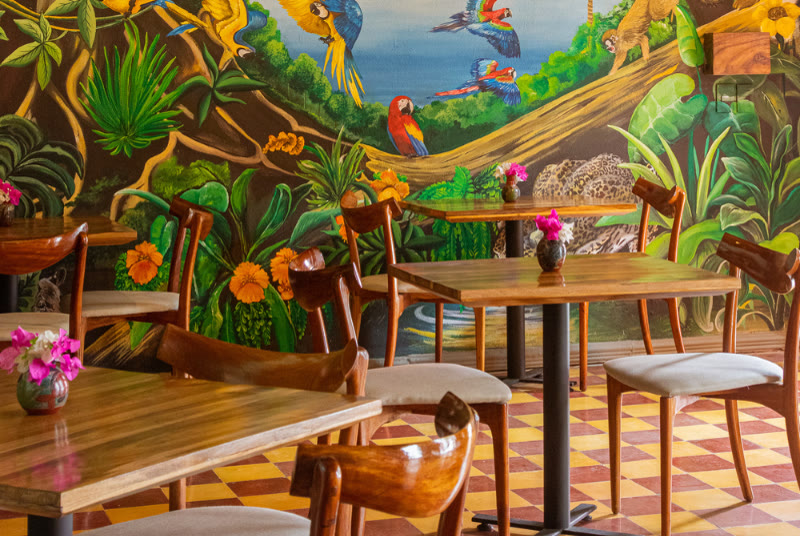
Image context: the lead image uses a real interior photograph from 50 Best Stories rather than a plated dish. That is the right visual anchor because this article's main claim is architectural and social. Celele's blue room, art-lined walls, and domestic scale explain how the restaurant can carry field research, fermentation, music, and hospitality in one atmosphere without becoming stiff or didactic.[5]
Around the opening, color is presented as evidence, not decoration
The first revealing thing in the video is how quickly Rodríguez moves from concept to territory.[1] He does not begin with luxury ingredients, global recognition, or chef autobiography. He begins with contemporary cuisine inspired by the gastronomic culture and biodiversity of the Colombian Caribbean, then says the plates will show an explosion of colors because the Caribbean is color.[1] That might sound like an aesthetic slogan, but the written sources show that the color logic is backed by product research. The official site says Caribe Lab mapped ingredients, recipes, and techniques before the restaurant opened, while the menu continues to rely on seasonal adjustments and fermentation to keep regional produce in circulation.[2] The 2025 Latin America's 50 Best profile makes that visible at dish level, from flowers and cashews to coconut, yam, preserved peppers, and local beans.[4]
That matters because many contemporary restaurants borrow "biodiversity" as an attractive word while serving plates that could have come from anywhere. Celele seems to be trying something stricter. The colors do not just perform freshness or tropical abundance; they signal a regional pantry that has been studied, sorted, and made workable.[1][2][4] Even the Discovery profile's note about house-made fermented spirits fits that argument.[3] Fermentation here is not trend language. It is one of the tools that lets research leave the notebook and enter the glass or plate without becoming generic. The restaurant's vividness is therefore operational. It comes from keeping the territory alive in serviceable forms.
Around the middle, research stops being background prestige and becomes the actual product
The short becomes more interesting once Rodríguez identifies his role in sustainable development and research at the restaurant and within Proyecto Caribe Lab.[1] That line matters because it changes what kind of institution Celele appears to be. The kitchen is not presented as a sealed creative studio receiving ingredients from anonymous suppliers. The official site says the team works hand in hand with producer associations, fishermen, harvesters, artisans, the Guillermo Piñeres Botanical Garden of Cartagena, biologists, and educational institutions.[2] In other words, the restaurant's flavor decisions are not divorced from relationships. The dinner is built out of an ongoing network of observation, sourcing, and collaboration.
This is where the restaurant's current accolades start to make more sense. Latin America's 50 Best notes that Celele won the Sustainable Restaurant Award 2025, citing commitment to native regional ingredients, ethical sourcing, and local-community partnerships.[4] That recognition is easy to misread as moral branding attached to a successful restaurant. The video plus the official site suggest something more structural. Sustainability at Celele is not an extra message taped onto luxury. It is the method by which the menu continues to exist as a Caribbean menu rather than a mood board.[1][2][4]
The home page's emphasis on fermentation is crucial here.[2] Fermentation, preservation, and seasonal change are what allow a restaurant tied to a broad coastal region to remain dynamic instead of freezing itself into a few signature plates. They also keep the work from becoming ethnographic display. The point is not simply to preserve recipes at a distance. The point is to let a researched regional pantry behave like living cuisine inside an urban restaurant. Celele's luxury, then, is not distance from ordinary food systems. It is a more careful participation in them.
Around the ending, the blue house explains why the research can still feel generous
The most valuable line in the clip may be Rodríguez's claim that the team has worked hard to make the service experience feel different from everything else in the city.[1] On its own, that sounds like standard hospitality self-promotion. Next to the written sources, it becomes much more precise. The official site reminds readers that in 2018 Celele opened in a little blue house in the traditional Getsemaní neighborhood.[2] The 50 Best Stories feature explains what that location has been made to do: guests are supposed to feel as if they have come to someone's home, with a cheerful front-of-house team, folkloric playlists, local art, and a room that rejects white-tablecloth stiffness without abandoning care.[5] Discovery describes the same place as stylish and laid-back rather than ceremonially formal.[3]
That social choice is the reason the restaurant's research agenda does not harden into a lecture. Celele's blue house is not merely a charming shell for serious cooking. It is the final instrument of interpretation. A more severe room could make the dinner feel pious, as if the guest were being assigned biodiversity rather than welcomed into it. Celele instead seems to use hospitality to make knowledge feel generous.[1][3][5] Music, color, ferments, and house-scale service all work toward the same end: they turn regional complexity into something a diner can feel without being scolded or overwhelmed.
Seen in that light, the short's logic is unusually compact and coherent.[1] Caribe Lab provides the research spine. Fermentation and seasonal editing provide continuity.[2] Producers, fishers, artisans, and scientific partners provide the living network behind the menu.[2][4] The blue house in Getsemaní provides the social setting in which all that work can arrive as pleasure instead of abstraction.[2][5] Celele's strongest claim, then, is not that it has "Caribbean flavor" in some loose sense. It is that the restaurant has built a full translation system, from territory to hospitality. That is why the video is worth embedding. In under two minutes, it shows that the real product is not just a dish. It is a way of making biodiversity feel inhabitable.[1][2][3][4][5]
Sources
- 50 Best, "Discover Colombia's Art of Hospitality: Inside Celele," YouTube video.
- Celele official homepage - Caribe Lab origins, producer and research partnerships, Getsemaní blue house, and seasonal fermentation framing.
- 50 Best Discovery, "Celele - Cartagena - Restaurant" - colorful dining room, playful presentation, and house-made fermented spirits.
- Latin America's 50 Best Restaurants 2025, "Celele" - Caribe Lab research background, sample dishes, and Sustainable Restaurant Award note.
- 50 Best Stories, "Fine dining with Caribbean flair: Cartagena's best restaurant Celele is ripping up the rulebook" - house-style service, music, interior, and hospitality philosophy.