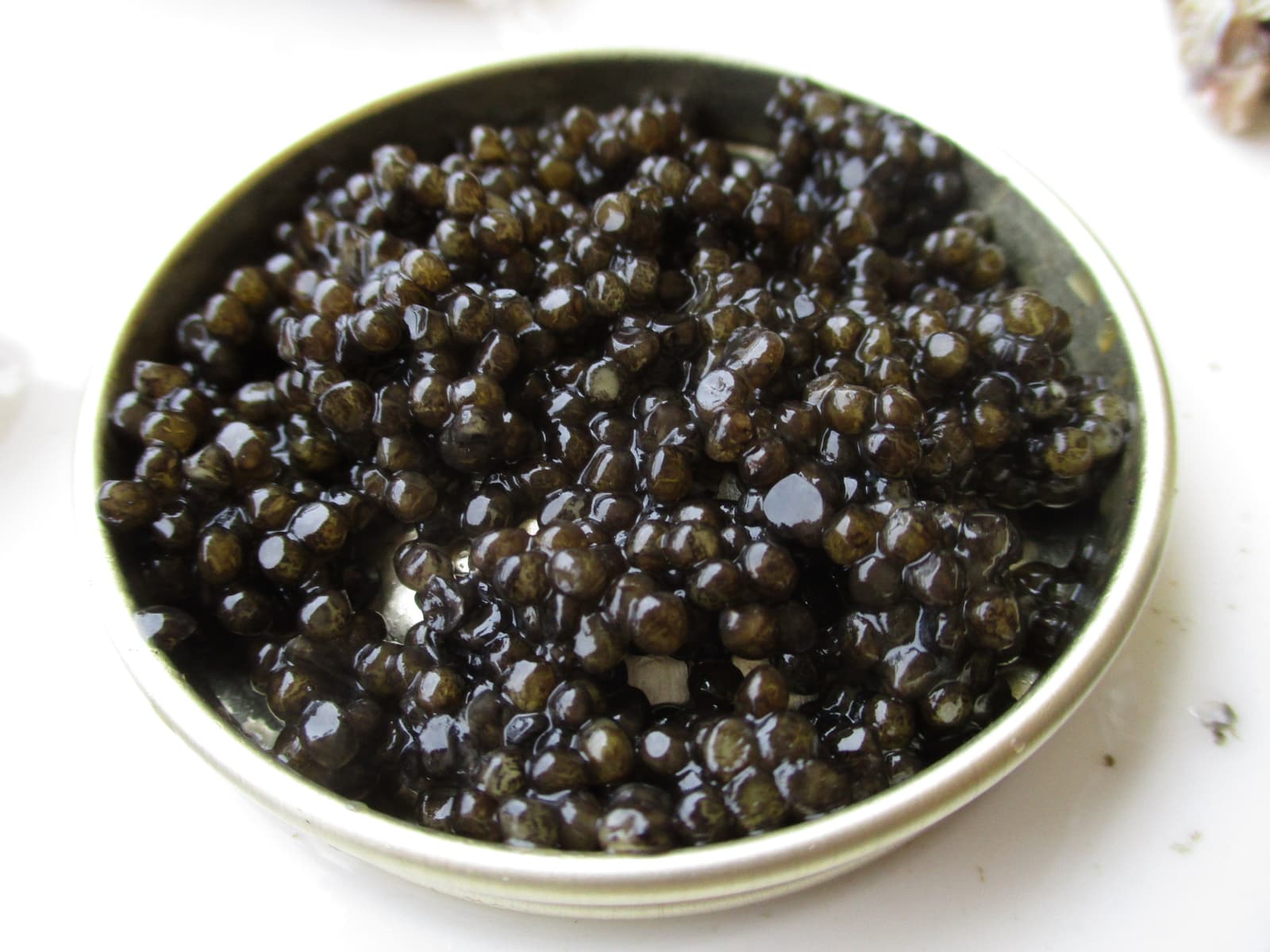
Caviar service has a bad habit of looking simpler than it is. A tin appears on ice. A spoon appears beside it. Blini, creme fraiche, chive, egg, or potato may orbit the plate. The room gets quieter because everyone understands the social code: this is the expensive part.
But the better way to read caviar in fine dining is as an ingredient-sourcing report compressed into a few grams. The spoon is not where the story begins. It begins with a sturgeon, a harvest method, a salt level, a primary container, a label that should be difficult to fake, a shipping chain that must stay cold, and a restaurant willing to show enough of that chain to make the ceremony credible.
The Codex Alimentarius standard gives the strict baseline: sturgeon caviar is granular caviar from fish in the Acipenseridae family, made by treating their eggs with food-grade salt.[1] That definition is useful because it strips away menu glamour. Caviar is not a magic black garnish. It is a preserved animal product with a narrow technical identity. FDA guidance in the United States makes the naming problem explicit from another angle: because many consumers understand "caviar" as sturgeon roe, labels for caviar from other fish should identify the fish source.[6] In dining-room terms, the first luxury is not shine. It is honesty about what the eggs are.
The tin is a document
Restaurants often frame caviar around touch: mother-of-pearl spoon, chilled tin, soft blini, cold vodka or Champagne, the small pop of eggs against the palate. Those details matter, but they can distract from the tin itself. Under CITES-linked labeling guidance summarized by TRAFFIC, all caviar from sturgeons and paddlefish is covered, and primary containers need non-reusable labels that seal or otherwise show if a container has been opened.[2] The label carries a species code, a source code, a country-of-origin code, the harvest or repackaging year, and a plant registration code.[2]
That turns the package into a control object, not just a brand surface. A serious restaurant should know what the code means. A serious diner does not need to interrogate the server like a customs officer, but the kitchen's sourcing discipline should be visible in the way the product is described. "Osetra" or "kaluga hybrid" should not function as perfume words. They should point to species, farm, origin, harvest, and condition.
The reason is blunt: caviar is valuable enough to invite cheating. A 2023 Current Biology study tested 149 sturgeon meat and caviar samples from Lower Danube countries and found illegal wild-caught origin, CITES and EU trade violations, and consumer deception across a large share of the samples.[4] The study matters for fine dining because it moves the ethical problem out of the abstract. Fraud is not only a conservation issue somewhere upstream. It can become a restaurant-quality issue: wrong species, wrong origin, damaged traceability, inferior handling, or a product that is not what the guest is paying to taste.
Aquaculture changed the flavor of luxury
Old caviar mythology leans heavily on rivers, empires, Caspian glamour, and wild scarcity. Contemporary fine dining has to be more precise. Legal international trade has shifted toward farmed sturgeon, and FAO's aquaculture profile for Siberian sturgeon notes that in many western countries caviar became the main purpose of rearing the species.[3] The same FAO page also shows why species-level clarity gets complicated: farming occurs across many countries, and statistical categories can blur exact species and hybrids.[3]
That does not make farmed caviar lesser by default. It makes the restaurant's selection job more technical. A good tin is not proved by invoking wildness. It is proved by clean species identity, careful maturation, good egg separation, restrained salting, cold storage, and enough traceability that the menu can stand behind its language. In modern service, the old romance of rarity should give way to a colder question: did the farm and processor preserve what makes these eggs worth eating?
This is where "malossol" can become either meaningful or lazy. Light salting can protect delicacy; it can also become a menu word that sounds luxurious without telling the diner how the product actually eats. The Codex standard's definition keeps salt at the center of the product.[1] Salt is not a garnish. It is the preserving agent that shapes texture, shelf life, and flavor release. Too little control and the eggs taste loose or unstable. Too much and the caviar becomes metallic, harsh, or merely salty.
The cold chain is part of the recipe
Fine dining usually treats cooking as the active craft and storage as back-of-house housekeeping. Caviar reverses that hierarchy. By the time the tin reaches the restaurant, the most important cooking decision has already happened: the eggs have been cured. The restaurant's craft is preservation, portioning, temperature, and restraint.
Codex labeling provisions require storage under appropriate time and temperature conditions.[1] That sentence may look bureaucratic, but it is the heart of service. Caviar wants cold clarity, not refrigerator neglect. If it warms too much, aroma can thicken and texture softens. If it is buried under aggressive garnish, the guest tastes the garnish more than the eggs. If it sits open too long, the service becomes theater detached from product care.
Michelin's caviar service advice is useful because it treats presentation as a way to preserve perception rather than overwhelm it: keep service chilled, use non-reactive spoons such as mother-of-pearl or wood, and let accompaniments support rather than bury the roe.[5] The spoon detail is famous for a reason. Whether a restaurant uses pearl, horn, wood, glass, or another neutral material, the point is the same: the utensil should not add metallic distraction to a product whose value sits in salinity, fat, marine sweetness, nuttiness, and texture.
The best caviar service therefore feels almost under-designed. Ice is not decoration; it is thermal control. Blini is not a mattress for status; it is a warm, soft carrier. Creme fraiche is useful only if its fat and acidity frame the eggs rather than mute them. Potato can be excellent because it gives heat and starch without competing too hard. Egg-on-egg garnish can be clever or redundant. Chive can sharpen or bully. Every accompaniment should answer one question: does this help the roe taste more like itself?
What the room should prove
The failure mode is easy to spot. A restaurant adds caviar to a dish as an upcharge halo: caviar on fried food, caviar on pasta, caviar on a custard, caviar on something already rich enough to hide the eggs. Some of those dishes can be delicious. The problem is when the caviar functions only as a price signal. If the roe disappears into butter, smoke, truffle, cheese, or hot sauce, the menu has used it as punctuation rather than as an ingredient.
A stronger service makes three things legible. First, identity: the restaurant should know whether it is serving beluga, osetra, sevruga, Siberian sturgeon, kaluga hybrid, paddlefish, or another roe, and it should avoid letting marketing names replace traceable facts.[2][6] Second, condition: the eggs should arrive cold, glossy, separate, and clean-tasting, without muddy aroma or tired texture.[1][5] Third, purpose: the dish should explain why caviar is present. It may be there for salinity, fat, iodine, texture, or ceremony, but it should not be there merely because the supplement price needs a costume.
The most persuasive caviar moments are often modest. A chilled tin opened at the table and served plainly can be more luxurious than an overbuilt composition because it puts the sourcing claim under direct scrutiny. Warm potato with a precise spoonful can work because starch and heat make the cold roe vivid. A tiny seafood course can work if the caviar extends the marine register rather than covering weak seasoning. Even a playful low-high pairing can work when the chef understands contrast instead of relying on shock.
The practical rule is simple: the more expensive the ingredient, the less room there is for vague sourcing and careless temperature. Caviar service should slow the table down, but it should also sharpen the table's standards. Ask what fish, what source, what code, what condition, what carrier, and what purpose. A restaurant does not need to turn dinner into a compliance seminar. It does need to respect the fact that the tin is carrying ecological history, regulatory pressure, aquaculture craft, fraud risk, and fragile pleasure at once.
That is why caviar still belongs in fine dining when it is handled seriously. It is not because black pearls automatically make a plate grand. It is because the ingredient forces the room to connect luxury with proof. The best service starts before the pearl spoon: at the label, in the cold chain, and in the decision to let a few salted eggs remain specific.
Sources
- Codex Alimentarius, Standard for Sturgeon Caviar (CXS 291-2010, amended through 2024) - product definition, salt treatment, contaminant framework, labeling, and temperature-storage requirements.
- TRAFFIC, Universal Caviar Labelling Requirements - CITES-linked label system, covered sturgeon and paddlefish products, non-reusable primary-container labels, species/source/origin codes, harvest year, and registration codes.
- FAO Fisheries & Aquaculture, "Cultured Aquatic Species Information Programme: Acipenser baerii" - Siberian sturgeon aquaculture profile and caviar-focused production context.
- Arne Ludwig, Jutta Jahrl, Leonardo Congiu, et al., "Poaching and illegal trade of Danube sturgeons," Current Biology (2023) - genetic-isotope market study of sturgeon products and caviar trade violations.
- MICHELIN Guide, "Ask The Expert: How To Buy And Enjoy Caviar" - service guidance on chilled presentation, spoon material, accompaniments, and tasting context.
- U.S. Food and Drug Administration, "CPG Sec. 540.150 Caviar, Use of Term - Labeling" - U.S. guidance on caviar naming and identifying the fish source on labels.
- Wikimedia Commons, "File:Caviar 001.jpg" - real 2018 photograph by Arnaud 25 used as this article's image.