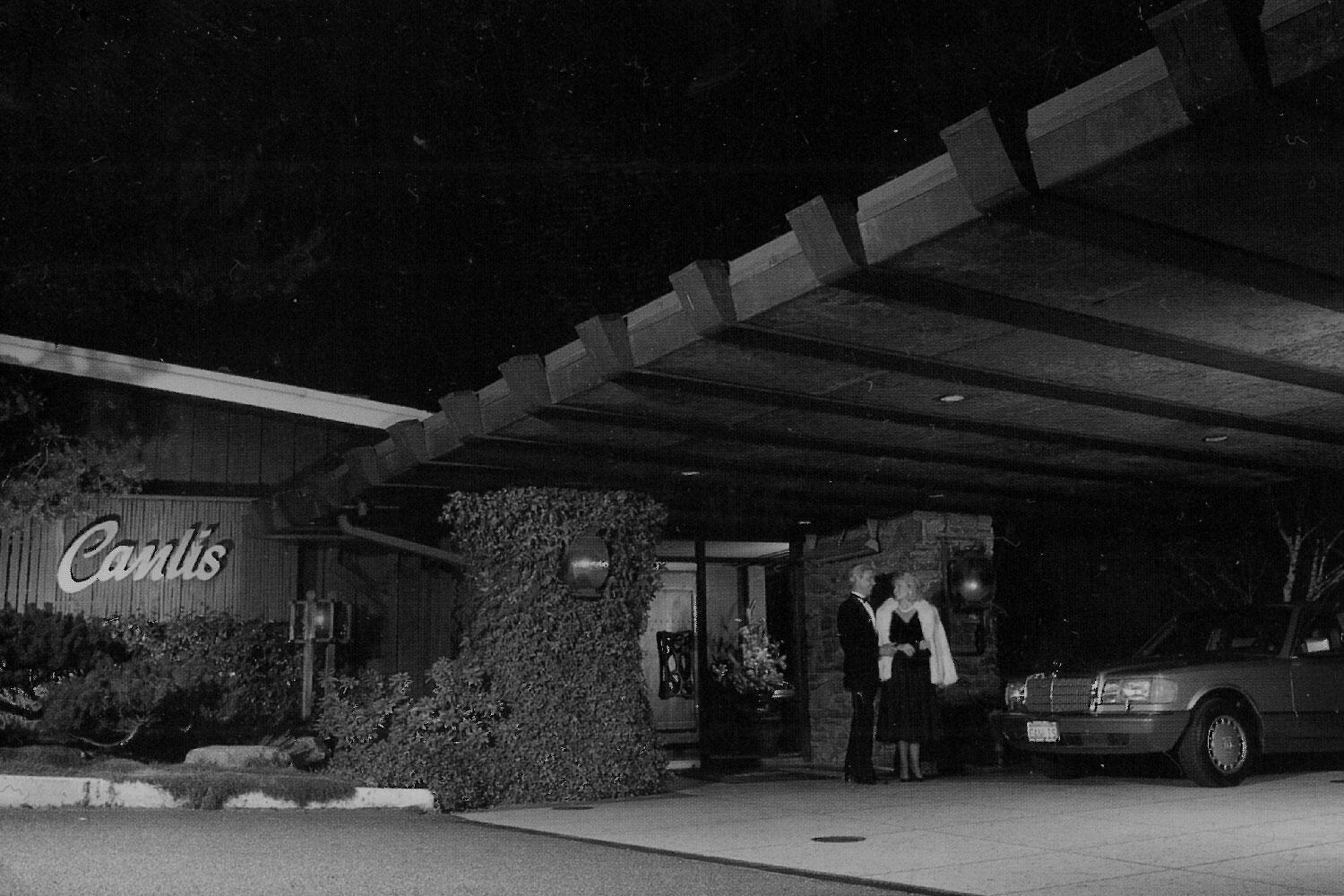
The lazy description of Canlis is that it is Seattle's old special-occasion restaurant with the view. That is not false, but it misses the useful tension. Canlis has lasted because the view stayed legible while the operating idea underneath it kept changing: Honolulu hospitality became Northwest Modern architecture; a family dining room became a national wine room; a legacy kitchen became a tasting-menu stage; and, in 2025, a period of national-chef ambition gave way to a Seattle-born chef promoted from inside the house.[1][2][3][4]
That makes the current Canlis more interesting than a nostalgia tour. In a city where new restaurants often define themselves against old ceremony, Canlis is still trying to make ceremony adaptive. The building says continuity. The kitchen now has to prove that continuity does not mean stillness.
The House Was Built As A Counterargument
Peter Canlis opened the Seattle restaurant in 1950 after the Hawaii chapter that shaped his ideas about service. The official family history frames the original breakthrough not as European grandeur but as a different hospitality grammar: Japanese warmth, team-style service, and a refusal of old captain-service pretension at The Broiler in Waikiki, followed by a Seattle bet that a restaurant "way outside the city" could still pull diners if the room was beautiful enough.[1]
The details matter because they keep Canlis from being reduced to one architectural silhouette. Peter hired the young residential architect Roland Terry to make the restaurant feel like a home rather than a New York or Chicago dining palace. He folded in Northwest art, a piano lounge, fresh fish moving by air between Hawaii and Seattle, salmon and Dungeness crab, and a dining team of Japanese-descended women in kimonos, some of whom had recently lived through wartime internment.[1] There is discomfort in that history as well as glamour. The restaurant borrowed symbols, service habits, and Pacific routes at a moment when American hospitality was still sorting out who got to serve, who got to be seen, and what counted as luxury.
James Beard Foundation's 2019 Design Icon essay explains why the room still holds power. To qualify for the award, a restaurant design had to remain substantially unchanged for at least 20 years, influence later dining spaces, and still be operating. Canlis fit because Terry's Northwest Modern building used stone walls, a fireplace, piers, raked glass, angled walls, and hillside siting to make the interior subordinate to the night view outside.[2] In other words, the room was not only pretty. It solved a dining problem: how to make a dramatic city-facing space intimate enough that dinner still feels personal.
That solution is why Canlis can survive so many culinary eras without losing its outline. The guest arrives under the low roof, feels the building lean into the hill, and understands that this is not a neutral restaurant box. The architecture already has an opinion. It says that luxury in Seattle should look outward, use wood and stone without apology, and make the weather, darkness, and city lights part of the meal.
A Legacy Restaurant Has To Keep Escaping Its Own Museum
Legacy can be a trap. A restaurant with a famous building, a family name, a signature salad, and a long wine cellar can become an elegant preservation society for itself. Canlis has always risked that fate, which is why its best chapters are the ones where preservation and disruption appear together.
The official story says Chris and Alice Canlis took over after Peter's death in 1977 and then spent 30 years narrowing the business around family, service, and a hospitality ethic described as turning toward the stranger.[1] That language can sound soft until you put it beside the restaurant's later public life. The third generation, Mark and Brian Canlis, took over in 2007 and deliberately pushed the restaurant onto a larger national stage.[1][4] They inherited not only a room but an expectation that the room should keep mattering.
The wine program shows how that worked at its best. Canlis's current wine page says the restaurant became a Wine Spectator Grand Award destination in 1997 and had accumulated 28 consecutive Grand Awards by the page's current count; it also notes the 2017 James Beard Award for Outstanding Wine Program, four Master Sommeliers trained through the program, and nine advanced sommeliers.[5] These are trophy facts, but the more important line is operational: Canlis says the program is meant to relate to people who simply want a bottle with dinner and move on.[5] That is the difference between a cellar as a vault and a cellar as hospitality infrastructure.
The current food format keeps the same push-pull. The official menu page presents a six-course dining experience in which guests choose three courses and the kitchen handles the rest. It also preserves older signals as optional add-ons: a dry-aged bone-in ribeye course with Canlis potatoes and Dungeness crab with sturgeon caviar, and the original Canlis Salad prepared tableside from the 1950 menu.[6] The format is revealing. Canlis is not pretending its past disappeared. It is putting the past in controlled contact with the current meal.
That is a smarter stance than either pure reverence or pure reinvention. If the salad were the whole point, Canlis would become a museum. If the salad vanished completely, the restaurant would discard one of the few edible rituals that still makes the house feel specific. By making it an extra course, the restaurant lets memory sit at the table without forcing memory to run the evening.[6]
The 2025 Reset Made Locality The Test
The most important recent Canlis story is not an award. It is a handoff. In February 2025, Eater Seattle reported that Brian Canlis was leaving Seattle for Nashville and that executive chef Aisha Ibrahim would also leave the restaurant in April, ending a decorated chapter that had brought Filipino heritage, global experience, and national attention into the kitchen.[3] That kind of double departure could have turned Canlis into a crisis of authorship: family transition on one side, chef transition on the other.
Instead, the replacement choice made the restaurant's current question sharper. Eater reported in June 2025 that owner Mark Canlis promoted James Huffman, then executive sous chef, to executive chef after a broad search.[4] That report framed the choice as a turn inward: Huffman had worked up through the Canlis kitchen for nearly a decade, and Mark Canlis described the restaurant's 2026 horizon less in terms of chasing the big stage and more in terms of doing the work well for Seattle.[4]
That is a meaningful pivot because Canlis has often been most legible through outside validation: national awards, big-name chefs, design canon, the rare wine-cellar class. Huffman's promotion asks a less glamorous question. What if the next credible Canlis is not the one that imports prestige, but the one that makes its own staff, suppliers, and city feel more central?
For a restaurant this old, locality cannot be a slogan. Canlis already has the most obvious locality available: the view over Lake Union and the city. The harder task is making the menu feel local without shrinking into polite Pacific Northwest adjectives. The six-course format gives Huffman a useful frame: enough structure for a serious meal, enough guest choice to keep the room from becoming severe, and enough space around the legacy add-ons to let old and new signals coexist.[6]
The risk is also clear. A legacy dining room can mistake continuity for automatic affection. Seattle is not the same city that accepted Peter Canlis's extravagant out-of-town wager in 1950. It is richer, more expensive, more skeptical, more globally fed, and less patient with ceremony that cannot explain itself. A local chef does not solve that by biography alone. The food has to make the promotion feel like a point of view, not simply a stable succession plan.
Why The Room Still Matters
Canlis remains useful because it exposes a problem every long-lived fine-dining restaurant faces: how do you carry inheritance without letting inheritance do the cooking? The building cannot change too much, because the building is one of the restaurant's core achievements. The menu cannot stay fixed, because the city outside the glass keeps moving. The answer has to be a disciplined tension.
That tension is visible before the first course. The porte-cochere in the archival photograph looks almost ceremonial, but not palace-like. It is low, compressed, and domestic in scale. The guest does not enter through a glittering lobby. The guest is pulled under a roofline, then released toward glass, stone, and view.[7] The movement teaches the restaurant's thesis before service begins: grandeur is acceptable only if it is made intimate.
The best version of Canlis in 2026 would follow that architectural lesson. Let the room keep its silhouette. Let the wine program remain grand but conversational. Let the old salad and tableside gestures survive as controlled memory. Let Huffman's kitchen show why a Seattle-born chef who came up inside the house can say something sharper about the city than a prestige hire parachuted in from elsewhere.[3][4][5][6]
The restaurant's burden is that everyone already knows it is important. Its opportunity is that importance no longer has to mean expansion, spectacle, or national attention. Canlis can be more compelling by becoming exact about its own place: one hillside room, one family name, one cellar with real depth, one menu negotiating with 1950 without surrendering to it, and one new chef asked to make continuity taste like a living thing.
Sources
- Canlis, "Our Story" - official history of Peter Canlis, the Hawaii-to-Seattle service lineage, Roland Terry commission, family generations, and award chronology.
- James Beard Foundation, "Get a Look Inside the 2019 Design Icon Award Winner" - design criteria and architectural reading of Canlis as Northwest Modern restaurant design.
- Harry Cheadle, "Canlis Is Losing Chef Aisha Ibrahim and Shaking Up Its Ownership." Eater Seattle, February 5, 2025 - reporting on Brian Canlis and Aisha Ibrahim departures.
- Harry Cheadle, "Who Is James Huffman, Canlis's New Executive Chef?" Eater Seattle, June 4, 2025 - reporting on Huffman's promotion from executive sous chef.
- Canlis, "Wine" - current official wine-program page covering Grand Awards, James Beard wine recognition, sommelier training, corkage, and wine-service philosophy.
- Canlis, "Menu" - current official menu page covering the six-course format, ribeye add-on, and tableside Canlis Salad from the 1950 menu.
- Canlis image asset, "Seattle_Outside.jpg" - real archival photograph of the Canlis porte-cochere used as the article cover.