Beurre blanc looks almost too simple to carry a fine-dining argument. A little wine or vinegar, shallot, butter, heat, and a whisk: that is the whole visible apparatus. There is no roux, no egg yolk, no long stock reduction, no dark gloss from bones roasted for hours. Yet the sauce keeps returning to serious kitchens because its luxury is not ingredient rarity. Its luxury is control.
The sauce asks a cook to hold a contradiction in place. Butter wants to melt into fat. Acid wants to cut. Heat wants to push the whole thing past the point of stability. Service wants the sauce now, glossy and warm, before it tightens, splits, or dulls. That is why beurre blanc remains more interesting than its plain ingredient list suggests. It is a last-minute emulsion that makes restraint taste lavish.
The regional story matters because it gives the sauce a landscape rather than a textbook origin. Archives de Nantes identifies Clemence Lefeuvre, born in 1860 and associated with Saint-Julien-de-Concelles, as the creator of beurre blanc, serving Loire fish with the sauce at La Buvette de la Marine in La Chebuette.[1] The Grand Prix Clemence-Lefeuvre history page gives the practical shape of the legend: Loire fish, a local butter-and-vinegar sauce, shallot and white pepper added later, and a restaurant culture that made the preparation famous enough to inspire a culinary prize in 1993.[2]
Whether every detail of the origin story can be pinned down is less important than the pattern it preserves. Beurre blanc did not begin as a luxury object floating above place. It began as a fish sauce beside a river. The Loire setting explains the sauce's best behavior: bright enough for freshwater fish, rich enough to feel generous, light enough not to bury delicate flesh. Fine dining did not have to make beurre blanc grand. It had to learn not to overcomplicate it.
The Reduction Sets The Voice
The first craft decision is not butter. It is the reduction. The Grand Prix recipe starts with finely cut gray shallots, a vinegar base reduced nearly dry, then butter incorporated in small pieces while the cook keeps turning to form an emulsion.[2] James Beard Foundation's version widens the base to white wine, white wine vinegar, shallots, salt, pepper, and chilled butter, then reduces the wine-vinegar-shallot mixture before whisking the butter in piece by piece.[4]
That reduction is the sauce's voice. If it is weak, the finished sauce tastes like warm butter with a rumor of acidity. If it is harsh, the butter cannot soften it enough. If the shallot is left raw or chunky, the sauce becomes rustic in the wrong way, interrupting the gloss it is supposed to deliver. The cook is making a tiny, concentrated stage on which the butter can behave as sauce rather than as melted fat.
This is also why Muscadet and Loire fish sit so naturally in the beurre blanc imagination, even when a kitchen uses another dry white wine. The sauce is built around the meeting of acid, minerality, and butterfat. It should not taste heavy first. It should taste lifted, then rich.
Cold Butter Is The Discipline
Britannica's general sauce entry describes beurre blanc as a reduced seasoning liquid beaten into butter before the butter can fully melt.[3] That sentence catches the key technical boundary. The cook is not simply melting butter into a pan. The cook is persuading whole butter to become a warm, creamy suspension.
James Beard Foundation's method makes the practical discipline clearer: remove the pan from heat, whisk in a couple of butter pieces until the sauce begins to cream, continue adding pieces over low heat or warm water, and avoid letting the sauce get too hot because it will separate.[4] The instruction sounds modest, but it is the whole art. The butter has to enter gradually enough that the water phase and fat phase stay organized. Heat has to be present, but never allowed to dominate.
That is why beurre blanc is such a useful test of a kitchen. A broken sauce is not mysterious. It usually means the cook treated butter like an ingredient to be dumped in rather than a structure to be built. Too much heat clarifies the fat. Too little attention leaves the emulsion loose. Too much holding time turns the sauce from alive to anxious.
The best versions do not feel thick in the way cream sauces feel thick. They feel glossy, almost tremulous, with enough body to coat fish, scallops, asparagus, lobster, or a small vegetable course without smothering it. The diner should sense butter, but also the argument against butter: acid, shallot, temperature, and timing keeping richness from becoming blunt.
Why It Belongs In Fine Dining
Fine dining often loves visible difficulty, but beurre blanc is difficult in a quieter way. It does not announce its labor through height or architectural plating. It announces it through the absence of heaviness. A good spoonful looks calm because the struggle has been kept out of sight.
That quietness is exactly the point. A heavy sauce can buy authority with density. A modern foam can buy attention with form. Beurre blanc has fewer places to hide. On a scallop, it has to let the sear remain legible. On a fish course, it has to brighten the flesh rather than turn the plate into dairy. On asparagus, it has to make green bitterness feel luxurious without making spring taste like cream.
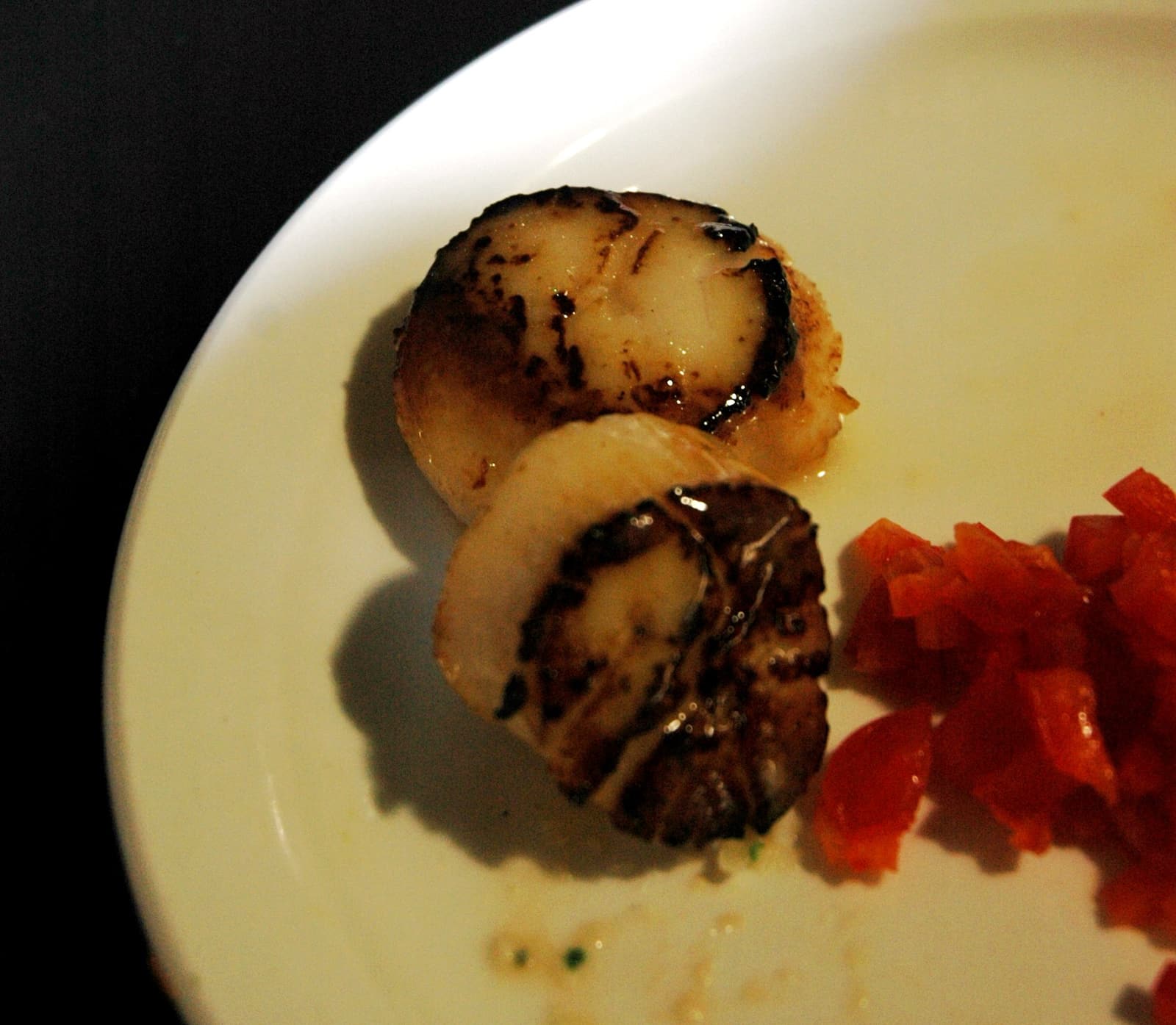
The Commons photograph used here is not a palace dining-room image, and that helps. It shows scallops with a pale sauce that sits low on the plate, close to the protein rather than piled over it.[5] The visual lesson is direct: beurre blanc is not meant to be a blanket. It is a pressure test for proportion. Enough sauce and the seafood tastes complete. Too much and the sauce becomes the meal.
The Cream Question Is A Philosophy Question
Many kitchens stabilize beurre blanc with a little cream, and the practical reason is obvious. Cream gives insurance. It makes holding easier and splitting less likely. But the classic sauce is interesting precisely because it does not want too much insurance. The Grand Prix version lists salted butter, gray shallots, wine vinegar, and pepper; James Beard Foundation uses chilled butter, wine, vinegar, shallots, salt, and pepper.[2][4] In both, the drama comes from butter mounted into an acid base, not from cream carrying the structure.
This does not make cream a moral failure. Restaurants live under service pressure, and a sauce that must survive pickup windows may need help. But the choice changes the personality. Cream makes beurre blanc more forgiving and more opaque. A stricter butter-mounted version feels sharper, more volatile, and more dependent on timing. It asks the room and kitchen to cooperate.
That cooperation is why the sauce still feels current. Contemporary fine dining is full of claims about seasonality, lightness, and precision. Beurre blanc can express all three without a manifesto. It says: here is the fish, here is the acid, here is the butter, and here is the exact moment before the sauce falls apart.
The Last-Minute Luxury
The best part of beurre blanc is that it resists being fully prepared in advance. It can be held briefly and gently, as James Beard Foundation notes, but it does not want to become a batch product.[4] That makes it a service sauce in the deepest sense. It belongs to a narrow time window.
That time window is what fine dining is often trying to sell when it is honest. Not rarity by itself. Not performance by itself. The feeling that someone controlled a fragile sequence for you and delivered it at the point of maximum clarity. Beurre blanc gives that feeling without spectacle. It is a small sauce with a large demand: keep richness moving, keep acid audible, keep heat disciplined, and do not let the butter confess that it wanted to separate all along.
This is why the sauce survives. It turns a regional fish accompaniment into a grammar for modern restraint. It lets a kitchen be generous without being heavy. It makes ordinary butter feel expensive by refusing to let it behave ordinarily. And at its best, it gives the diner one of fine dining's cleanest pleasures: fragility made calm enough to eat.
Sources
- Archives de Nantes, "Clemence Lefeuvre (1860-1932)" - municipal archive note identifying Lefeuvre, La Buvette de la Marine, La Chebuette, Loire fish, and beurre blanc context.
- Grand Prix Clemence-Lefeuvre, "L'Histoire" - regional history page and recipe notes for beurre blanc, including Saint-Julien-de-Concelles, Loire fish, shallot, vinegar, butter, and the 1993 prize.
- Encyclopaedia Britannica, "Sauce" - reference overview of sauce families and the beurre blanc method of beating reduced seasoning liquid into butter before it fully melts.
- James Beard Foundation, "Beurre Blanc" - recipe and method note covering Loire Valley association, wine-vinegar-shallot reduction, chilled butter incorporation, heat control, and holding.
- Wikimedia Commons, "File:Scallops Beurre Blanc Qualicum Bay scallops (6879665349).jpg" - real 2012 photograph by University of the Fraser Valley used as the article image.