The Bocuse d'Or is easy to misread if you treat it as fine dining's sports day: tall hats, flags, supporters, medals, nervous young chefs, and enormous platters engineered for a few minutes of judging. The spectacle is real. It is also the least interesting part if it is left alone.
The deeper achievement is that Paul Bocuse found a way to make elite kitchen labor public without making it simple. Founded in 1987, the competition took skills usually hidden in closed professional kitchens and placed them inside an arena where time, equipment, national style, teamwork, technical finish, and crowd pressure all became visible at once.[2][4] That made it more than a prize. It became a staging system for what fine dining wants from a cook when nobody can hide behind the dining room.
The official competition language still carries that original tension. Bocuse d'Or describes itself as created by a cook for cooks, more than a gastronomic competition, and now structured around national selections, continental stages, and a Lyon final for 24 countries.[1][2] The public numbers are blunt: more than 70 national selections, continental qualifiers, two days of competition, and roughly five and a half hours of cooking around shared themes.[1][2] Those figures explain why the contest has lasted. It does not merely crown one brilliant plate. It builds a long training funnel that turns craft into performance under constraint.
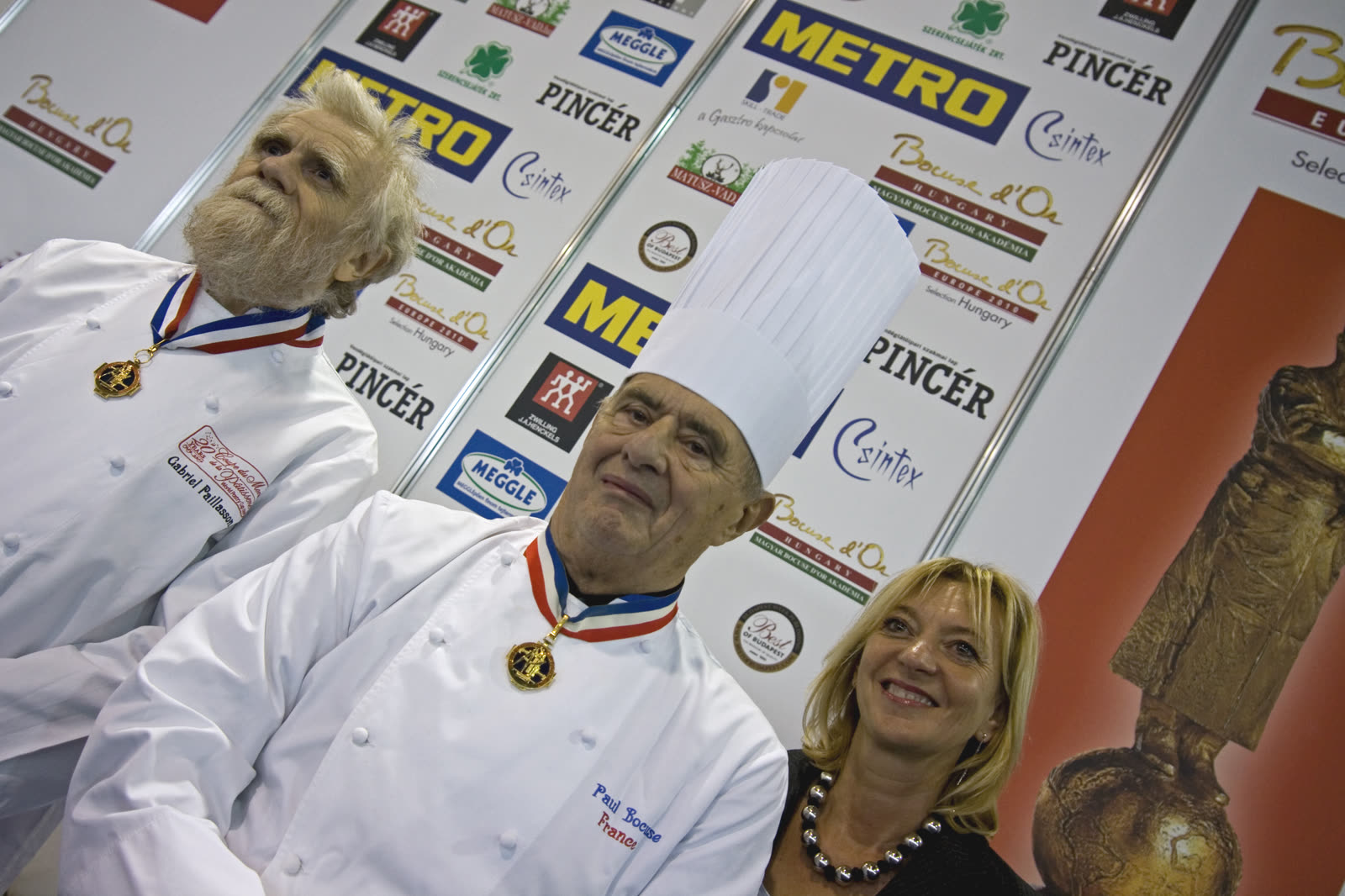
Image context: the cover shows Paul Bocuse in 2010 at a Bocuse d'Or Hungary selection setting, not a finished dish. That is deliberate. The argument here is not that one platter changed cuisine. It is that Bocuse's competition changed where the chef could stand: in public, under pressure, still judged by precision rather than charisma alone.[6]
Bocuse understood visibility as a professional tool
Bocuse's public persona matters because the contest would make little sense if he had been only a private kitchen technician. Maisons Bocuse frames him as a chef who brought the profession "out of the shadows," a telling phrase for a cook whose career was built as much on representation as on recipes.[3] The French Legion of Honor archive gives the cleaner chronology: Bocuse founded the international Bocuse d'Or in 1987, later led the Meilleurs Ouvriers de France competition, and in 1989 was named "Cuisinier du siècle" by Gault & Millau.[5]
That sequence matters. Bocuse did not invent culinary excellence, and he did not invent culinary competition. What he did was attach elite cooking to public recognition at a moment when chefs were becoming modern cultural figures. The old kitchen hierarchy prized discipline, speed, and repetition, but its prestige often remained internal: masters knew who could really cook. Bocuse's move was to let outsiders see enough of that pressure to understand why the profession mattered.
The FCSI history of the competition is useful because it makes the stadium idea explicit. Florent Suplisson, the contest director quoted there, describes the original ambition as building a gastronomic arena, borrowing the emotional structure of sport while keeping the task culinary.[4] The aim was not only entertainment. It was to expose the work: cooks in view, kitchens equipped in parallel, supporters close enough to change the room's temperature, judges waiting, and the clock always present.
The clock is the real ingredient
Five and a half hours sounds generous until the task is read properly.[1][2] Competitors are not making dinner for a relaxed table. They are translating a national culinary identity, a mandatory theme, technical showmanship, and restaurant-level finish into a one-time presentation that must survive heat, timing, transport, carving, visual inspection, and tasting. FCSI's account gives the slightly older competition figure as five hours and 35 minutes and emphasizes the team unit: chef, commis, and coach working under shared rules and equipment.[4]
That format changes the meaning of a dish. In a restaurant, a course can be protected by the whole service environment: lighting, explanation, wine, sequence, and guest mood. In the Bocuse d'Or, the dish has to prove itself in a narrower way. It must communicate quickly, look coherent from a judging angle, eat properly after the final handoff, and still carry enough personal or national signature to be remembered.
This is why the platter tradition has such staying power. A platter is not only nostalgic grandeur. It is a test of architecture. The cook has to think in volume, symmetry, garnish logic, carving sequence, and heat retention. A plated dish tests another intelligence: portion scale, immediate composition, modern restaurant realism. FCSI notes that the plate theme was introduced in 2013 alongside the platter to reflect how food is actually served in restaurants.[4] That change did not abandon ceremony. It tightened the contest by asking cooks to master both spectacle and service reality.
National identity becomes a constraint, not a costume
The most interesting Bocuse d'Or entries rarely look like generic "international luxury." The competition's own current final page says Lyon and France serve as a stage for the world's cuisines, and that the event is a place where countries promote their cuisine, terroir, and chefs.[2] That is a delicate bargain. The contest is French in origin, held in Lyon, and named for one of the great French public chefs. Yet its durability depends on not reducing every team to French technique wearing a flag.
Suplisson's comments in the FCSI history make that point directly: the event was intended to be international, and competitors were expected to bring their own cooking rather than simply arrive in Lyon to reproduce French or European food.[4] That is where the competition becomes useful to fine dining more broadly. It forces national gastronomy to move past slogan and into buildable form. What does "Norwegian," "Mexican," "Japanese," "French," or "Swedish" mean when it has to be expressed through a shared brief, a fixed time window, a professional commis, and judges who may not share the same childhood flavor memory?
The answer cannot be only ingredient choice. It has to become technique, rhythm, restraint, and judgment. A team that leans too hard into symbolism risks making food that reads better than it eats. A team that hides behind universal luxury risks losing any reason to represent a country at all. The Bocuse d'Or pressure sits precisely there: turn locality into craft without turning craft into costume.
The commis makes the myth less lonely
The hero image of the Bocuse d'Or tends to focus on the chef: name, country, face, medal. The format itself is more interesting because it refuses pure solo authorship. The official final page notes that Paul Marcon won in 2025 with his commis Camille Pigot, and the official contest page separately names special recognition for the best commis.[1][2] FCSI's history also stresses the team structure of chef, commis, and coach.[4]
That matters because fine dining often tells the story of genius too cleanly. The Bocuse d'Or keeps the lead chef visible, but the actual work depends on delegated precision. A commis has to prep, watch, adjust, and execute while the public attention flows elsewhere. The coach cannot cook, but can shape timing, discipline, and morale from just outside the action. In other words, the competition dramatizes a restaurant truth that dining rooms sometimes hide: a great plate is authored, but it is also organized.
This is why the contest can launch careers without being only a talent show. The professional gain is not simply "winner gets famous." It is that the candidate has spent months learning how to make a kitchen idea repeatable under stress. The FCSI account describes up to 18 months of preparation through national and regional selections, and quotes Rasmus Kofoed on the mental pressure required to compete well.[4] That kind of preparation is closer to building a small temporary institution than practicing one recipe.
The arena did not cheapen the kitchen
There is an obvious objection: once cooking becomes an arena event, does it stop being cuisine and become pageantry? The Bocuse d'Or survives because the answer is no, at least when the format works. The show elements are not pasted onto the cooking. They intensify the old kitchen problems: timing, clarity, division of labor, heat, repetition, and the ability to finish when the room is not calm.
That is the lineage lesson. Bocuse's restaurant career, his public chef image, his 1987 competition, and the modern global selection system all belong to the same professional argument: fine dining is not only what appears at the table. It is also a discipline of bodies, tools, assistants, timing, national memory, and public accountability.[1][2][3][4]
The contest can look excessive because fine dining itself is excessive when seen from the service side. There are always hidden clocks, rehearsals, hierarchies, burns, corrections, and compromises. The Bocuse d'Or did not invent that pressure. It gave it a stage.
That is why the competition still matters even for diners who will never follow the medal table. It offers a cleaner view of what restaurant luxury often conceals. Before a dish becomes graceful, it has to survive a system. In Lyon, the system is loud, timed, national, theatrical, and unforgiving. The best teams do not escape that pressure. They make it edible.
Sources
- Bocuse d'Or official homepage - current overview of the competition system, national selections, continental stages, qualified countries, two-day format, and timed trial.
- Bocuse d'Or, "Finale" - official final-page description of the January 24-25, 2027 Lyon final, 1987 founding, international recognition role, terroir framing, and 2025 winner.
- Maisons Bocuse, "Our History" - official Bocuse family history covering Paul Bocuse's public-profession role, honors, and the 1987 creation of the Bocuse d'Or.
- Tina Nielsen, "Bocuse d'Or: Golden gastronomy," Foodservice Consultants Society International - feature on the contest's arena format, five-hour-plus task, chef-commis-coach structure, national selections, platter and plate themes, and professional pressure.
- Grande Chancellerie de la Legion d'honneur, "Paul Bocuse" - archival profile noting Bocuse's 1987 founding of the Bocuse d'Or, 1989 MOF leadership, and "Cuisinier du siècle" recognition.
- Wikimedia Commons, "File:Bocuse dor selection hungary 2010.jpg" - real 2010 photograph by Gabor Turcsi/Rajongo01 used for the article image.