The easiest way to misread Locavore NXT is to treat it as Bali fine dining with a sustainability gloss: rice fields, tropical architecture, long menu, beautiful ingredients. The stronger reading is more practical. This is a restaurant built to make sourcing visible before the first course lands.
The official site calls NXT a hyper-local restaurant hub and currently frames the tasting menu as The Source.[1] That title is blunt in a useful way. It shifts attention away from the finished plate and toward the chain of decisions that makes the plate possible: what grows on site, what can be foraged, what can be fermented, what can be preserved, what waste can become input, and how much of Indonesia's pantry can be held inside one dining campus without turning into a sampler.
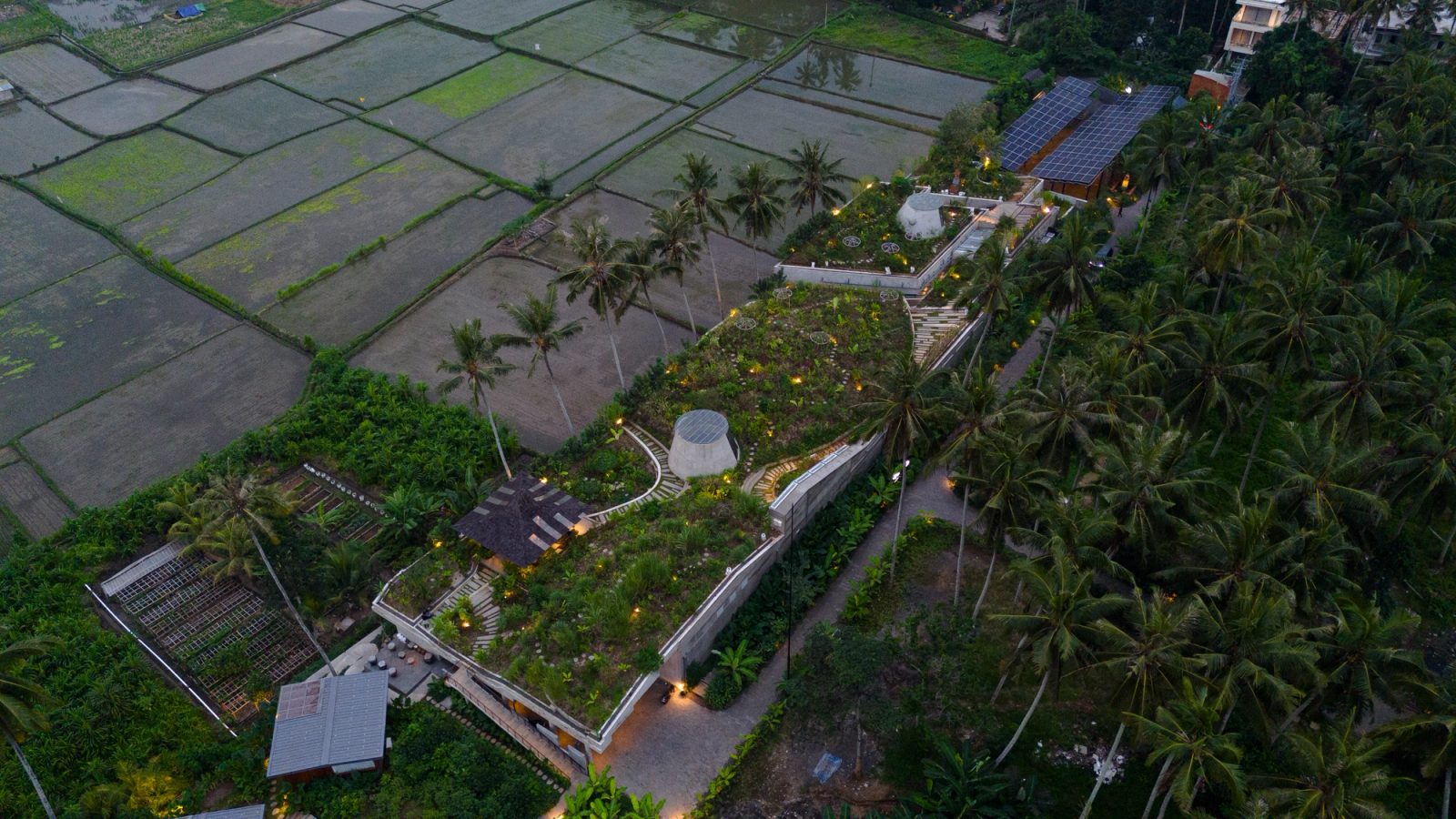
The image choice follows that argument. I used Locavore NXT's own aerial photograph rather than a glamour shot of one course because the restaurant's claim is spatial. The roof is not decoration. The surrounding paddies are not backdrop. The building, garden, solar panels, and palm-lined access route all tell the guest that dinner is meant to be read as a place-based operation, not just a sequence of clever bites.[6]
The building is part of the pantry
Asia's 50 Best ranked Locavore NXT No. 44 in its 2026 list and describes the restaurant as a next-generation version of the original Locavore, opened in late 2023 and led by Ray Adriansyah and Eelke Plasmeijer.[2] The useful detail is not the number by itself. It is the infrastructure named around it: rooftop food forest, fermentation lab, underground mushroom chamber, plant-forward cooking, seasonal hyper-local ingredients, and foraged material.[2]
That is a different promise from ordinary local sourcing. Many good restaurants can name farms and fishers. NXT tries to collapse some of the supply chain into the guest's field of vision. 50 Best Discovery is even more explicit: it says the restaurant is about hyper-local produce, with ingredients, furniture, and glassware coming from Indonesia; it also notes that the rooftop food forest, fermentation lab, and mushroom fruiting chamber supply many ingredients for a menu exploring Indonesian food, ecosystem, culture, and tradition.[3]
The sourcing claim therefore has two layers. The first is geographic: use Indonesia as the boundary, not imported luxury as the default. The second is architectural: make the restaurant itself carry part of the growing, fermenting, and research load. That does not make the restaurant self-sufficient in any absolute sense, and it should not need to. The more credible claim is narrower: NXT has built a room where guests can see that sourcing is not a slogan left behind in the kitchen office.
"The Source" turns the menu into a route
FoodieS' February 2026 report gives the current menu its clearest outline. The Source is described as a 16-course forage-to-table tasting menu in Ubud, launched in January 2026, with ingredients traced through wild landscapes, fringe farms, rooftop gardens, and in-house fermentation projects.[4] Guests are invited to explore the Rooftop Food Forest during the meal, which matters because it changes the timing of evidence. The place is not explained only through a server's speech. It becomes part of the meal's route.[1][4]
That route keeps the menu from sounding like a parade of rare ingredients. The report's dish examples show a kitchen interested in overlap and afterlife. A young coconut preparation is treated partly through the texture of seafood, with seaweed and a roasted seaweed bisque giving it a coastal register.[4] In the basement Root System section, mushrooms, coffee, and soybeans are worked through tofu, okara, preserved mushroom treatments, shoyu, and dashi.[4] The important pattern is not novelty. It is recurrence: one ingredient stream is asked to do several jobs before it leaves the menu.
That recurrence is where Locavore NXT feels most serious. Fine dining often performs abundance by adding more components. NXT appears more interested in pressure: how many useful states can one local product hold? Fresh, fermented, preserved, roasted, steeped, converted into drink, turned into waste input, brought back as seasoning. When that loop works, the dish does not merely say "Bali." It shows the labor needed to keep Bali from becoming a decorative theme.
Fermentation is infrastructure, not seasoning
The fermentation work is easy to romanticize because it sounds artisanal and mysterious. In this restaurant, it reads more like infrastructure. Condé Nast Traveler describes the dining room as pitched in rice fields just outside Ubud, with roughly 20-course menus drawing on a rooftop food forest, subterranean mushroom vault, koji fermentation lab, and surrounding farmers, fishermen, and foragers.[5] That list matters because fermentation sits beside growing and procurement, not above them.
The beverage side reinforces the same point. FoodieS reports that both alcoholic and non-alcoholic pairings are built from local ingredients and developed with the R&D kitchen, fermentation team, and head mixologist Raka, with examples such as mushroom arak and Rooftop Flower pet-nat.[4] Drinks can expose whether a sourcing thesis is real. If the food tells a local story and the pairing program defaults to imported prestige, the argument splits. At NXT, the beverage program seems to keep the pantry logic active in the glass.
This does not mean every guest needs to admire every fermentation as a technical achievement. The test is simpler: does the fermentation make the product more expressive, more stable, or more useful across courses? The best evidence in the public reporting points that way. Fermentation helps the restaurant handle seasonality, build umami without leaning on imported luxury, create non-alcoholic complexity, and carry local products beyond their fresh window.[4][5]
Circularity becomes more convincing when it is specific
Sustainability language in fine dining can become vague quickly. Locavore NXT is strongest when the claims stay material. FoodieS reports solar panels on the rooftop, a Circular Waste Centre for sorting and repurposing waste, and a Worm Sewage Treatment Plant with more than 20,000 worms processing organic material for fertilizer and irrigation use.[4] Asia's 50 Best also notes that NXT won the Sustainable Restaurant Award 2025.[2]
Those details do not prove perfection. They do something more useful: they make the restaurant's constraints inspectable. Solar panels, waste sorting, worm treatment, mushroom growing, fermentation, roof planting, and local procurement are not the same kind of work, but together they make a pattern. The restaurant wants fewer invisible exits. Waste should have a destination. Local products should have more than one use. The building should carry some production burden. Guests should understand that dinner came through a chain of choices rather than a generic luxury distributor.
The Sustainable Restaurant Association's note on the 2025 award helps explain why the prize matters editorially: the recognition was tied to Locavore NXT's sustainability work at the Asia's 50 Best ceremony, not just to a polished dining-room reputation.[7] Awards can be blunt tools, but here the award is useful because it points to the same infrastructure described by the restaurant, 50 Best, and current menu reporting.[1][2][4][7]
The risk is concept overload
There is a real danger in this kind of restaurant. When a place has a food forest, mushroom chamber, fermentation lab, circular waste center, foraging excursions, local glassware, and a mission statement, dinner can start to feel like a guided tour of the concept rather than a meal. The guest may leave remembering the apparatus more than the taste.
Locavore NXT's best defense is appetite. The sources suggest that the restaurant is not simply showing systems for their own sake. It is using them to create a menu with coconut, seaweed, mushrooms, coffee, soybeans, koji, local beverages, preserved materials, and foraged ingredients that can move between pleasure and explanation.[4][5] The challenge is balance: enough context that the guest understands why the campus exists, not so much context that every course turns into a sustainability footnote.
That balance is why Ingredient / sourcing report is the right lens. The restaurant is not most interesting as a ranking story, a Bali travel recommendation, or a chef profile. It is most interesting as a visible supply architecture. The meal asks whether a high-end restaurant can make its sourcing chain part of the luxury without making virtue replace flavor.
Why it matters now
The timing is part of the story. The original Locavore helped make Ubud legible to international fine-dining audiences. NXT, opened in late 2023 and now carrying 2025 and 2026 recognition, has to answer a sharper question: what does the next version of local cuisine look like when "local" is no longer enough as a claim?[2][3][4]
Its answer is not simply to buy closer. It is to build closer. Put the food forest on the roof. Put mushrooms and fermentation inside the campus. Put waste handling into the operational story. Put foraging, fringe farms, local beverage work, and Indonesian-made material culture into the same frame. Then let the guest move through enough of that frame to understand why the menu tastes the way it does.[1][3][4][5]
That is the real luxury at Locavore NXT. Not scarcity for its own sake, and not tropical atmosphere dressed as seriousness. The luxury is traceability with texture: a dinner where the source is not hidden backstage, because the source is part of the room.
Sources
- Locavore NXT, official homepage - current restaurant framing, "The Source" menu placement, events, foraging experience, and official visual context.
- Asia's 50 Best Restaurants 2026, "Locavore NXT" - No. 44 list profile covering Ubud, Ray Adriansyah and Eelke Plasmeijer, late-2023 opening, rooftop food forest, fermentation lab, mushroom chamber, plant-forward cuisine, and 2025 Sustainable Restaurant Award.
- 50 Best Discovery, "Locavore NXT - Bali" - venue profile covering Indonesian sourcing, furniture and glassware, rooftop food forest, fermentation lab, mushroom fruiting chamber, tasting-menu price, service schedule, and address.
- FoodieS Team, "Locavore NXT Launches 'The Source,' a 16-Course Forage-to-Table Tasting Menu in Ubud" (February 20, 2026) - current menu report covering the 16-course format, rooftop food forest visit, Root System dishes, local beverage pairings, optional foraging experience, solar panels, waste center, and worm treatment plant.
- Condé Nast Traveler, "Locavore NXT - Restaurant Review" - restaurant review covering rice-field setting, concrete building, roughly 20-course menus, rooftop food forest, mushroom vault, koji fermentation lab, and surrounding farmers, fishermen, and foragers.
- Locavore NXT, official Sanity-hosted aerial photograph used as the article image.
- The Sustainable Restaurant Association, "Asia's 50 Best Recognises Sustainability at This Balinese Restaurant" - award context for Locavore NXT's 2025 Sustainable Restaurant Award recognition.