Plenty of winery restaurants sell a comforting equation: nice view, polished bottles, local produce, long lunch, home safe. Amisfield in Queenstown has moved in the opposite direction. Its current reputation rests on scenic assets, obvious wine wealth, and a photogenic Lake Hayes setting, but those are only the outer shell. The stronger reading is that Amisfield has turned the winery-restaurant format into a pressure machine. Hunters, fishermen, gatherers, farmers, cellar depth, and a chef who openly treats Central Otago as something to compress rather than soften all get forced into one tightly controlled room.[1][2][4][5]
That is why the recent accolades matter, but only up to a point. Cuisine's Restaurant of the Year 2025 citation gave the house 19.5/20, praised Vaughan Mabee, head chef Sun Peng, and the team's "theatrical approach," and noted that Amisfield became the first New Zealand restaurant to reach the World's 50 Best top 100 at No. 99 in June 2025.[3] Those signals confirm momentum. They do not explain the house style. The explanation sits in the operating details on Amisfield's own restaurant page: lunch at NZ$395, dinner at NZ$595, pairings that rise to NZ$695, and a public-facing visual language that leads with wild mushroom, sheep horn, local produce, and titi rather than with generic luxury shorthand.[1] The restaurant is telling you up front that it wants the region to arrive with edge still attached.
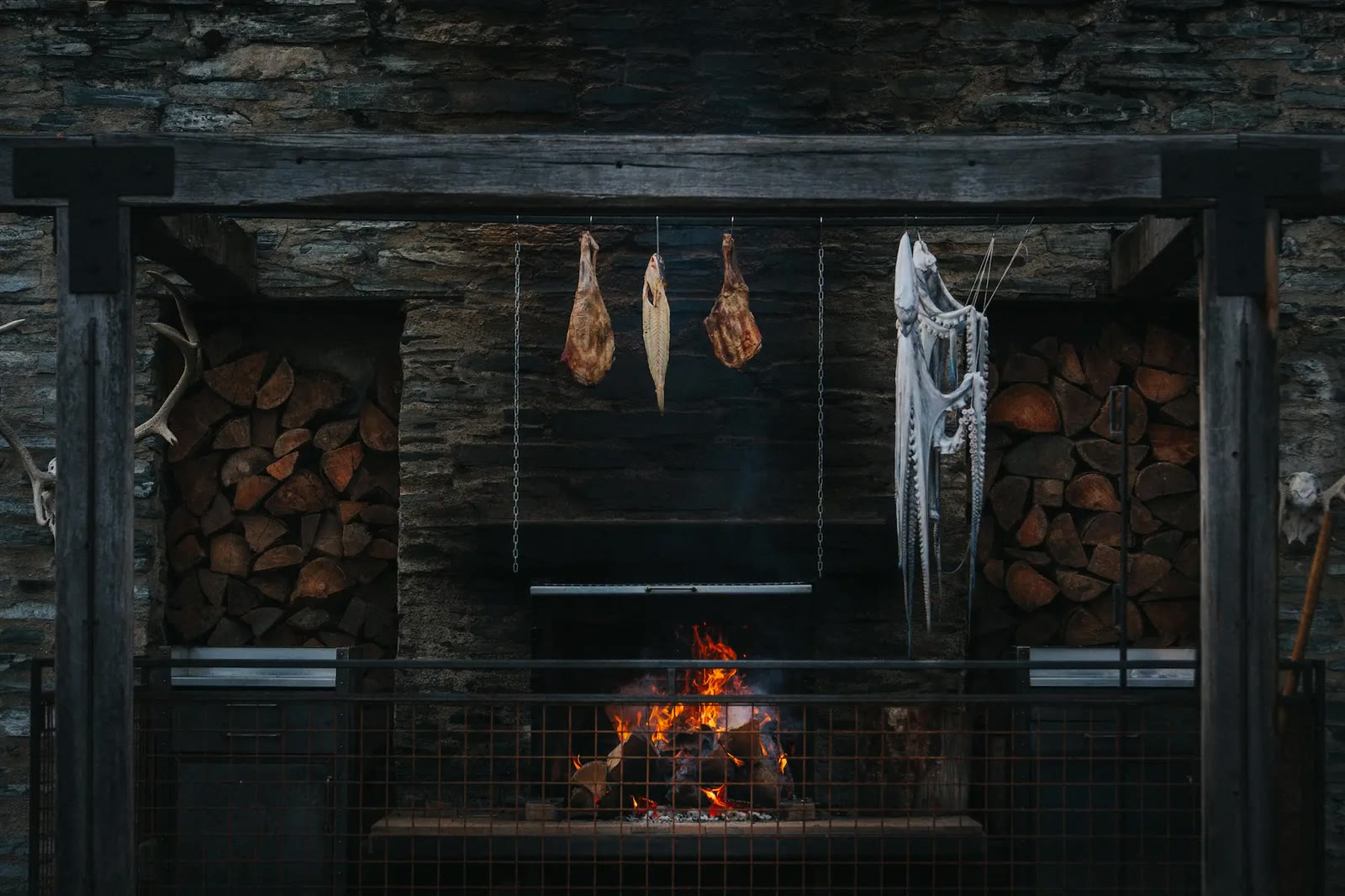
Image context: the cover uses a Sam Stewart photograph published on The Best Chef Awards' Vaughan Mabee page rather than a vineyard landscape. That choice is deliberate. This article is about Amisfield as a fire-and-cellar restaurant, not as a scenic postcard. The hanging fish, octopus, and meat above the hearth make the point faster than any exterior shot could.[5]
The room works because it is winery-backed but not winery-softened
Amisfield's institutional base matters here. The estate began in 1988, grew out of John Darby's early Central Otago vineyard bet, and now describes itself as a 93-hectare organic single-vineyard estate beneath Mount Pisa.[2] Yet the restaurant does not behave like a side amenity attached to wine tourism. On the official restaurant page, the tasting menu is framed as the core experience, and it is explicitly designed to be matched with wines from the estate.[1] The 50 Best Discovery profile sharpens the setting further: a rustic stone-and-wood building within a winery landscape, with Lake Hayes in view and mountains closing the frame.[4]
That combination could have produced a house built around reassurance. Instead it produces concentration. The Best Chef Awards page says the restaurant's design, attributed there to architect Kerry Mason, reflects the surroundings and invites guests into a highly composed version of New Zealand hospitality.[5] The official contact page, meanwhile, treats the Lake Hayes site as the place where visitors encounter the "true essence" of Amisfield.[2] Read together, those sources suggest that the room is meant to translate the region, not simply overlook it. Wine is already in the walls. Landscape is already outside the glass. The restaurant does not need to keep repeating those facts softly. It can move straight to pressure, contrast, and appetite.
That is why the pricing structure feels revealing rather than merely expensive. Lunch at NZ$395 and dinner at NZ$595 already ask the guest to accept a total-work argument, and the house's top pairings at NZ$395 for lunch and NZ$695 for dinner make clear that the cellar is structural, not decorative.[1] Amisfield is not treating wine as the pleasant companion to a restaurant. It is treating the restaurant and the cellar as one machine.
Vaughan Mabee cooks Central Otago as a hard-edged pantry
The chef biography explains the force behind that machine. Amisfield says Vaughan Mabee has led the restaurant since 2012, while both the official site and The Best Chef Awards place his earlier training at Martín Berasategui in Spain and Noma in Copenhagen.[1][5] Those reference points matter less as prestige badges than as clues to method. Mabee does not present Central Otago as a charming list of local ingredients. He treats it as a pantry with altitude, weather, game logic, and enough sharpness to withstand theatrical plating without dissolving into mood.
Amisfield's own language is unusually blunt about the supply chain. Its culinary philosophy celebrates "a select group of fishermen, hunters, gatherers, and farmers," and says each partner is chosen for quality, sustainability, and ethical practice.[1] The same page says dining there should move from alpine peaks to ocean depths, which sounds promotional until you place it beside Mabee's personal biography on the Our Story page: outside the kitchen he spends time hunting, fishing, and foraging native New Zealand foods.[2] The link between producer list and chef biography is the key. At Amisfield, wild product is not just branding handed down from marketing. It is part of the chef's own operating imagination.
That is why the public-facing dish signals matter. Before you ever study a menu PDF, the restaurant page has already shown sheep horn and titi as headline images.[1] The 50 Best Discovery profile pushes in the same direction with its mention of wild fallow deer on antler and wild mallard feet finished with black truffle claws.[4] Cuisine's award text then calls the result "a daring dance of innovation" and a theatrical style that still reads as distinctly New Zealand rather than generically avant-garde.[3] Amisfield's real trick is that it stages wildness without letting the food slide into random shock tactics. The forms are dramatic; the regional grammar stays legible.
The cellar gives the theater its spine
Many high-end rural restaurants can build one memorable game or seafood course. Fewer can make wine integration feel inevitable rather than ceremonial. Amisfield gets there because the wine program starts with its own estate identity. The broader Amisfield story is rooted in Pinot Noir and aromatic whites from the organic Mt Pisa site,[2] and the restaurant page makes pairings part of the core package rather than an optional flourish.[1] The 50 Best Discovery listing goes further, calling out the house Pinot Noir, Riesling, and Pinot Gris as especially strong while also noting international bottles in the mix.[4]
That detail matters because Mabee's food language carries weight: smoke, game, ocean product, preserved textures, and high-contrast plating all ask for a cellar that can keep pace without flattening the dishes into heaviness. The split between the more modest Amisfield & International Wine Pairing and the much more ambitious Amisfield Cellar & Sommelier Wine Pairing tells you how seriously the house takes that problem.[1] One track lets the region converse with outside bottles; the other says the estate's own depth deserves to be treated as a major part of the evening's argument.
So the cellar is not only monetized expertise. It is narrative control. A restaurant that wants Central Otago to read as more than rustic atmosphere needs liquid precision as much as it needs kitchen bravado. Amisfield understands that. The wine program keeps the meal from collapsing into a sequence of intense gestures by giving those gestures rhythm, temperature, and relief.[1][4]
Why this restaurant matters now
What finally makes Amisfield feel important in 2026 is that it refuses the easiest version of regional fine dining. It does not sand Central Otago down into a calm farm-to-table postcard. It keeps the region's harder materials in play: hunting culture, lake-and-mountain isolation, marine reach, smoke, antler, organic vineyard discipline, and a cellar strong enough to make all that ambition coherent.[1][2][4][5]
The awards record gives the restaurant visibility, and it deserves that visibility.[1][3] The deeper achievement is compositional. Amisfield has found a way to make a winery restaurant feel less like hospitality wrapped around scenery and more like a fully argued house style. The room, the fire, the producer network, the chef's background, and the pairings all keep pushing the same line. Central Otago does not arrive here as comfort first. It arrives as flavor under pressure.
Sources
- Amisfield, "Restaurant" - official page covering the tasting-menu format, lunch and dinner pricing, wine-pairing tiers, culinary philosophy, featured dish imagery, and Vaughan Mabee's chef biography.
- Amisfield, "Our Story" - official page covering the estate's 1988 founding, the 93-hectare organic single-vineyard estate, and Vaughan Mabee's background, including hunting, fishing, and foraging.
- Cuisine, "Restaurant of the Year 2025" - award citation covering Amisfield's 19.5/20 score, theatrical team style, three-hat standing, and June 2025 World's 50 Best top-100 recognition at No. 99.
- 50 Best Discovery, "Amisfield Restaurant" - profile covering the stone-and-wood setting, Lake Hayes and mountain backdrop, visually aggressive dishes, and the strength of the wine program.
- The Best Chef Awards, "Vaughan Mabee" - profile covering Mabee's tenure since 2012, prior work at Martín Berasategui and Noma, architect Kerry Mason's setting, Amisfield's sustainability- and landscape-driven approach, and the Sam Stewart restaurant photography used on the page.